
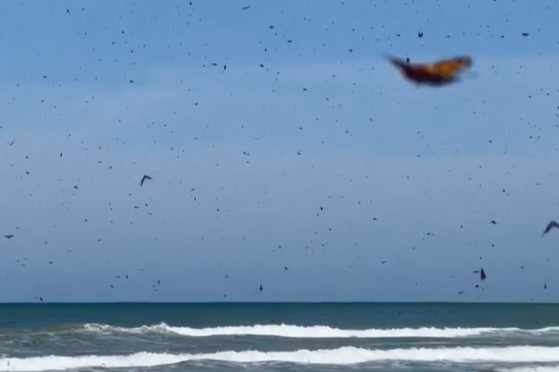
Feather-like flakes weren’t falling from the sky, but it was something equally mesmerizing. Thousands of butterflies drifted, swirled and fluttered over a Corpus Christi beach, creating a scene reminiscent of a snowstorm.
That’s how Tom Howe described a recent evening on North Padre Island, where he watched a seemingly endless stream of butterflies move along the shoreline south of Bob Hall Pier.
Howe was driving on the beach with his grandson and fiancée when the spectacle unfolded.
“For several days, there had been a significant increase in butterflies on the island,” Howe told Chron. “On this particular evening, as we drove south, there was a sudden increase in numbers; thousands, tens of thousands were coming through. As far as you could see down the beach was a mass of butterflies. Looking up, the sky was full of them.”
A video captured by Howe shows clouds of butterflies streaming across the beach and through the air.
Lauren Davidson, an entomologist and director of the Cockrell Butterfly Center in Houston, confirmed that the insects in the video were American snout butterflies.
“They have elongated mouthparts that form a snout shape, hence the name,” Davidson said. “That characteristic makes it hard to confuse them with any other native species.”
“Typically, we see large migrations of snout butterflies as well as other species as they head towards south Texas and Mexico in the fall,” Johnson said. “However, with the snout butterfly this time of year, this is not really a migration you would think of, like with monarch butterflies.“
Instead, recent weather conditions likely fueled a population boom.
After a prolonged drought followed by heavy rains, American snout butterfly numbers increased dramatically, Johnson said, noting that the phenomenon is common for the species.
“With such a large population, they are spreading in search of plants (hackberry) to lay their eggs and food to eat as adults,” she said. “They are just looking for more habitat.”
The largest wave of butterflies lasted about 40 minutes before gradually thinning out.
“The next day, there were still a few stragglers,” Howe said. “While they come through each year, this year was a particularly large number together.”