
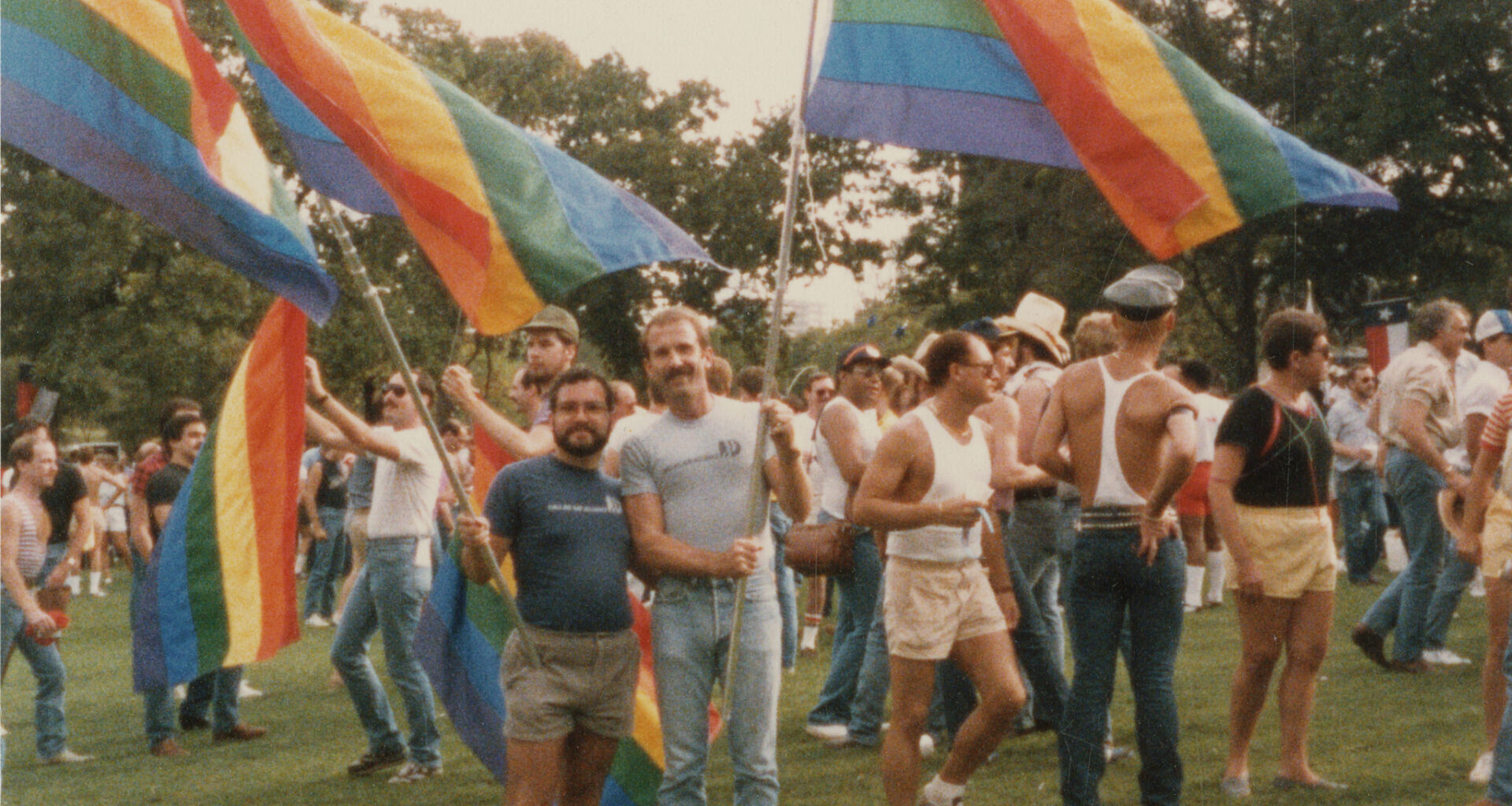
Dave Lewis (left) and Bill Nelson (right) at a Dallas gay pride parade in 1984.
courtesy Portal to Texas History
Dallas is something of a Southern mecca for gay men. But how did a city once known as a conservative stronghold, famous for its football team, become a beacon for gay life? The Dallas Way, a new book by University of Texas at Tyler professor M. Rhys Dotson, goes a long way toward answering that question.

The book’s title refers to the “nuanced and subtle” activism that emerged in a part of the country where leather daddies waving around sex toys (to reference one coastal provocation) was not going to cut it.
“Community leader Bill Nelson famously noted that when members of Dallas’ gay community went to City Hall, they always ‘put on a shirt and tie,’” the book tells us on its opening page. You can call this respectability politics, or you can call it savvy business sense. The men — and women, but (for complicated reasons) mostly men — who mainstreamed the gay rights movement in Dallas forged alliances with religious groups and local leaders, persuading skeptics by emphasizing their similarities with hetero society.
Article continues below this ad
I grew up in Dallas during the ’80s, and because my family attended one of the first churches to accept openly gay members (a tiny, artsy and now-shuttered place called Bethany Presbyterian), I came of age around deeply creative gay men who’d chosen Dallas as a second home. Over the next decades, I could see that Dallas — with its big-city mix of fashion, fine dining, top-tier shopping and the arts — welcomed gay men, but I never understood how that happened.
The Dallas Way connects the dots, offering a lost history about a city far from New York and San Francisco that played a quieter but nonetheless crucial role in one of the most important social movements of our time.
Dotson is an associate history professor and writes like one; his sentences are a bit dry for my tastes. But the local saga he captures is so gripping that I forgive him for writing a bit like, well, someone in a shirt and tie.
What follows are five of the most compelling parts of the book.
Article continues below this ad
A man named Phil Johnson basically launched the gay rights movement in Dallas
Phil Johnson, right, heading to the Gay Games in New York in 1994.
David Woo
Phil Johnson grew up middle-class in Dallas in the ’30s and ’40s, and he knew from a young age that he liked boys. Given the time period, he did nothing about this. But in 1945, he joined the Army, hoping it would “make a man” out of him. Instead, it cracked open his world.
Netflix should make a movie about Johnson’s time in the Army, where a proficiency in typing and shorthand landed him at an administrative unit in California. Apparently this is where the effeminate-presenting men wound up, because he was greeted by a sergeant who said, “Mercy, girl, where did you come from? Where have you been all my life?” And thus, Johnson got his first taste of living among openly gay men.
Back home in the Dallas of the late ’40s, Johnson did his best to pass, which apparently included studying dance at Southern Methodist University. He learned about Club Reno, an underground gay joint at South Ervay and Wood streets, but it was dark and dingy. Johnson, not much of a drinker, wasn’t into it.
Article continues below this ad
Gay culture grew alongside club culture partly out of necessity. Gay men needed a place to hide their wants and needs, and what better spot than dens of sex, drugs and booze? But Johnson hoped to create a community that could thrive in daylight.
He’d been reading newsletters about gay life in Los Angeles and San Francisco. In the mid-’60s, he founded Circle of Friends, what Dotson calls “Texas’ first homophile organization.” That’s a pretty stuffy phrase to describe the group’s profound role in social history. Circle of Friends planted a flag for gay culture in Texas, years before the 1969 Stonewall riots in New York basically launched the modern gay rights movement.
Churches played a huge role in Dallas’ acceptance of gay culture
Circle of Friends was co-founded with Doug McLean of First Methodist Church of Dallas, a minister inspired by a trip he’d taken to San Francisco, where he learned about the groundbreaking group, Society for Individual Rights. During a time when gay men were under threat from police harassment, the church affiliation offered Circle of Friends a literal sanctuary, both legal protection and safe meeting spaces. Reverend John Brand of the Munger Place Church also offered confidential counseling to group members. In 1970, the First Unitarian Church of Dallas began renting out a chapel for Circle of Friends meetings.
It’s hard for the 21st-century mind to comprehend the threat of being gay in 20th-century Texas, when laws against “lewd or lascivious” behavior could carry a prison sentence of two to 15 years. Some jobs required applicants to take polygraph tests, and they’d ask if you were gay, at which point the candidate could not only lose an opportunity for employment, but also be outed as a criminal. Many Dallas churches reinforced this mindset. In 1978, a minister at the hugely influential Highland Park Presbyterian Church gave a sermon making HPPC’s stance on homosexuality clear: It was a sin.
Article continues below this ad
But other Dallas ministers came to different conclusions, and thanks to their involvement, Dallas became a place where sexual freedom could grow alongside a spiritual life. Inspired by the example of Metropolitan Community Church in California, members of Circle of Friends started a Dallas branch of MCC in 1970. By the ’90s, that group became the Cathedral of Hope, which now boasts one of the largest — if not the largest — LGBTQ congregations in the world.
Dallas’ first gay pride parade coincided with an evangelical conference
Dallas’ first gay pride parade, 1972
Texas/Dallas History and Archives Division/The Dallas Morning News Collection, Dallas Public Library
In 1972, Circle of Friends member Ruth Shivers pitched Phil Johnson the idea of Dallas’ first gay pride parade. The duo secured a permit from the Dallas Police Department, but the timing wasn’t ideal. The city was also hosting Explo ’72, an evangelical conference for youth that Billy Graham dubbed a “religious Woodstock.” This would be interesting.
After news of the parade spread, backroom debates erupted over whether the city should cancel it. The parade went ahead anyway, under media scrutiny, launching from Kennedy Memorial Plaza on June 24, 1972. Do you want to guess who showed up first on that nervous-making, momentous day? Drag queens, of course, in their wigs and gold lame gowns.
Article continues below this ad
The event turned out peaceful, with Johnson leading about 17 cars and floats down Main Street as 130 people joined the procession. This was not the over-the-top pageantry of today’s gay pride parades. In their jeans and T-shirts, participants looked like scruffy college kids protesting the Vietnam War, except signs read “Sisterhood is powerful” and “Someone you love is gay.”
Related: Hepola: Dallas’ Met gala is DIFFA, a voyeuristic fantasia of style and imagination
AIDS was terrifying — but it galvanized the gay community
In 1983, Dallas had less than 10 confirmed cases of what was then called a “gay disease.” By 1985, Dallas and Houston were among the top 10 cities with confirmed AIDS cases. As awareness spread, so did fear and hopelessness. At Parkland Hospital, a patient named Rodney Self jumped to his death from a sixth-floor window. His suicide note said it was the only way out of his suffering.
Dallas activist Bill Nelson (right) sits with partner Terry Tebedo in a hospital room shortly before Tebedo’s death in 1988.
RICHARD MICHAEL PRUITT – staff p/DMN archives
For all its tragedy, the AIDS crisis gave rise to a new generation of Dallas leaders, including Bill Nelson, president of the Dallas Gay Alliance. He also created the AIDS Resource Center with his partner, Terry Tebedo, in 1985. That organization continues to serve the community, although it’s now known as the Resource Center.
Article continues below this ad
That women didn’t play a big part in the city’s early gay rights movement reflects both the times and the tensions between the sexes. Many lesbians were more involved in the feminist movement; meanwhile, AIDS rattled the gay male population, thrusting the plight of gay men into the spotlight. That’s not to say women weren’t involved in the struggle for equal rights, and Dotson introduces us to lesbian leaders like Louise Young and Vivienne Armstrong, but for the most part, this book tells the story of men (and those men are mostly white).
Related: Cece Cox, one of Dallas’ most influential LGBTQ leaders, announces her retirement
Dallas political activism was subtle but powerful
The Dallas Gay Political Caucus, which became the Dallas Gay Alliance, helped transform the legal and political landscape of Texas. But other forms of activism moved the needle, too. Inspired by ACT UP in New York City, a small group of activists formed the Gay Urban Truth Squad, aka GUTS, to counter false information about AIDS. Their nonviolent protests were powerful, including 610 chalk outlines outside City Hall to represent the 610 lives in Dallas County lost to AIDS by 1987. The following year, the number had risen to 794, and GUTS turned a vacant lot into a mock graveyard with 794 white crosses, a ritual they continued into the ’90s. It’s a sad story, but one of the most beautiful and enduring aspects of the gay community is its creative spirit.
The Gay Urban Truth Squad (GUTS) place wooden crosses in Lee Park in May 1990 to remember the 1,421 AIDS-related deaths in Dallas County.
EVANS CAGLAGE/Dallas Morning News
The Dallas Way ends with Lawrence v. Texas in 2003, a case that decriminalized same-sex relationships and lay the groundwork for Obergefell v. Hodges in 2015, making same-sex marriage legal nationwide. It’s a fitting end to a book that focuses on local gay culture’s push into the mainstream, but it’s only the start of another saga.
Here’s hoping Dotson has a second book in the works.