
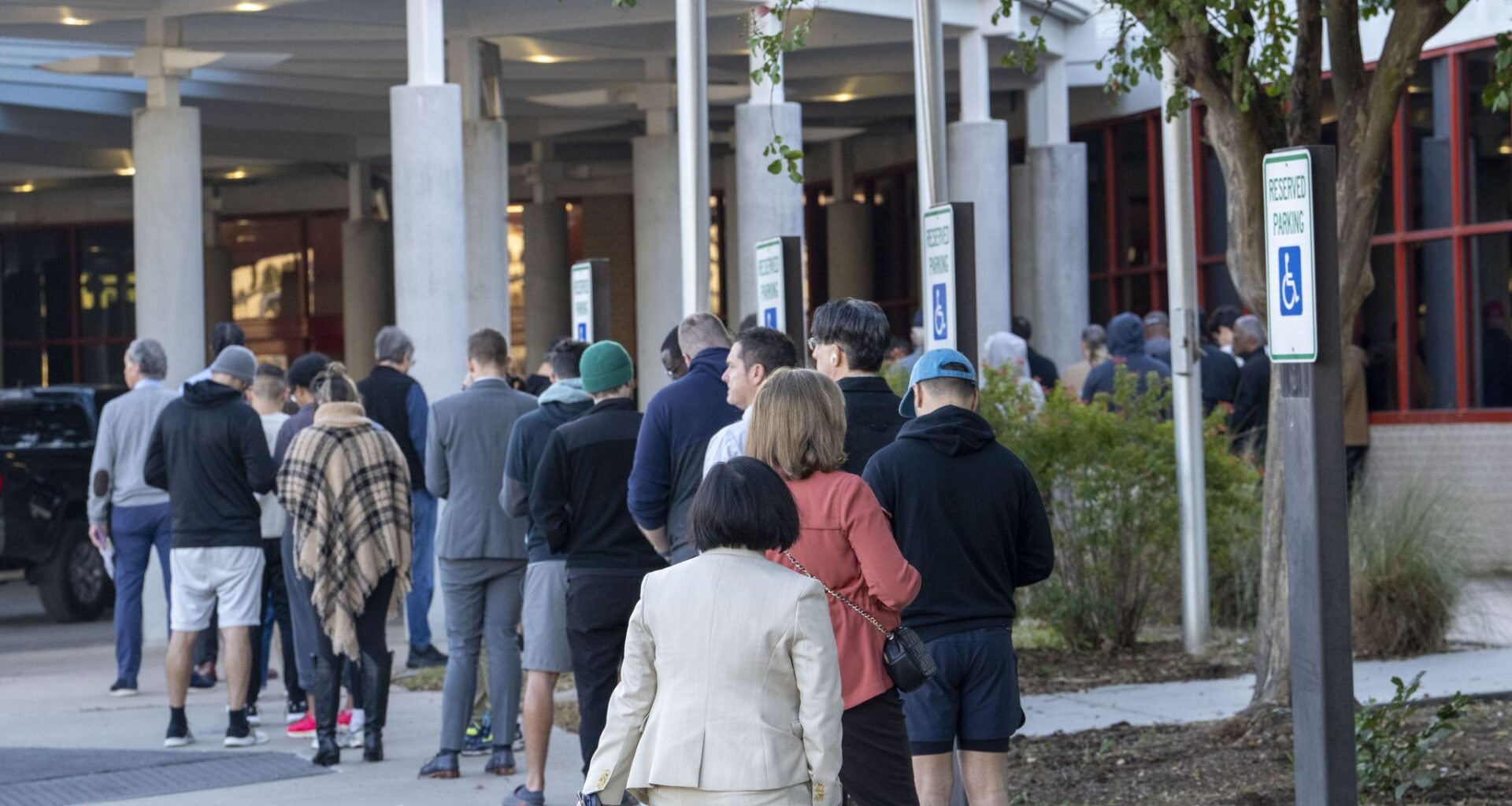
A line forms as people arrive to vote at the Metropolitan MultiService Center on West Gray Street in Houston, Tuesday, Nov., 4, 2025.
Kirk Sides/Houston Chronicle
Travis County officials say 13% of registered voters cast a ballot during the two-week early voting period that ended Friday, compared to around 10% in Williamson County. Texas voters have a lot to decide on, including 17 proposed amendments to the state constitution and a controversial proposed tax rate hike in Austin.

While Hays and Bastrop counties don’t track wait times at polling locations, Travis and Williamson counties do. All counties provide lists and maps of Election Day voting locations, which are open from 7 a.m. to 7 p.m. Tuesday.
Article continues below this ad
Voter Guide 2025: What’s on the ballot in Austin?
See maps of wait times, polling locations, and more info to know on Election Day as you head to the polls:
Travis County voting wait times and locations
Williamson County voting wait times and locations
What do I need to bring to vote in Texas?
According to VoteTexas.Gov, these are acceptable forms of ID to meet voting requirements:
Article continues below this ad
Texas driver’s license
Texas election ID certificate
Texas personal ID card
Texas handgun license
U.S. citizenship certificate with photo
U.S. military ID card
U.S. passport
Those who are unable to present one of the forms of ID listed above may fill out a Reasonable Impediment Declaration at the polls and present an alternative form of ID. That could be a utility bill, bank statement, government check or voter registration certificate.
Are cell phones allowed when you vote at the polls?
According to Texas law, cell phones are prohibited at the voting booth. An election judge can order people to deactivate or turn off the devices on-site. Those who don’t comply will be asked to leave.
Article continues below this ad
Poll watchers are also prohibited from having cell phones.
“Persons are not allowed to use wireless communications devices within 100 feet of voting stations,” according to the Texas secretary of state’s website. “Additionally, persons are not allowed to use mechanical or electronic devices to record sound or images within 100 feet of the voting stations.”
Such devices include cell phones, cameras, tablet computers, laptop computers, and sound recorders.
A voting station is the area where the voter marks the ballot.
Article continues below this ad

What are we voting for in Texas?
Texans face big fiscal choices at the state and local levels this year — from billions in property tax cuts to Austin’s proposed tax rate hike.
Texas voters will decide on 17 proposed amendments to the state constitution, including a package of billions of dollars in property tax cuts approved by state lawmakers earlier this year. Most proposals would deliver targeted tax breaks for homeowners, small businesses, veterans’ spouses and others, or ban new state taxes on capital gains and inheritances. Others would create new funds for water projects, technical colleges and dementia research, and address bail limits, parental rights and judicial oversight.
Article continues below this ad
At the local level, Austin voters will also decide whether to raise the city’s property tax rate to support a $6.3 billion budget the city council approved in August. If voters approve the higher rate, the owner of a $500,000 home would pay about $300 more a year in city taxes. If it fails, the same homeowner would pay about $100 more, as the city would revert to the lower state limit.
For a full rundown of what you’ll see on your ballot this election, check out our 2025 Voter Guide. The American-Statesman Editorial Board, a team of opinion journalists who operate separately from the reporters on the news side, offers recommendations for most of this year’s ballot measures.