
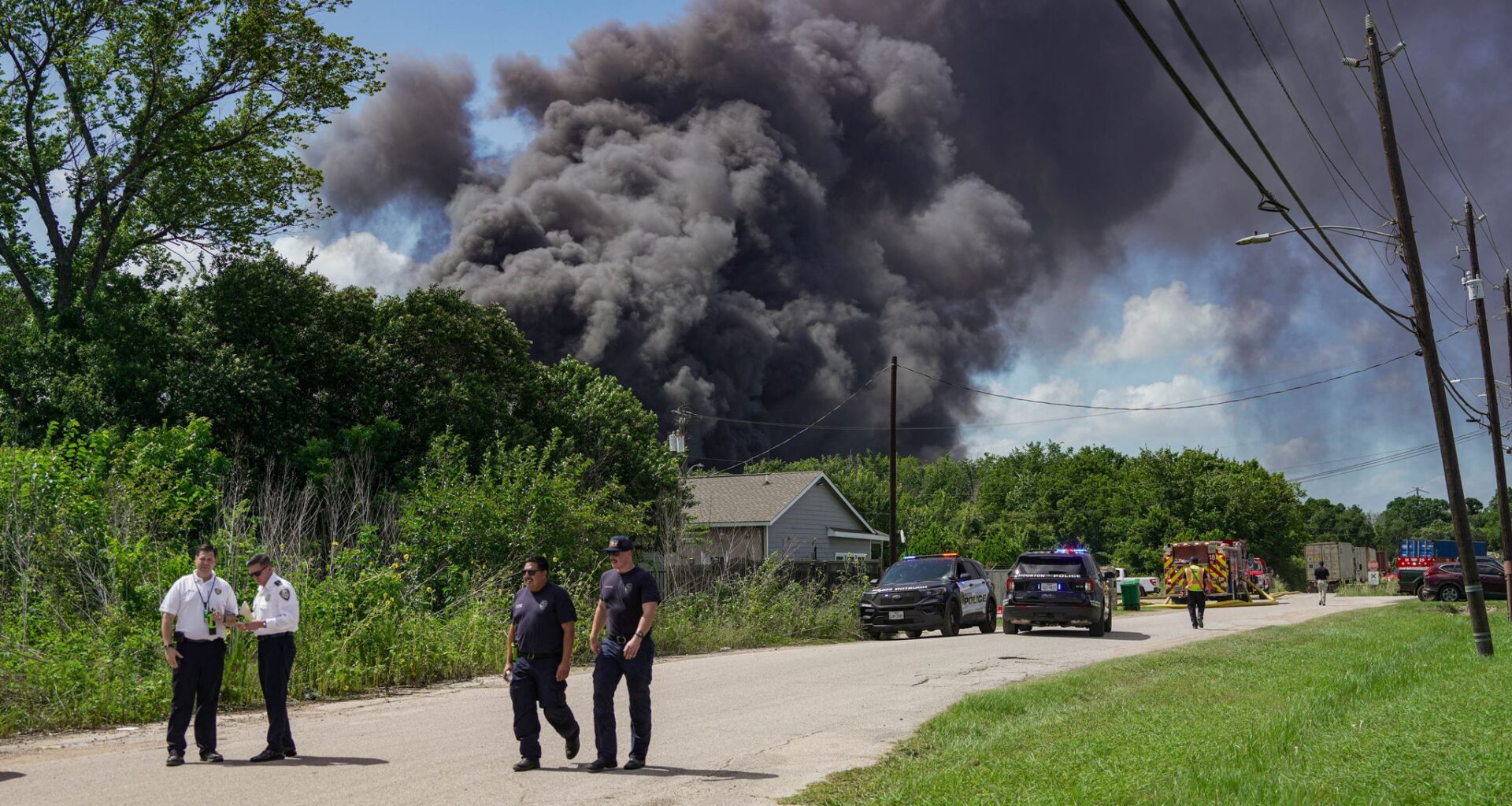
Air quality monitors in two different Houston-area neighborhoods downwind of the massive fire at Mammoth Metal Recycling detected spikes in particle pollution on Monday afternoon soon after the fire began.
Dozens of firefighters fought the stubborn blaze near Kellogg Street and Lawndale Street in Houston’s East End on Monday as a dark plume of smoke spewed from piles of burning tires.
Local nonprofit Air Alliance Houston later pulled data from community-installed air monitors nearby and found that the levels of harmful particle pollution peaked that afternoon at downwind monitors in Denver Harbor and Kashmere Gardens over four miles from the fire.
“Disasters like this really emphasize why community air monitoring is important, to show communities what’s in the air,” said Anthony D’Souza, Air Alliance’s program manager.
The smoke from a fire can contain numerous health-harming air toxins and particulate matter — a cloud of microscopic solid and liquid particles. Short-term, the pollutant can exacerbate asthma and other underlying conditions, while longer term exposure can cause lung cancer and heart problems.
Particulate matter in the air is measured in micrograms, which are a millionth of a gram. The most severe spike in pollution detected near the fire was at an air monitor in Denver Harbor. That monitor found levels of particulate matter reached nearly 98 micrograms per cubic meter of air during the fire, and continued showing elevated readings for hours.
No federal health standards exist for a short-term spike in particulate matter. The EPA sets a maximum 24-hour average for particulate matter at 35 micrograms per cubic meter.
The Houston Health Department monitored the city’s air quality starting Monday in residential areas surrounding the fire, and city officials said they did not identify any levels of poor air quality that were cause for concern. But Fire Chief Thomas Muñoz cautioned residents who have respiratory conditions to limit their exposure outdoors.
“Individuals who are sensitive to smoke, including those with respiratory conditions, should take appropriate precautions and limit prolonged outdoor exposure if necessary,” Muñoz said.