
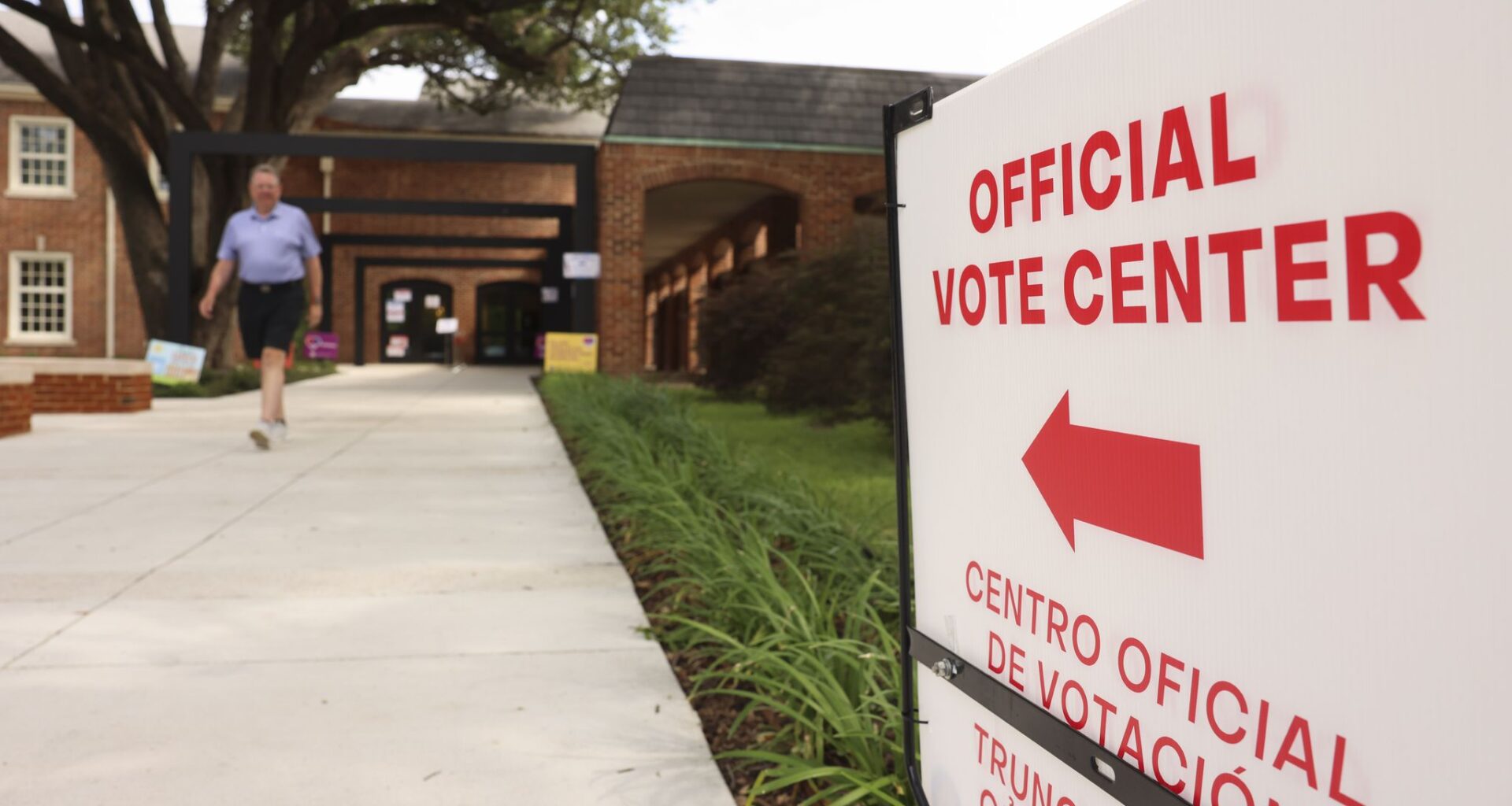
Voters walk out of a voting center during primary election runoff day at University Park United Methodist Church on Tuesday, May 26, 2026. Republican Suzanne Bellsnyder writes that her party’s effort to close primaries is a bad idea.
Shafkat Anowar/The Dallas Morning News
In Texas, many elections are effectively decided long before November. That’s why the growing push to close the state’s primaries matters far beyond Republican politics. It is a fight over who gets to participate in the elections that actually determine who governs Texas.
For years, closing Texas primaries was a long shot. A small but influential faction inside the Republican Party kept pushing for it, while most Texans paid little attention. This month, that changed. Three developments happened in quick succession.
Delegates to the Republican Party of Texas convention adopted closing the state’s primaries as part of their top election priorities. Gov. Greg Abbott embraced the idea from the convention stage, declaring that “only Republicans will vote in Republican primaries.” And Secretary of State Jane Nelson — who said she was bound by her oath to enforce the election laws on the books and would implement closed primaries only if the Legislature enacted them — announced she will step down July 17.
Article continues below this ad
Taken together, those events transformed a fringe proposal into a serious possibility.
The first question Texans should ask is simple: Who wants this? The answer is not most voters.
Polling conducted late last year by Ragnar Research on behalf of Unite America found that majorities of Texans — including Republican primary voters — support keeping Texas’ current open primary system, which allows voters to choose which party’s primary to participate in each election cycle without formally affiliating with a party. Texans opposed closing the primaries by a wide margin — 54% to 19%. Even among Republican primary voters, opposition outpaced support.
Those advocating for closed primaries claim they are protecting the will of Republican voters. As a lifelong Republican, I can tell you they have it backward. The open primary helped build the modern Republican majority in this state — I know, because I was in the trenches of that revolution three decades ago. I chaired the College Republicans and spent years working to elect Republicans up and down the ballot. Our party can and should earn voters’ support on its policies and principles. It should not slam the door on them.
Article continues below this ad
The debate is often framed as a matter of party rights. But the practical effect is something different: reducing the number of people who can participate in the elections that matter most.
Consider how few Texans already decide statewide nominations. The Republican runoff for U.S. Senate this year drew roughly 1.39 million ballots — less than 8% of the state’s registered voters. In that election, just like most elections in Texas, the winner of the Republican primary is heavily favored to win the general election.
Closing primaries will not broaden participation; it will narrow it further. That should concern Texans regardless of party. Democracy becomes more representative when more people participate. It becomes less representative when fewer people do.
The voters most affected would not be political insiders. They would be ordinary Texans who choose not to formally identify with either major party. Nearly 3 million Texans fall into that category. Under the current system, they can participate in the primary election they believe is most consequential. Under a closed system, they would be required to affiliate with a party in advance or lose their voice in many of the races that effectively determine who will hold office.
The impact would be particularly significant in rural Texas, where primary elections often function as the only meaningful contest. But the effects would not stop there. In many suburban and urban districts, primaries already exert outsized influence over who ultimately serves in office.
Article continues below this ad
Then there is the practical challenge. Texas does not register voters by party affiliation. It has no party-registration system to administer closed primaries. Creating one would require building an entirely new process and asking millions of Texans to navigate it.
Every additional barrier tends to fall hardest on voters who already face the greatest challenges to participation.
The governor is correct about one thing: If Texas is going to make a change this significant, it should happen through the Legislature, not through a lawsuit.
But even that assurance deserves scrutiny. Abbott has already demonstrated his willingness to use primary elections to shape legislative outcomes. After 21 House Republicans blocked his school voucher proposal, he spent more than $8 million of his own campaign funds backing primary challengers against members of his own party, with allied groups spending millions more. A record 15 Republican incumbents were swept out of office, and Abbott then declared he had the votes to pass vouchers. The message was unmistakable: Oppose the governor’s priorities and you may face political consequences in the next primary. That reality inevitably shapes any future legislative debate over closed primaries.
Ultimately, this argument is bigger than one lawsuit, one governor or one political party. Texas already suffers from low primary participation and highly predictable general election outcomes in many districts. Together, those conditions mean primary elections often determine who governs long before most voters cast a ballot in November. Closing primaries would concentrate even more power in a smaller electorate.
Article continues below this ad
That leaves Texans with a simple question: Should the people who choose our leaders come from the broadest possible cross-section of our communities, or from an increasingly narrow group of voters who meet a particular political test?
For years, that question seemed theoretical. It no longer is.
Suzanne Bellsnyder is editor of the Texas Rural Reporter.
Have thoughts about this? Send a letter to the editor using our letters form or email letters@dallasnews.com. Letters should be no more than 200 words and include the first and last name of the writer and city of residence.