
AP Photo/LM Otero, File
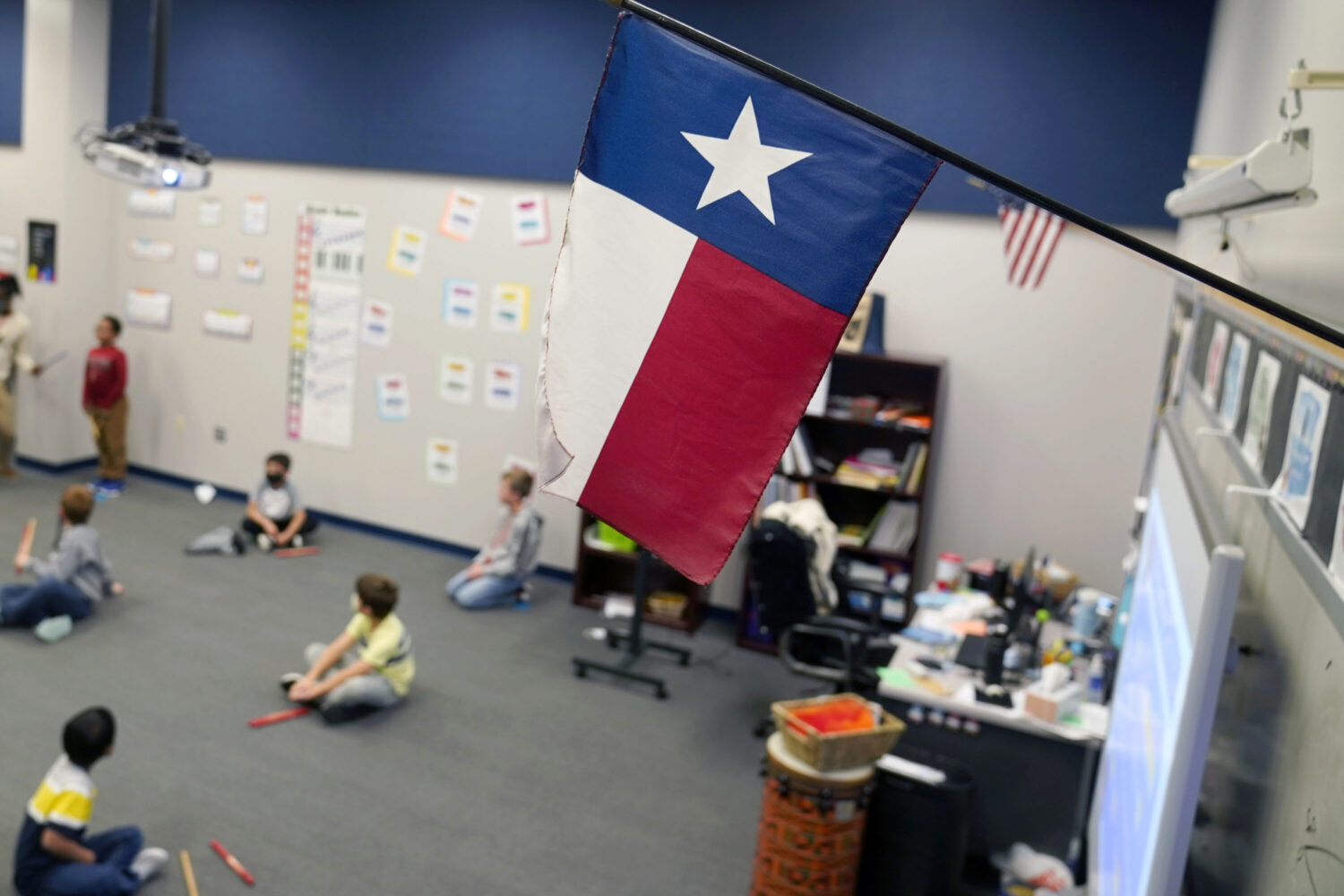
FILE – A Texas flag is displayed in an elementary school in Murphy, Texas, Thursday, Dec. 3, 2020.
The State Board of Education voted Friday to approve a controversial change for Texas public schools, incorporating Christian stories from the Bible into classrooms.
The state board also is expected to vote on a rewrite of the social studies curriculum for kindergarten through eighth grade. That change to social studies classes would deemphasize world history and refocus lessons on Texas and U.S. history.
Friday’s vote means at least one Christian text will be added to required reading materials in several grade levels. The Christian stories to be added include “Parable of the Prodigal Son” and “The Eight Beatitudes” from the Bible as well as many others.
Sign up for the Hello, Houston! daily newsletter to get local reports like this delivered directly to your inbox.
The move could be unique to Texas. Antero Garcia, president of the National Council of Teachers of English and a Stanford University professor, told the Associated Press he doesn’t know of any other state with a mandatory reading list that includes religious texts.
The changes will impact more than 5 million students across Texas and are scheduled to begin for the 2030-31 school year.
Carrie Griffiths, the executive director of Our Schools Our Democracy, a public education advocacy group, said the state board is failing students in Texas public schools.
“I think Texans need to be afraid because we’re literally watching our democracy dissolve in front of us,” Griffiths said. “It’s special interest driving the decisions, not professionals, not educators, not the community, not taxpayers, not Texans.”
Not all members of the Republican-led state board were in agreement about the Bible passages or the proposed changes to social studies curriculum. Board member Marisa B. Perez, a Democrat from San Antonio, took to social media to outline her concerns late Wednesday night.
“The last several months have challenged me more than any other time on the board that I can remember,” Perez wrote. “As I sit in the board room tonight, reflecting on my 13 years of service on the Texas State Board of Education, I cannot help but acknowledge that my ‘quiet’ is a contemplation of where we find ourselves today: a decimation of accurate, honest, and holistic social studies education for Texas public school students.”
Texas residents weigh in
Mohammed and Ruth Nasrullah from the Clear Lake area near Houston started their drive to Austin at 6:30 a.m. Monday to speak to the board during public comment.
Nearly 500 others joined them.
After arriving they waited more than 8 hours for their turn to speak. They were allotted 2 minutes to protest the proposed changes to the board members and raised their concerns about the addition of Christian texts and the potential “manipulation” of world history.
“They’re trying to change the way things are framed, as well as taking important key facts out and keep people out of the equation,” Ruth said. “I understand how important it is to have all the context and to know all the players in history, and it’s sort of like they’re manipulating it.”
Mohammed wrote his remarks the night before and made sure to bring 20 copies of his speech to hand out to board members. Ruth changed her draft several times on Monday after listening to hours of testimony, some of it difficult for them to hear.
“[One speaker] basically told a whole lot of lies about Islam and Muslims, and talked about how dangerous we are – including me and my husband and all the other Muslims who were there – to American democracy and to Texas,” Ruth said.
She added that when the speaker concluded, people sitting next to her in the overflow room applauded.
“It was hurtful,” Mohammed said. “When a lot of folks started applauding and clapping, I felt a feeling of fear. There were so many people who are actually supporting these proposed changes. It was really a very, very unsettling feeling.”
Conservative activist Bonnie Wallace is one of the speakers who supports the changes and encouraged the board to approve them.
“”Children are living lonely, desperate lives. They have not been introduced to Jesus. We have forgotten to focus on what is pure, what is noble, what is holy,” Wallace said to the board. “I encourage you to vote for the reading list presented. This reading list will not fix every problem, but it is a good start and I applaud you for putting the teachers first.”
James Hallamek with the Texas State Teachers Association disagreed the changes were made with teachers in mind.
“The reading list also overly centers religious theme works exclusively focused on Christian and Hebrew Bibles,” Hallamek said. “Conversations about faith, they belong between parents, their children and their faith communities. These conversations should not be dictated by politicians or state education officials. When schools require religious texts and interpretations, it puts teachers in impossible positions of navigating conflicting beliefs among families.”
Jillian Perkinz, a ninth-grader who attends Port Neches-Groves High School outside of Beaumont, also testified that she felt the reading list overwhelmingly represents a politically conservative worldview.
“I believe that religion and Bible reading should occur in religious schools and churches, not public schools,” Perkinz said. “Public schools are for everyone, including kids of no faiths or different faiths.”
Ruth and Mohammed Nasrullah no longer have kids in the public school system, but say they still felt compelled to be a part of the public education debate.
“We’re members of a community, you know, none of us lives in a bubble,” Ruth said.
Added Mohammed: “My concern is that the students, not just the Muslim students, but all the students who will study these social studies textbooks, will be deprived of so much historical information that they will grow up with very limited knowledge and these are the ones that 20 years from now will be our future leaders and they will be developing policies with such limited [knowledge] or ignorance about Islam and Muslims and other minorities.”
Bible lessons were already coming to Houston ISD
The adoption of Bible-infused statewide education materials comes two years after the board of education approved Bluebonnet Learning materials that include stories from the Bible in reading and language arts lessons for elementary school students. The curriculum was developed by the Texas Education Agency (TEA) and is optional for schools and districts in the state, although there are financial incentives for using the materials, which have come under criticism.
The Bluebonnet curriculum teaches elementary school students about the Golden Rule using text from the Bible, introduces fifth-graders to Leonardo Da Vinci’s “The Last Supper” painting based on the Christian story about the last meal of Jesus Christ, and features a story on the Parable of the Prodigal Son from the Bible.
It also came under fire earlier this year after the TEA issued more than 4,000 corrections and changes in February – including hundreds of copyright violations, formatting errors and typos. According to The Texas Tribune, the corrections will cost taxpayers up to $8.4 million.
On Thursday night, Houston ISD became the largest and latest district to adopt the Bluebonnet Learning materials. Deputy Superintendent Kristen Hole added that 30% of districts across the state had already adopted the materials and 12% of kindergarteners through fifth-graders were actively using them.
In a statement sent to Houston Public Media, the Houston ISD press office wrote, “The Bluebonnet materials align with Houston ISD’s existing literacy framework, including explicit and systematic phonics, knowledge-rich grade-level texts, and instruction designed to build strong readers. HISD will continue using its own lesson design and instructional approach, incorporating the Bluebonnet materials to meet new state requirements while minimizing changes for teachers.
“References to the Bible within the instructional materials are presented as literature and historical text for academic study, consistent with Texas state standards. They are not used for religious instruction or religious practice,” the district added.
The state-appointed board members for HISD, along with Superintendent Mike Miles, defended the curriculum and denied it was overtly religious.
“What we’ve done is left the politics of it in Austin,” Miles said. “I don’t get to choose what the State Board of Education, nor do I want to choose what the State Board of Education approves or doesn’t approve.”
Houston ISD officials reported they would be able to access roughly $3.3 million in additional funding by implementing the curriculum.
Dozens of parents and faith leaders in the community came to Thursday’s meeting to speak to the HISD board members and urge them not to approve the adoption of Bluebonnet.
Rabbi Joshua Fixler, who attended the meeting to protest, called the quick vote to approve the materials a “betrayal.”
“I am deeply concerned that the Bluebonnet curriculum is a violation of our public school students’ religious liberty,” Fixler said. “I am also deeply concerned that this board slipped this item onto the agenda late, so that people couldn’t testify.”
News the district was planning to adopt Bluebonnet was made public three days before a special school board meeting. It was the last meeting before the board’s summer break and three weeks after the end of the 2025-26 school year.