
The entrance of Six Flags Over Texas in June 2026.
Caroline Collins
As more attractions come to North Texas — Frisco’s Universal Kids Resort opens in July, McKinney recently approved a surf park and a Peppa Pig theme park opened last year in North Richland Hills — is Six Flags still a summer staple?
This summer marks the 65th anniversary of the opening of Six Flags Over Texas. The park was the first of the Six Flags chain, welcoming visitors through its gates for the first time on Aug. 5, 1961. There was much fanfare surrounding the park’s opening. In attendance were the Marine Corps band, news stations and the mayors of Dallas, Fort Worth, Arlington, Grand Prairie and Irving.
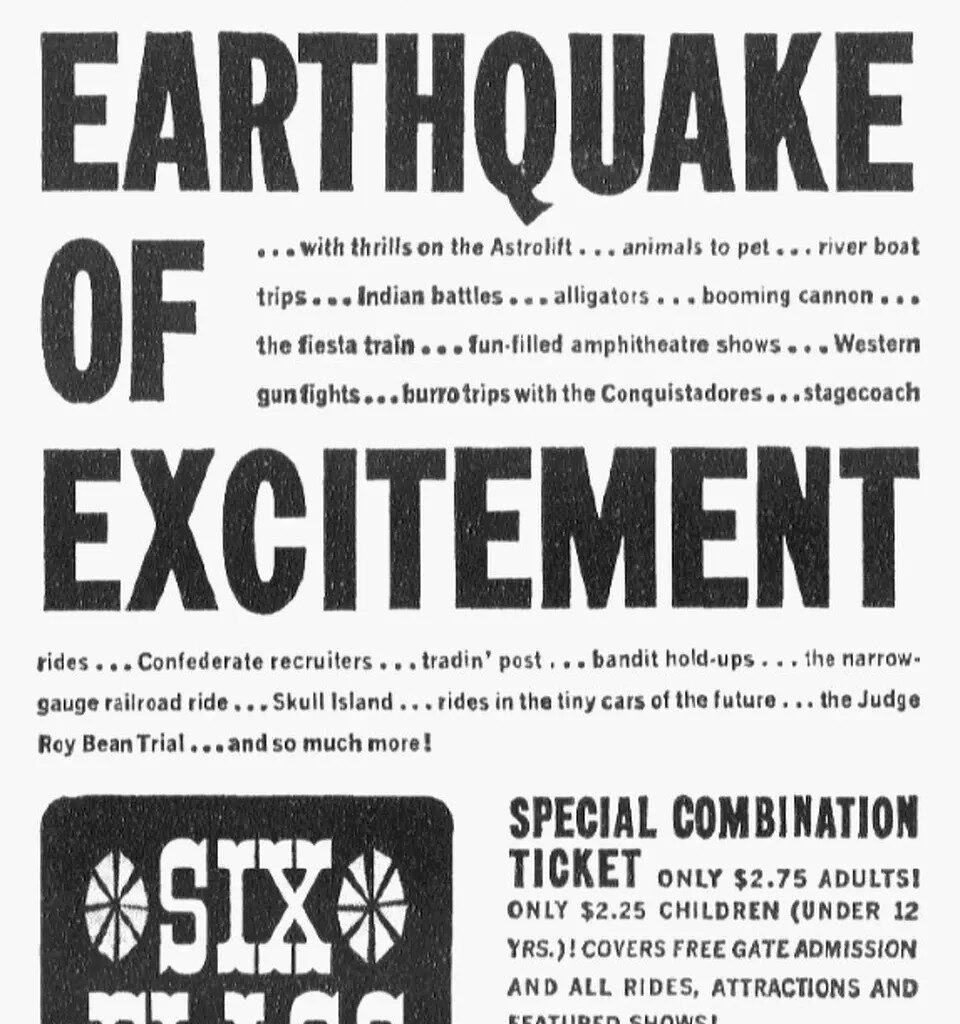
In its inaugural season, the park saw 564,000 visitors. Admission was $2.75 for adults and $2.25 for children. A hamburger set you back 50 cents and a soda was 10 cents.
An ad that ran in October 1961 advertising Arlington as the home of Six Flags Over Texas.
The Dallas Morning News
Real estate developer Angus Wynne invested $10 million for the park’s construction. He wanted a family park that would entertain visitors and educate them about the state’s heritage. “Six Flags,” of course, refers to the six nations of which Texas has been a part.
Article continues below this ad
Most people don’t go to Six Flags to learn about Texas history, but it’s still kind of charming strolling through the park’s different sections with their themed architecture, period-style facades and nods to the cultures that shaped the state, even if some of it is a little hokey.
When it opened, the park was staffed by about 400 workers who gave live performances and manned the rides. The operators were known for their “spiels,” which told the story of the attractions and immersed guests in the park experience. Some workers took liberties to improvise and add their own creative flair to the scripts.
An ad from September 1961 that ran in The Dallas Morning News.
The Dallas Morning News
By the end of the decade, annual attendance at the park was close to 2 million visitors. And by 1980, the Six Flag franchise was expanding, opening a second park in Texas as well as others in Georgia, Missouri, California and New Jersey.
I grew up going to Six Flags Great Adventure in Jackson, N.J., first for a middle school band trip, then with high school friends when I got older.
Article continues below this ad
During the last week of school, my classmates and I donned our highlighter-green Edison Intermediate T-shirts and piled onto buses for a field trip. The magic of Six Flags was that we had unlimited freedom for the day.
I’m sure there were chaperones pestering us to slather our arms with sunscreen and teachers telling us to slow down on the funnel cake, but I don’t remember them being there. I do remember racing the boys in the percussion section to be the first in line to ride El Toro, the wooden coaster. And I remember my clammy palms as we inched forward in line for Kingda Ka, convincing myself I could conquer the world’s tallest and fastest coaster, squeezing my eyes shut for the entirety of the 28 second ride and its stomach-lurching 418 foot drop.
In high school, my friends and I piled into the car for a day trip to the park and rode the roller coasters until we were dizzy, racing to get back in line as soon as we stumbled off, giddy with adrenaline. I have fond memories of those last days of childhood spent running around the park and laughing with my friends, before our school experiences were clouded by the pandemic and we withdrew into our cell phones.
I forgot how much fun a trip to Six Flags could be. The park might not have live dolphin performances or canoe rides anymore, but on a recent visit I found much of the excitement it must have had when it first opened. And some of the original rides from the 1960s like the log flume and the Runaway Mine Train still have visitors lining up. Even in my 20s, I felt the same rush of excitement waiting in line to ride the New Texas Giant as I did all those years ago hyping myself up for Kingda Ka.
I was happy to see gaggles of teenagers racing their friends through the park, counting heads in line to strategically place themselves so they would get a front row seat and laughing at the photos of their wind-strew hair and gaping mouths plastered on the TV at the end of the ride. It’s good to know that Six Flags is still a hangout spot.
Article continues below this ad
But the outlook for the Six Flags franchise isn’t promising. In 2024, Six Flags merged with its biggest regional competitor Cedar Fair in an $8 billion deal with hopes of making Six Flags competitive with entertainment giants like Disney and Universal. The New York Times reported that the company recorded a net loss of $1.6 billion in 2025. In March, the company announced its plans to sell seven of its parks to save money.
With the world coming to North Texas this summer for World Cup matches in Arlington, maybe Six Flags can entice soccer fans to make an extra stop. And as more attractions like Universal’s Kids Resort market themselves to young children and families, maybe Six Flags can bring back school groups, summer camps, teenagers and young adults.
There’s no doubt that Six Flags isn’t the destination it once was, simply because there are more options of things to do in the area, but if you have a teenager moping around the house this summer, a trip to Six Flags might just cure the boredom.
Have thoughts about this? Send a letter to the editor using our letters form or email letters@dallasnews.com. Letters should be no more than 200 words and include the first and last name of the writer and city of residence.