
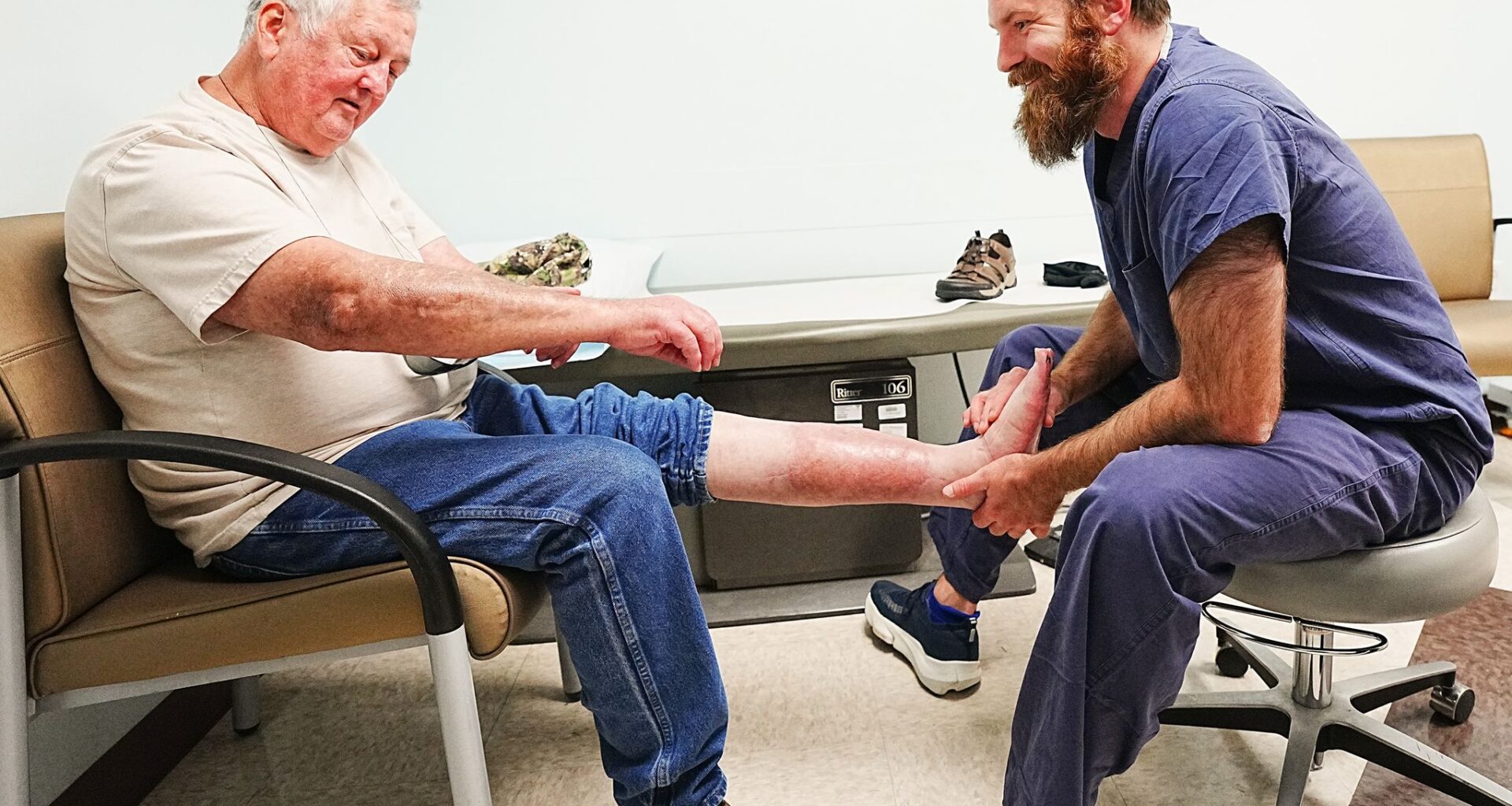
Donald Alexander meets with Dr. Patrick Kellam, an orthopedic surgeon at UT Physicians Orthopedics Trauma Monday, June 22, 2026. Alexander’s leg was severely injured in a accident and almost lost his foot.
Elizabeth Conley/Houston Chronicle
Donald Alexander was cutting his grass in Brazoria County last summer when his riding lawn mower clipped the trunk of an oak tree that had been damaged by Hurricane Beryl.
The blade struck the trunk, ripping off a piece of wood that pierced Alexander’s shin like an arrow.
“I literally felt like I got hit by a school bus,” Alexander, now 77 years old, said. “I knew it was a serious situation.”
Article continues below this ad
READ MORE: How Houston hospitals prepared for World Cup health and safety challenges like Ebola
He looked down and saw his foot hanging from a strip of skin. A neighbor heard him cry out and she called 911 when she realized what had happened. Alexander took off his belt and used it as a tourniquet to stop the bleeding until paramedics arrived.
The wound looked bad. Alexander assumed he’d need a miracle to avoid amputation. But quick treatment by paramedics and emergency physicians made it possible for Alexander to undergo a series of complex surgeries that offered a good chance at saving his foot.
MORE COVERAGE: A study mapped Houston’s mental health deserts across ZIP codes. See how your neighborhood compares.
Article continues below this ad
Alexander was flown to Memorial Hermann – Texas Medical Center, one of the busiest trauma centers in the nation, where doctors from the UT Physicians trauma team had treated similar injuries. Alexander said a prayer with the trauma team and decided to move forward with a series of surgeries to save his foot.
“I knew they were going to do whatever was necessary,” he said.
‘Pretty dire condition’
Alexander was in “pretty dire condition” after a helicopter flew him to the hospital, said Dr. Mohin Bhadkamkar, a plastic and reconstructive surgeon with UT Physicians and co-director of the Orthoplastic Limb Restoration Program. But Alexander could still move his foot because some nerves and blood vessels remained intact.
Dr. Patrick Kellam, orthopedic surgeon at UT Physicians Orthopedic Trauma, looks at the recover of patient Donald Alexander’s leg at UT Physicians Orthopedics Trauma Monday, June 22, 2026. Alexander’s leg was severley injured in a accident to the point where he almost lost his leg.
Elizabeth Conley/Houston Chronicle
“If those (blood vessels) were gone, we may not have even had a chance to save his leg,” Bhadkamkar said.
Article continues below this ad
Patients with similar injuries typically have a 10% risk for amputation, said Dr. Patrick Kellam, an orthopedic surgeon with UT Physicians Orthopedic Trauma Clinic. Alexander’s age and the fact he has diabetes put him at higher risk for surgical complications, but doctors opted to skip some precautionary tests because the risk of Alexander losing his leg outweighed an infection or other problems, Kellam said.
Kellam and his colleagues cleaned debris from the wound and stabilized Alexander’s leg by using pins and bars to realign the limb.
One week later, they performed a definitive bone repair by inserting a rod through the center of Alexander’s tibia. Kellam also removed a fragment of bone that no longer had blood supply and replaced it with an antibiotic cement spacer.
Donald Alexander meets with his doctors, Dr. Mohin Bhadkamkar, plastic and reconstructive surgeon, left, and Dr. Patrick Kellam, orthopedic surgeon, at UT Physicians Orthopedics Trauma Monday, June 22, 2026. Alexander’s leg was severley injured in a accident to the point where he almost lost his leg.
Elizabeth Conley/Houston Chronicle
Transplanting muscle and skin
Once Kellam repaired the bone, Bhadkamkar needed to perform additional surgeries to cover it with muscle and skin. That work needed to begin within 24 hours to reduce the risk of infection, blood clots and other problems.
Article continues below this ad
“The quicker you can get it covered, the less likely you are to have a complication afterward,” Kellam said.
The muscle that covered Alexander’s leg bones was irreparably damaged, so the trauma team decided to transplant a piece of another muscle from his lower back. The procedure could compromise some function in Alexander’s back, but his age made that less of a concern, Bhadkamkar said.
READ MORE: A Spring teen was told months of severe pain was all in her head. Then a doctor took a closer look.
“Unless you’re in a profession or an occupation that requires a high level of performance or muscle, it really doesn’t matter,” he said.
The muscle was so large that the surgery took 11 hours. Bhadkamkar used a microscope to reconnect it to arteries and veins in Alexander’s leg.
Article continues below this ad
Five days later, Bhadkamkar used a skin graft from Alexander’s thigh to cover his lower leg. Alexander remembers his leg looking “very bad” after the surgeries were completed, but he was grateful the entire ordeal was less painful than he anticipated.
“I could feel the pain, but it was not like you would imagine,” he said.
Donald Alexander talks with two doctors that have helped him keep and recover from a serious accident at UT Physicians Orthopedics Trauma Monday, June 22, 2026.
Elizabeth Conley/Houston Chronicle
A remarkable recovery
Alexander spent about three weeks in the hospital before moving to a Brazoria County rehabilitation facility in September 2025. His therapists encouraged him to lift weights with his arms and hands shortly after he arrived because he’d lost 45 pounds since the injury.
Alexander restored classic cars until he was 72 and always kept busy, so he was eager to get back on his feet. Doctors initially set a timeline of eight to nine months before he could use his leg, but Alexander was cleared to bear full weight just two months after surgery and has been walking without a cane since Christmas.
“I’m not one to sit around, so I was not going to let (rehab) hold me back,” he said.
Alexander’s doctors credit his mindset because a patient’s dedication to rehab is often an indicator of how well they will recover.
“You can call it luck, but I think it’s the patient’s attitude,” Kellam said. “I will take some credit for our team and everything we do, but a lot of this is on Donald.”
Alexander still carries some risk of infection and other complications, but that risk is significantly lower than it was in the initial weeks after his surgeries, his doctors said.
He does have some limitations; he can no longer climb a ladder or carry anything heavy. But he knows that might have been inevitable at his age, anyway, so he’s grateful the trauma team was able to save his foot.
“I won’t be running any foot races,” he said. “But I can walk a good distance without any problems.”