
We can think of few projects so transformational to Dallas as Klyde Warren Park.
The dream of Sheila and Jody Grant to reconnect Uptown and downtown over the expanse of the Woodall Rodgers Freeway was once considered a dream. Today, it is an international model for restoring cities that highways broke apart.
We couldn’t be happier to announce here that, after years of hard work, the park is almost ready to begin a long-planned, 1.7-acre western expansion that will restore even more of our city to the public.
The nearly $200 million expansion is expected to begin in the fall with the construction of an additional deck between St. Paul and Akard streets. This additional space will make the entire park 7.1 acres of reclaimed space over the freeway.
Article continues below this ad
The existing park, at 5.4 acres, has already generated some $6 billion dollars in growth for Uptown and downtown. At a time when the central business district has seen its share of bad news, it’s worth remembering the incredible growth that can be traced directly to the planning and opening of this welcoming public space.
Jody Grant, founder of Texas Capital Bank, estimates that the addition will bring some $3 billion to $3.5 billion in additional growth. We don’t doubt it based on the increased demand for land around the park when it became clear it was more than a dream.
Jacob Lawn will be a 37,000 square-foot patch of open space that can be used for private or public events.
Courtesy Woodall Rodgers Park Foundation
“We announced this project in February of 2005, and that started the stampede to acquire properties within reasonable distance of the park,” Jody Grant said.
Article continues below this ad
His team has counted 29 high-rises built since that time, and anyone who looks at the before and after pictures should believe it.
This westward expansion toward the Perot Museum will open up that much more potential, even as it reminds us that freeways both create and diminish economic opportunity.
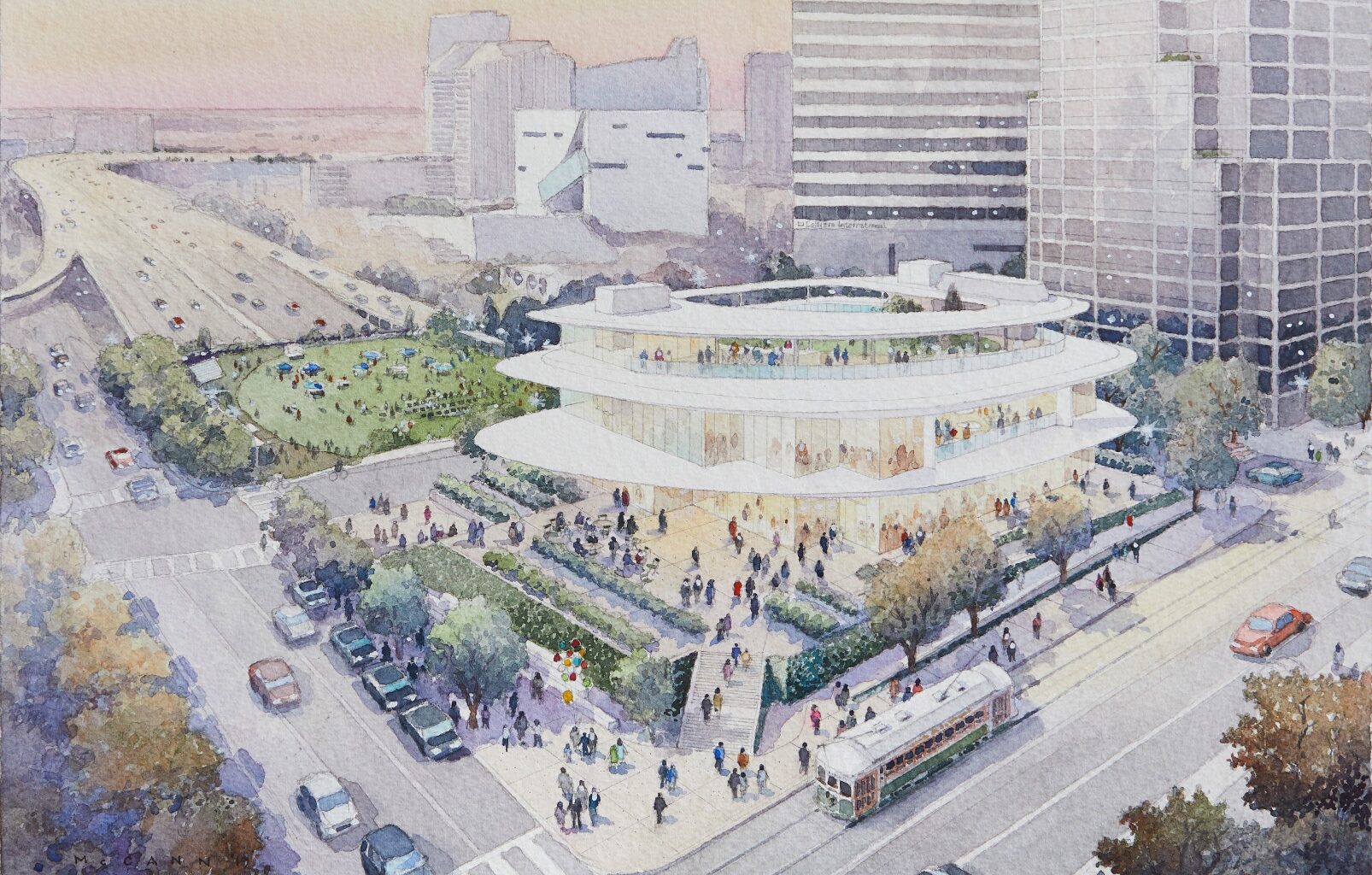
The addition to the park will include a glass and steel pavilion that the Grants have planned to the last detail.
“It’s already been totally designed. We have the chandeliers, the furniture, everything picked out,” Sheila Grant said.
We expect the pavilion, with a 5,000 square-foot indoor meeting space and a rooftop terrace that can accommodate 600 people, will be in instant demand upon completion.
Article continues below this ad
Klyde Warren Park has long been a holiday destination with its Christmas tree lighting. But the addition will allow for an ice skating rink in winter, too.
Courtesy Woodall Rodgers Park Foundation
It also serves a critical role in drawing revenue for the park.
From the beginning, the Grants wanted Klyde Warren to be self-sustaining. It is so important that the park be free from the annual budget wrangling at City Hall. But operating Klyde Warren at the high level people have come to expect comes at great expense. The events building could, by itself, bring in some 25% to 30% of operating expenses, the Grants estimate.
That pavilion will be in the new space between St. Paul and Akard (and both streets will remain open upon completion). West of Akard will be the Jacob Lawn, a 37,000 square-foot turf open space that can be used for private or public events. Sheila Grant described it as a place for activities similar to the RHS Chelsea Flower Show in London or the Christmas Market in New York’s Bryant Park. During the Christmas season, there is also a plan to use the lawn for an ice-skating rink the size of Rockefeller Center’s.
All of this work will take a little while, but the new, $111 million deck should be complete in about two years after it begins. After that, finishing out the park will take another 18 to 24 months and some $80 million to $100 million in private donations.
Article continues below this ad
No project of this nature happens in a vacuum. This has been a public-private partnership from the start, and the expansion is no different. The city of Dallas has contributed enormously. Special thanks also goes to Michael Morris at the North Texas Council of Governments for ensuring this project got the federal funding required to build the deck.
A view from the pavilion roof, long planned and now closer to becoming a reality
Courtesy Woodall Rodgers Park Foundation
We write a lot about vision on this page. So it’s worth noting here what that really means. You can trace this park to a day in 2004, when Jody Grant had a “yahoo” moment standing near the site of the current Winspear Opera House, looking down into the canyon of speeding cars below him. It could be a park, he decided. He could see it right there in front of him.
Woodall Rodgers Freeway was designed with the idea that one day, somehow, it could be spanned with a deck. But it was Grant who decided it not only could be done, it had to be done for Dallas.
He and his wife risked their own funds to get the project started. And there were plenty of naysayers along the way. But the Grants developed a vision; they developed a fundraising strategy; they worked tirelessly on design and planning; they talked to anyone who would listen. They understood that this park could change things for the better. They believed in it as a space for all of the city. It has become a space for more than that. It has become the blueprint for making neighborhoods whole again, bit by bit.
Article continues below this ad
The Klyde Warren Park expansion adds two acres to the deck park, including an western-facing overlook.
Courtesy Woodall Rodgers Park Foundation
Here in Dallas alone, we have seen the results, with the beautiful Halperin Park now spanning Interstate-35 and bringing a major piece of Oak Cliff back together. The plan for decking Interstate-30 is underway now.
People who see what is and what can be for their city are not easy to come by. We are lucky to have these two in Dallas, doing this work for a beautiful public space that will endure long after we are all gone.
Have thoughts about this? Send a letter to the editor using our letters form or email letters@dallasnews.com. Letters should be no more than 200 words and include the first and last name of the writer and city of residence.