
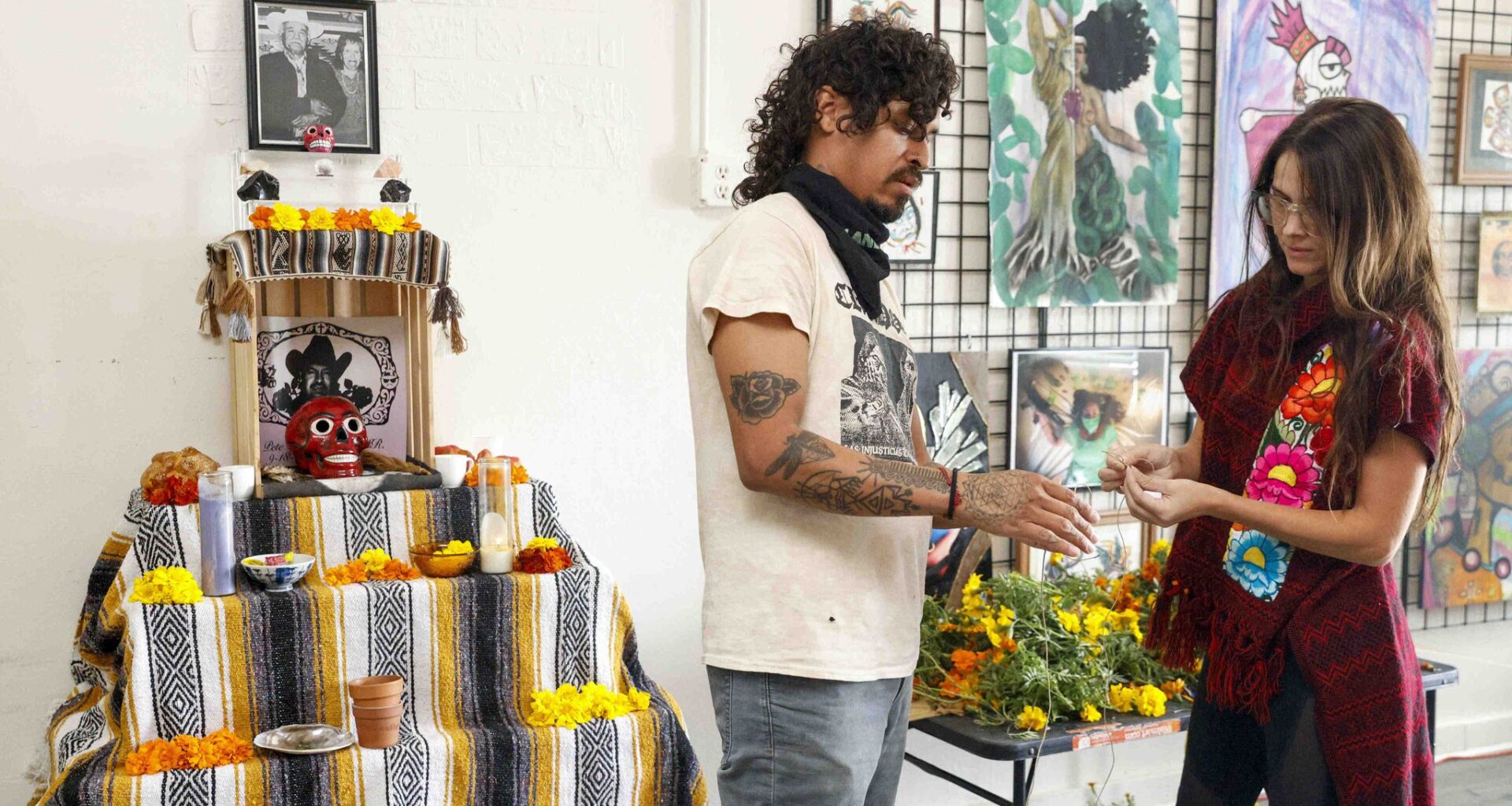
Victor Ortiz, the owner of Mi Barrio 214, and local artist Raquel Zamora tie marigolds to a string as they construct a community ofrenda, or altar, at the community center. Mi Barrio closed in June.
2022 File Photo/Elias Valverde II
Viktor Ortiz sits in front of a display of artwork at Mi Barrio 214, which has closed. Ortiz received notice to vacate a few weeks before Mi Barrio’s closure. His landlord sold the building. The new owner wanted a different tenant, and Ortiz couldn’t afford to buy the building to stay there.
“I’ve gone through the stages of grief,” Ortiz said.
2022 File Photo/Elias Valverde II
Mi Barrio 214, a cultural community center in Pleasant Grove, held its last event on June 13. In an evening full of art, cumbia and community, patrons said goodbye for now to the neighborhood gathering space.

A food pantry, cultural center and art gallery, Mi Barrio served every community need owner Victor Ortiz could think of.
“I’ve always had in mind that it’s our space,” Ortiz, who grew up in Pleasant Grove, said. “It was always supposed to be a space for community.”
Article continues below this ad
The shadow of gentrification
Ortiz received the notice to vacate a few weeks before Mi Barrio’s closure. His landlord sold the building. The new owner wanted a different tenant, and Ortiz couldn’t afford to buy the building to stay there.
“I’ve gone through the stages of grief,” Ortiz said. “But it’s staying in the neighborhood, it’s staying in the community.”
In this case, another local business will be moving into Mi Barrio’s former location. That lessens the blow of losing the building, Ortiz said. But he said he worries that gentrification is beginning to spread into the neighborhood.
When artists improved Pleasant Grove in a “cultural way,” Ortiz said that he saw infrastructure improvements that had been needed all of a sudden being addressed.
Article continues below this ad
“These are the telltale signs of gentrification,” Ortiz said. “We want all the benefits, but we don’t want the cost of lives, of families being uprooted and separated.”
Danaë Gutierrez, who operated food drives at Mi Barrio through The Harvest Project Food Rescue, said she worries about gentrification in all of Dallas. Tax increases can price out older people who’ve lived in an area for years and live on a fixed income, she said.
“That’s one of the worries that I have for our communities,” Gutierrez said. “Everything’s getting so expensive but to the point where it’s not in you budget to pay your taxes, or you pay your taxes or you pay your food.”
Pleasant Grove’s third space
Mi Barrio was designed to be a place where people can hang out without spending money, known as a “third space.” Ortiz grew up going to 1919 Hemphill in Fort Worth and the Phoenix Project in East Dallas, two examples of third spaces. Those places, and others he saw across the country, inspired him to open his own.
It was important to him to start Mi Barrio in Pleasant Grove, where he grew up.
Article continues below this ad
“I wanted to stay in the hood because there’s a real big need for kids to have a third space,” Ortiz said.
Pleasant Grove is a majority Hispanic neighborhood, according to the U.S. Census Bureau. It and other neighborhoods in South Dallas deal with disparities in accessing healthcare, food, transportation options and infrastructure compared to the city’s northern neighborhoods.
Ortiz saw a way to meet some of those needs and provide increased access to the arts in a neighborhood without many opportunities for artists to show their work.
Combining a grant from the city of Dallas with his own savings, Ortiz opened Mi Barrio in 2022. He said he kept it going with his personal funds and small grants.
Mi Barrio didn’t make money, Ortiz said. He measured success by the benefit it provided to Pleasant Grove’s residents.
Article continues below this ad
“It was never about profit, it was more about people and community,” Ortiz said.
People could use Mi Barrio as a space to create art, and workshops and dance, music and art events regularly took place there. It was a place that Rodolfo Macias, a cumbia DJ who performed there, felt free to share his art.
“It was a space that we need in Dallas,” Macias, the artist behind Cumbia 319, said. “When us as artists didn’t have a space to do a show, there was Mi Barrio, no? And they didn’t charge us a single peso, a single dollar.”
It also hosted food drives in partnership with The Harvest Project.
“Mi Barrio started as a vision that Victor had and then it evolved to so much more,” Gutierrez, executive director and founder of The Harvest Project, said. “It’s not a vision of just one person but it’s a vision of community.”
Article continues below this ad
Gutierrez said it was important to host food drives in a community center like Mi Barrio rather than a typical food bank. It erased some of the stigma attached to accepting free food because it came from people from the same background as the people asking for help.
“You were not just a stranger coming to get help,” Gutierrez said. “You were just family coming to get food that we have.”
The purpose of a third space took on new meaning as Immigration and Customs Enforcement ramped up deportation efforts. Gutierrez said that community members trusted Mi Barrio and felt it was a safe place to go for food and other resources.
Next steps
Mi Barrio’s story isn’t over, Ortiz said, it just doesn’t have a physical home. In the meantime, Ortiz hosts pop-ups while looking for funding for a new location.
Article continues below this ad
Ortiz said he’s proud of what he accomplished. From food distributions to workshops with immigration lawyers and financial experts, he felt that Mi Barrio was able to make an impact.
“Everything we set out to do, we did it,” Ortiz said.