
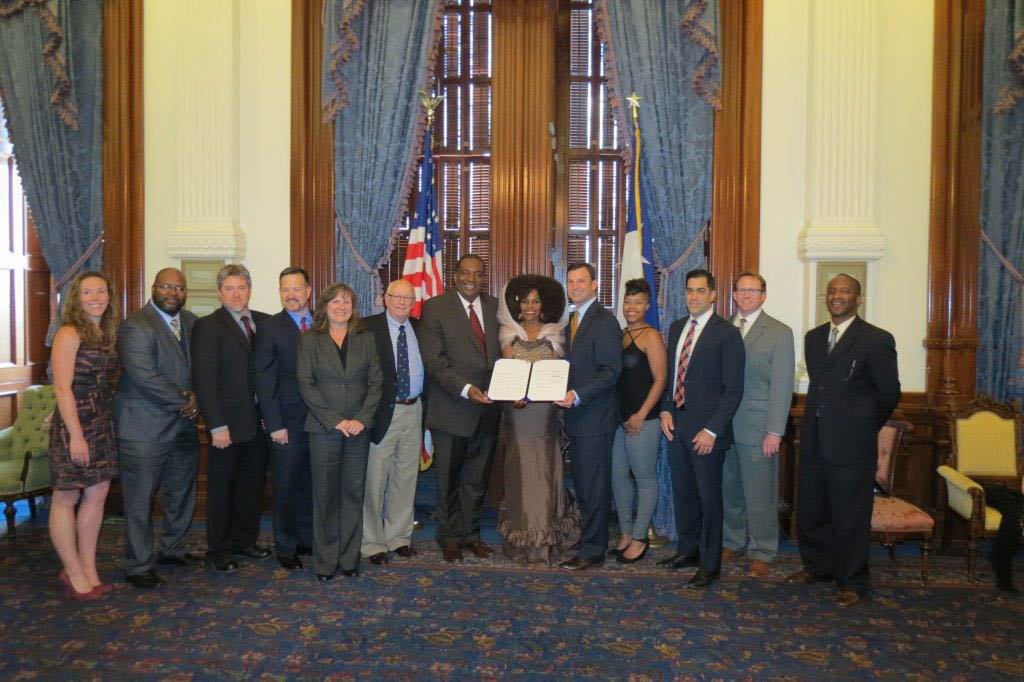
While the state arrested her for not having the proper cosmetology license, Brantley argued that braiding is a legacy of African ancestors and that those requirements should not apply. For about 10 years, Brantley worked with one of her clients, who happened to be a lawyer, against the requirement to stop her work as a braider and require her to attend cosmetology school where she would learn how to use chemicals with hair, even though chemical use was not a part of her practice.
“I don’t put my hands in processed chemicals that people go to their schools for,” she says. “I don’t use sharp instruments, I’m not using scissors to cut anybody’s hair or anything like that.”
An injunction was put on her building, shutting her down and leaving her and her five children homeless, she says.
“Somebody in the community that knew I had been braiding their wife’s hair said, ‘You can come and have my house,’ and that’s when me and the children went back into the house, and I had to wait a long period,” she says. “My livelihood was put on hold until my lawyer could get them to release the injunction.”
In 2007, Texas began regulating hair braiders into the state’s barbering statute. This meant that to teach the 35-hour braiding curriculum Texas now required, Brantley had to install barber chairs, obtain at least 2,000 square feet of floor space and mount five sinks. Additionally, she was required to become a licensed barber school instructor, which would require up to 750 hours learning to teach barbering and pass written and practical exams on barbering instruction.
Brantley says when that ruling came down, she was told there was no one who could teach her.
“These people owe me because they were already in violation of what they sent me through for the first 10 years, and then after, they said in 2007, ‘Well, we can’t find nobody to teach you ancestral braiding. We don’t even know what ancestral braiding is, so there’s nobody here that can teach you. So we’re going to grandfather you, but we’re going to make every other Black person pay us $500 to $1,000 for 35 hours, and we’re going to use your curriculum that you so graciously gave us during the hearings,’” she says. “They captured my whole concept of ancestral braiding, and it’s just sad, and what they did was they put it in their curricula, and then they said, ‘Well, you are free to braid hair, but you’re not free to teach any classes.’”