
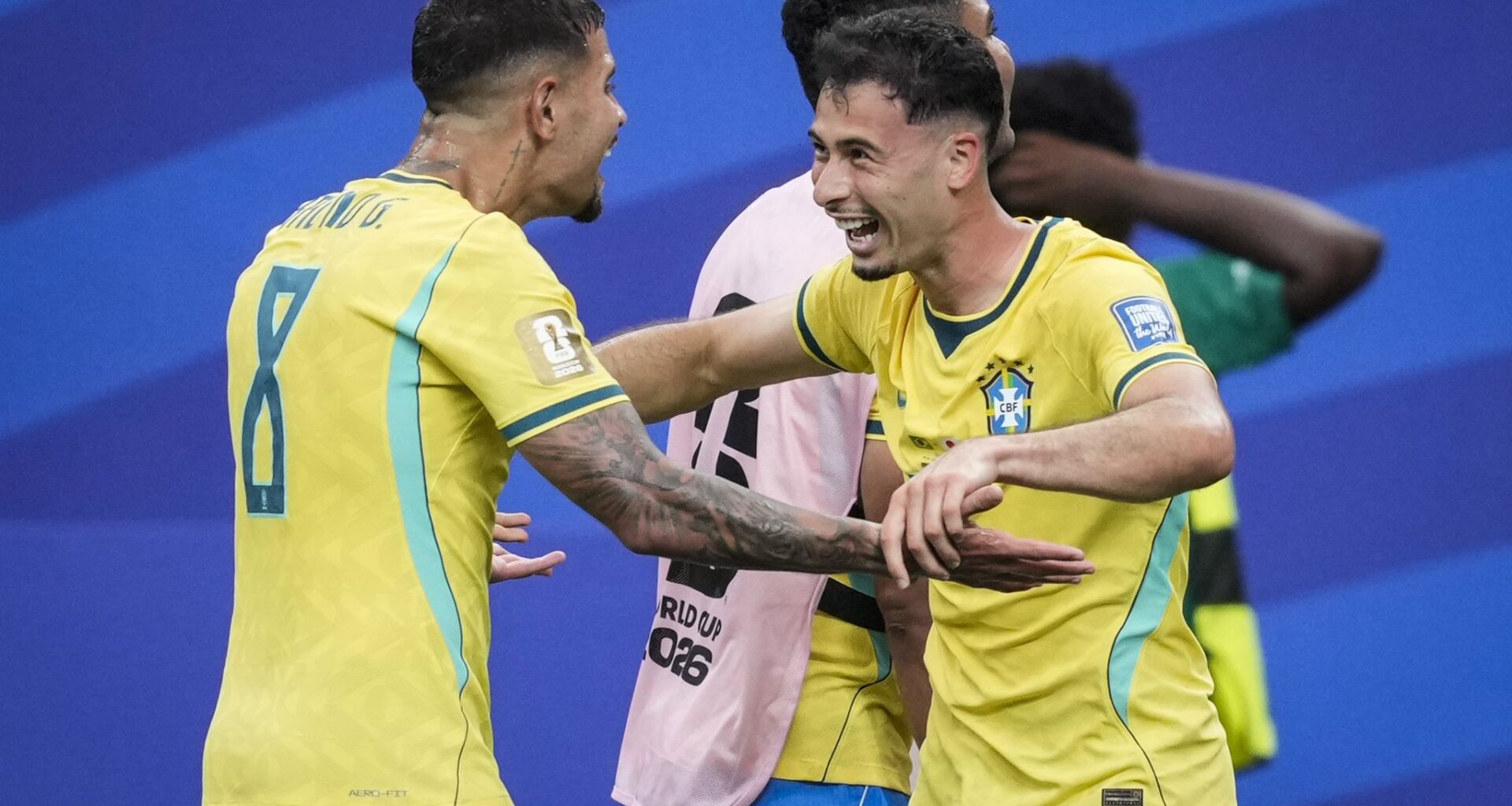
Brazil midfielder Bruno Guimarães (8) and forward Gabriel Martinelli (22) celebrate Martinelli’s goal against Japan during the second half of a World Cup round of 32 soccer match in Houston, Monday, June 29, 2026.
Brett Coomer/Houston Chronicle
Brazil forward Rayan (26) drops to his knees as he celebrates a 2-1 win over Japan in a World Cup round of 32 soccer match in Houston, Monday, June 29, 2026.
Brett Coomer/Houston Chronicle
Brazil celebrates a goal by Brazil forward Gabriel Martinelli against Japan during the second half of a World Cup round of 32 soccer match in Houston, Monday, June 29, 2026.
Brett Coomer/Houston Chronicle
Brazil midfielder Casemiro (5) celebrates his goal against Japan during the second half of a World Cup round of 32 soccer match in Houston, Monday, June 29, 2026.
Brett Coomer/Houston Chronicle
Brazil midfielder Casemiro (5) heads the ball past Japan goalkeeper Zion Suzuki (1) for a goal during the second half of a World Cup round of 32 soccer match in Houston, Monday, June 29, 2026.
Brett Coomer/Houston Chronicle
Brazil midfielder Casemiro gives a thumbs up to fans as he celebrates a 2-1 win over Japan in a World Cup round of 32 soccer match in Houston, Monday, June 29, 2026.
Brett Coomer/Houston Chronicle
Brazil players celebrate a 2-1 win over Japan in a World Cup round of 32 soccer match in Houston, Monday, June 29, 2026.
Brett Coomer/Houston Chronicle
Brazil fans celebrate a 2-1 win over Japan in a World Cup round of 32 soccer match in Houston, Monday, June 29, 2026.
Brett Coomer/Houston Chronicle
On the anniversary of its first World Cup triumph — led by “King” Pelé in Sweden in 1958 — Brazilian football paid tribute to the greatest icon in its rich history with a nerve-wracking victory. To secure the win, the team had to rely more on its pedigree and character than on the “jogo bonito” of those days.
Gabriel Martinelli’s stoppage-time goal spared the team the agony of extra time and a potential penalty shootout, sealing a 2–1 victory over a spirited Japanese side at Reliant Stadium. Japan ultimately succumbed to the superiority of the five-time champions, who secured their place in the FIFA World Cup Round of 16.
Martinelli, the Arsenal midfielder, was in the right place at the right time to spark Brazilian celebrations. He fired a diagonal right-footed shot past goalkeeper Zion Suzuki — finding the net just inside the left post — after receiving a superb pass from Bruno Guimarães inside the box. The goal came in the sixth minute of stoppage time, just as the 68,777 spectators packing the stadium were bracing for extra time. Earlier, Japan had opened the scoring in the 29th minute through Kaishu Sano, while Casemiro briefly leveled the match in the second half (56th minute) with a header.
Article continues below this ad
“It was a very tough match, and when the second goal came, I saw the whole crowd erupt with joy,” said Casemiro.
Brazil, seeking an unprecedented sixth World Cup title, will play again on Sunday in East Rutherford, New Jersey, against the winner of Tuesday’s match between Ivory Coast and Norway in Arlington.
JAPAN’S HEARTBREAK: The Samari Blue are 0-5 in World Cup knockout rounds
“I suffered less than the fans because the team was playing well,” said coach Carlo Ancelotti at the postmatch press conference. “We faced a respectable opponent — very well organized, very dangerous, and with players who were strong in duels (…) our team wasn’t lost the way it was during the first half of the match against Morocco.”
Article continues below this ad
The experienced Italian strategist was referring to the scoreless draw in its opener, when the African side clearly outplayed Brazil in the first half —and could even have snatched a win — before Brazil rallied in subsequent matches to thrash Haiti and Scotland, finishing top of Group C on its way to the Round of 32.
But in this match, despite trailing on the scoreboard, Ancelotti and Brazil reacted in time — both tactically and mentally — to eventually reflect their superiority in the final score.
“When you win, it’s always down to the players, and when you lose, the blame falls on the coach,” said “Carletto” with a touch of sarcasm. He has won the UEFA Champions League five times — a record for a manager — and is the only coach to have won league titles in Europe’s five major competitions. “In modern football, suffering is normal (…) sometimes I have to sit here and speak after a defeat, and that’s much harder.”
BRAZIL 2, JAPAN 1: From stadium walk to final goal, the day in Houston
Bringing on Martinelli was one of the astute changes Ancelotti made to try to turn the match around in the second half after being caught off guard by the Japanese tactical setup, which had conceded possession but effectively shut down all of Brazil’s attacking avenues during the first half.
Article continues below this ad
The midfielder — a Premier League champion and Champions League finalist with Arsenal before his arrival at the World Cup — came on in the 65th minute, replacing Matheus Cunha. It was a move designed to inject fresh energy into a Brazilian side that did the heavy lifting in the second half, completely dominating possession and attacking with much greater depth.
“This was the most difficult match; we had trouble in the first half because they were sitting very deep, so in the second half we tried using more crosses. We faced a challenge and handled it very well after the break,” the coach explained, speaking in a mix of Portuguese, Spanish, and Italian. “In the first half, the aim was to play between the lines to feed the forwards, but they were packed tight at the back. At halftime, we discussed switching to crosses instead (…) we have the setup to strike, and there is still room for improvement.”
During that tricky first half, following the cooling break, Japan capitalized on one of its few deep forays. Danilo played a poor pass from the right toward the center; Sano intercepted it and surged through a massive gap in midfield. This exposed the defensive issues Brazil has been experiencing when out of possession: veteran Casemiro was late to close down the space, Gabriel Magalhães was positioned too deep, and the Japanese midfielder found enough room to fire a low right-footed shot past goalkeeper Alisson.
“We played against a very strong team, and their goal caught us by surprise — we didn’t expect it. But we knew we could turn the result around and that we would have our chances,” said Gabriel Magalhães.
IDENTITY CRISIS: Can Brazil’s ‘beautiful game’ survive?
Article continues below this ad
After the break, however, Brazil came out determined to find the net. Its attack became much more direct, targeting the flanks whenever advancing through the middle proved difficult.
This was also where the first of “Carletto’s” substitutions paid off. Attacking midfielder Lucas Paquetá had limped off at the end of the first half after taking a knock, so Endrick — a much more energetic and dynamic attacking threat — came on in his place for the second half.
This forced the Japanese defense to redouble its efforts to contain the wave of Brazilian attacks, and the need to keep an eye on Endrick gave Vinícius Júnior a bit more freedom on the left wing. Playing wide on the flank, the skillful Real Madrid forward was far more dangerous than when operating centrally. Crosses began raining in from the wings, and Suzuki — the talented, U.S.-born Parma goalkeeper — was forced to pull off a couple of crucial saves, most notably denying a header from Bruno Guimarães in the 52nd minute.
An equalizer seemed imminent and was the direct result of that pressure. It also served as a moment of redemption for Casemiro following his lackluster first half. The Manchester United midfielder rose between two defenders near the far post to head home a superb cross delivered by Gabriel Magalhães from the left.
HISTORY: How a Houston doctor helped Tostão, Brazil win 1970 World Cup
Article continues below this ad
“Casemiro played very well and was key with his equalizing goal,” said Ancelotti of the 34-year-old veteran, who was replaced by Fabinho late in the game, just before the winning goal was scored.
Brazil’s onslaught intensified; smelling blood, they kept attacking a Japanese defense that was clearly exhausted from constant defending. “Vini” — who had already scored four goals in the tournament — came agonizingly close to scoring in the 58th minute, but his shot from the left was slightly deflected by Suzuki before striking the goalkeeper’s left post.
Just as everyone in the stadium was bracing for extra time, Martinelli’s goal sparked pandemonium, keeping Brazil’s dream of an unprecedented sixth title alive—at least until Sunday. The story began with that first title in Sweden, when a 17-year-old Pelé scored twice in the final against the hosts to secure Brazil’s maiden crown with a 5-2 win.
WORLD CUP GUIDE: What to know about event in Houston.
“No one is perfect; mistakes happen in football, and what matters is how you bounce back from them,” said Ancelotti, speaking with the calm assurance of a seasoned veteran. “We recovered well in the second half; we never doubted the team could score — we just needed patience and had to guard against transitions, as that was where Japan could cause us trouble.”
“The team was also prepared to play extra time if necessary,” he added. “We’re strong because we know we’re still on the right track, continuing to improve and work hard. Now we need to rest, as tomorrow (Tuesday) we’ll find out who our next opponent is.”