
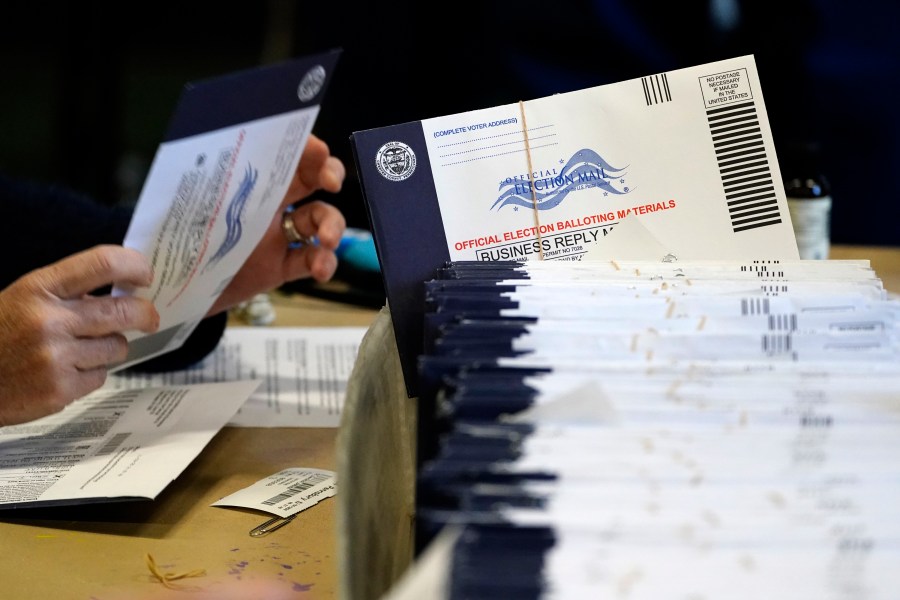
AUSTIN (Nexstar) — The United States Supreme Court ruled in favor of the state of Mississippi on Monday, saying they’re allowed to count ballots that are postmarked by election day, but arrive up to five days later.
“Personally, I was surprised by this ruling,” Votebeat Senior Reporter Dion Nissenbaum told Nexstar. Justice Amy Comey Barrett, appointed by President Donald Trump, and Chief Justice John Roberts, appointed by former President George W. Bush, joined the three Democratic-appointed justices in their decision. The other four Republican-appointed justices opposed the ruling.
“Most of the decisions we see from the court are 6-3 decisions along ideological lines and this was a 5-4 decision,” Nissenbaum said.
While the case didn’t have direct implications for Texas — it did highlight a similar Texas law.
In 2017, State Rep. Mike Schofield, R-Katy, authored House Bill 1151, which allowed mail-in ballots to be counted if they were received before 5 p.m. on the day after election day. Previously, all mail-in ballots had to be received by the time the polls closed at 7 p.m. the night prior.
“Our problem at the time was that many post offices throughout Texas were failing to deliver ballots on time and we would receive them en masse the next day, disenfranchising voters who thought they had voted on time,” Schofield told Nexstar in a phone call on Monday. “We think (22 extra hours is) about right. It’s not like the post office was going to hold them all week or for a month.”
HB 1151 passed unanimously back then.
A push for repeal
While the Supreme Court’s ruling leaves Texas’ current law untouched, it doesn’t mean the policy is immune from future challenges in Austin
“We’ve all been through elections and people always complaining about they found extra ballots or how did the mail work, they were digging stuff underneath. You can say if it’s true or not. This is a way to help rein that in,” State Rep. Dennis Paul, R-Houston, said during a House floor session in 2025.
He authored House Bill 1091, which would’ve reinstated the election day mail-in deadline. The bill never came to a vote, as State Rep. John Bucy III, D-Austin, successfully called a point-of-order claiming the bill’s analysis was substantially and materially misleading. However, Bucy expects lawmakers to revisit the issue in 2027.
“When I killed his bill last session, he implied that he’d be bringing it back next session,” Bucy said. If he does, it will be on the other side of the chamber as Paul is running to replace State Sen. Mayes Middleton, R-Galveston. “The Senate continues to file anti-voter legislation on the regular, even though Greg Abbott’s hand-picked secretary of states continue to reassure us and testify under oath about how safe and secure Texas elections are.”
Schofield didn’t give a direct answer when asked if he’d support Paul’s bill if it came back up.
“The most important thing is that we have one set of rules that is consistent for everybody and that your ballot will count if you follow them,” he said. “If we want to do it by giving an extra day, that’s fine. If we don’t think the post office is having problems delivering them anymore and we want them on time, I certainly support that.”
The one issue he did have a strong stance on — legally separating the state and federal elections in Texas so federal election law can never outweigh Texas election law.
“This Supreme Court case highlights the fact that Texas voting can be held hostage to the whims of Congress and whatever bills they pass,” he said. “I have filed a bill the last three sections that would bifurcate our elections from the federal elections. And under the US Constitution, if we do that… the Congress cannot make rules that curtail Texas elections.”
Limited impact
Voter by mail in Texas is incredibly rare compared to other states. In order to apply for a ballot, a Texan must meet one of the following criteria:
Expected to give birth within three weeks of the election;
Out of the county on election day and during all early voting days;
In jail but still eligible to vote
“It’s very narrowly used,” Nissenbaum said. “In the 2024 election, only 4% of voters in Texas cast their ballots by absentee.”
The small percentage of voters who do cast a ballot that way, will still have some breathing room in 2026, but Schofield says they should still take precaution.
“A new post office memo has told us that they can’t guarantee that they will postmark a ballot or any other mail the day it’s received,” he said. “As a result, I would caution any voter who votes by mail to make sure they get their ballot in the mail in plenty of time to make sure it’s counted. If you’re a voter in Texas and you cast your vote by mail, we want it to count.”
Copyright 2026 Nexstar Media, Inc. All rights reserved. This material may not be published, broadcast, rewritten, or redistributed.
For the latest news, weather, sports, and streaming video, head to KXAN Austin.