
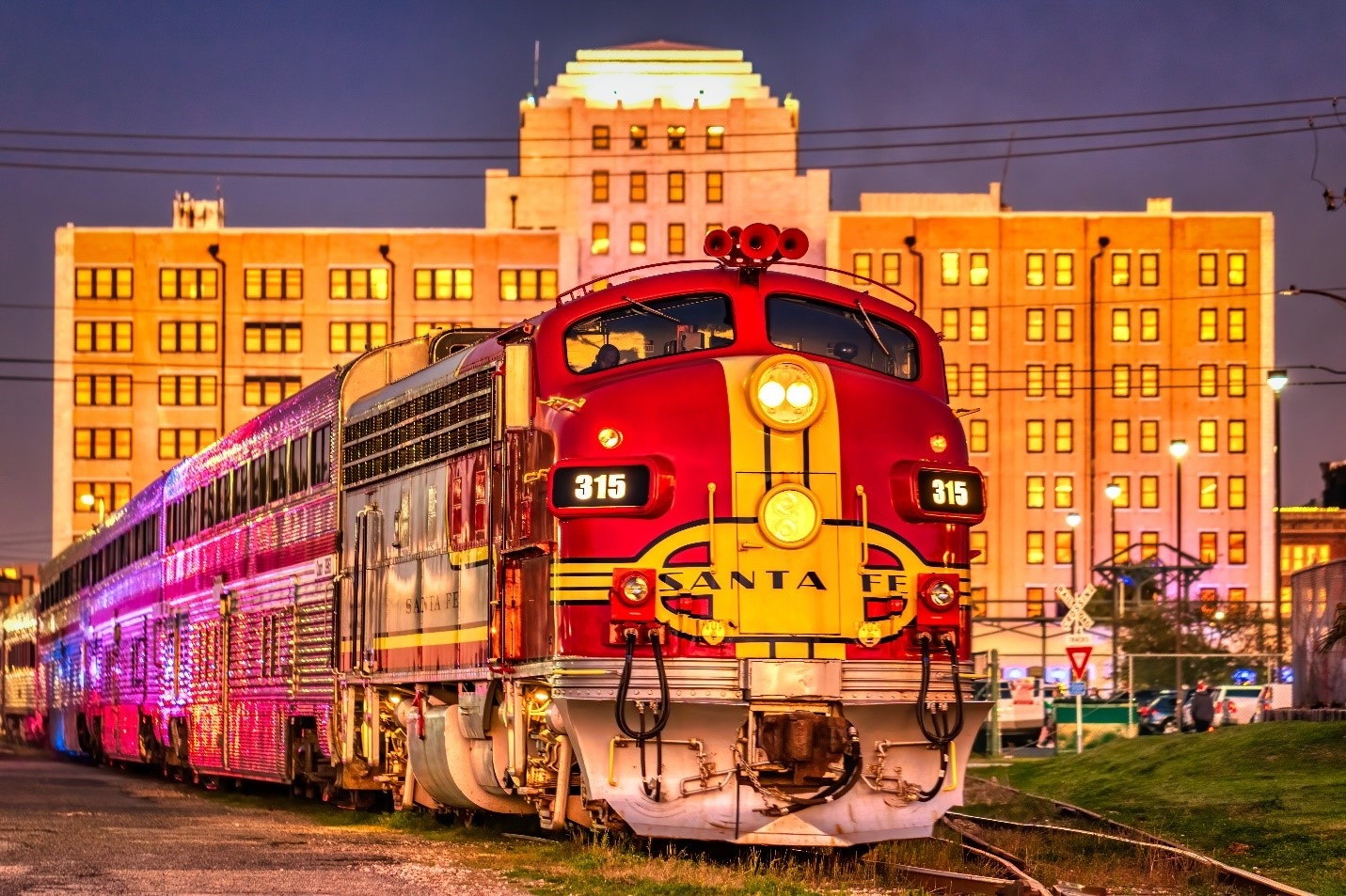
Built in 1937, the Atchison, Topeka & Santa Fe railroad’s Texas Chief engine became legendary for its red and silver “Warbonnet” color scheme.
Galveston Railroad Museum
Despite a momentary flash of hope last week, the possibility of boarding a train in Downtown Houston—or at Hobby or Bush airports—and exiting near Galveston’s Strand district anytime in the near future remains the longest of long shots. But given that it’s been more than 30 years by some accounts, and nearly 60 by others, this elusive yet persistent idea may never fully go away.

In this case, hopes were rekindled last Thursday in Nextdoor’s Avenue K community. A user from Tomball posted a link to a public survey for the Houston-Galveston Area Council’s Regional Public Transportation Coordination Plan, appending the question, “Would you ride a train to Galveston? Why not ask for it?”
Article continues below this ad
The post drew nearly 20 supportive replies, as Avenue K members shared the potential merits of commuting to and from UTMB (staff and patients alike), streamlining cruise passengers’ journeys to and from their vacations, and, perhaps most of all, “anything that helps me avoid the Gulf Freeway,” wrote one neighbor.
“That would be such a blessing,” echoed another.
If only such an informal sampling of public support could simplify what would be an extremely complex project, both logistically and politically. Indeed, Tricia Bentley with the council’s media relations department told Chron, that’s not quite how it works: any future mass transit between the Bayou City and the island is much likelier to be by bus than by rail.
“There are a number of different studies that we’re working on that are looking at different ways people travel across the region and how our transit services connect to one another, but nothing specific to passenger rail service,” Bentley said.
Article continues below this ad
Once home of Galveston Union Station, the Art Deco building known as Shearn Moody Plaza was completed in 1932 and became the site of the Galveston Railroad Museum a half-century later.
Chris Gray
The 20-question survey will help the HGAC, which coordinates intergovernmental activities across 13 Southeast Texas counties, formulate its newest Regional Public Transportation Coordination Plan, which would cover the years 2027 though 2031. The Texas Department of Transportation requires the council and its 23 counterparts statewide to submit one every five years, among other purposes, to “assess unmet needs and service gaps” and to ensure that transportation funding goes to areas where it is most needed.
Furthermore, the plan focuses on “transportation-disadvantaged populations,” including seniors, veterans, limited English speakers, and people with disabilities. In other words, it’s not just cruise passengers and UTMB commuters who could benefit from this theoretical train.
The council is also developing Regional Transportation Plan 2050, its longer-term regional strategy for the 7.2 million people in the eight-county Houston-Galveston area. The plan’s most recent iteration, RTP 2045, included more than 750 mobility enhancements and infrastructure projects and nearly $109 billion in transportation investments, according to the council’s website.
Article continues below this ad
The council will accept proposals for RTP 2050 until July 17. The project’s Phase 1 public feedback identified public transit as the public’s top investment priority with 23 percent, and ‘connectivity’ edged out ‘safety’ as the top overall priority. When respondents were asked to weigh “existing transportation” versus “preferred transportation,” rail showed the largest increase.
Interesting the wider public may prove problematic, though. Only 7 percent of attendees at the Phase 1 public meetings came from Galveston County, ahead of only Chambers County’s 5 percent. Any proposal for a Houston-Galveston passenger train would have to come from the cities or counties involved and/or their transportation agencies, Bentley said.
Now home to the popular Polar Express every holiday season, the station saw its last passenger train depart the island in April 1967.
Visit Galveston
But trains retain an uncanny hold on the public’s imagination, and the dream may never fully disappear as long as tracks stretch over the causeway.
Article continues below this ad
The first passenger rail service to the island was the Galveston, Houston & Henderson Railroad, which reached Virginia Point at the tip of the mainland in 1858 and completed a bridge over the bay two years later. The electric Houston-Galveston Interurban Railway, in service from 1911 to 1936, was said to cover its 50-mile route in about 75 minutes.
After the Depression, the Missouri Pacific and Atchison, Topeka & Santa Fe—owner of the legendary Texas Chief—continued to carry passengers from the mainland to Galveston Union Station (better known today as the Galveston Railroad Museum) until 1967, three years after Santa Fe closed its Gulf Coast offices there. In the late 1980s and early ’90s, the privately owned Texas Limited provided weekend service from Amtrak’s Washington Avenue station to Galveston.
As recently as 2012—which isn’t all that recent anymore—public support for a Houston-Galveston train was strong enough that the HGAC was considering a plan that would have carried as many as 2,000 passengers per day between the two cities. About as far as it ever got was the shuttles operated by the Gulf Coast Transit District, which now run from the island to Texas City, League City, and Metro’s El Dorado Park & Ride station.
Article continues below this ad