
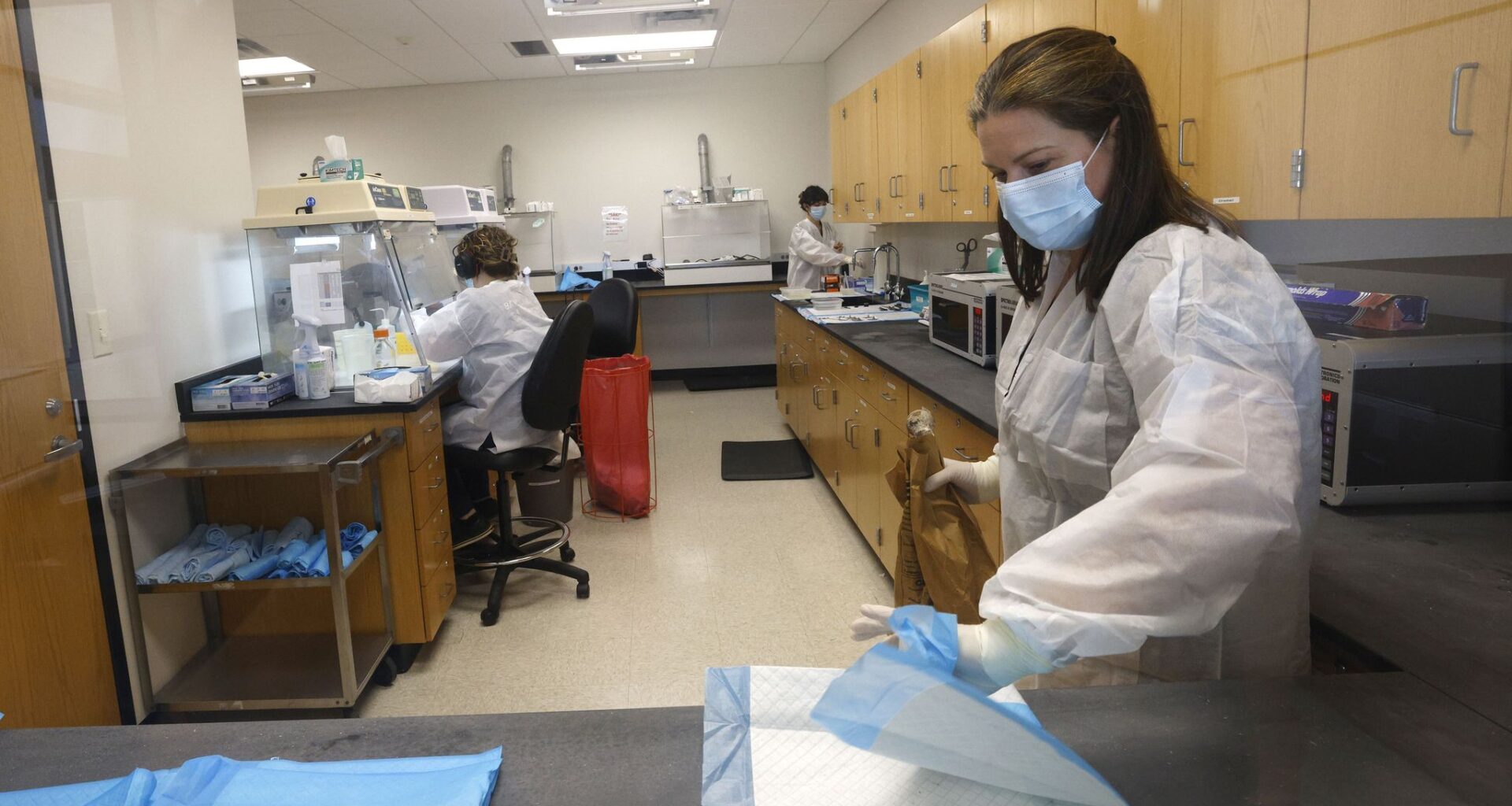
Technical Leader Krystle Rodriguez works in a laboratory of the Missing Persons Unit at the University of North Texas Health Science Center, Wednesday, June 24, 2026, in Fort Worth.
Chitose Suzuki/The Dallas Morning News
Erika Ziemak, casework laboratory director of Center for Human Identification at University of North Texas Health Science Center and Michael Coble, executive director of Center for Human Identification, pose for a photo at Coble’s office at the center, Wednesday, June 24, 2026, in Fort Worth.
Chitose Suzuki/The Dallas Morning News
Laboratory technologists work in a laboratory of the Missing Persons Unit at the University of North Texas Health Science Center, Wednesday, June 24, 2026, in Fort Worth.
Chitose Suzuki/The Dallas Morning News
FORT WORTH — Michael Coble watched the July 4 floods unfold on his television.

In the inky black early morning hours, rain fell hard and fast in Texas’ Hill Country. The Guadalupe River roared over its banks, swallowing cabins and homes and wiping out entire roads. Scores of Texans, including children at summer camp, were missing.
Coble — who runs the Center for Human Identification at UNT Health Fort Worth — was recovering from back surgery at home and knew a phone call was coming. His phone rang the evening of July 5. On the other end was Brady Mills, chief of the crime laboratory for the Texas Department of Public Safety.
Article continues below this ad
“We’re going to need your help,” Mills told him.
Coble’s team would use DNA to provide answers to grief-stricken families and a heartbroken state.
The first samples arrived the next day.
Related: Camp Mystic summer camp files for bankruptcy after 28 deaths in July 4 flood
Article continues below this ad
The floods
The Guadalupe River zigzags through the Hill Country, a beloved recreation spot for generations of Texas families who have fished, tubed and swam. Even before last year’s floods, the region was nicknamed “flash flood alley” for its hilly terrain and thin soil. It is one of the most dangerous river basins in the United States.
On July 4, massive storms, remnants of Tropical Storm Barry, stalled over the region and dumped 2 to 4 inches of rain per hour. Years of drought resulted in compact, parched soil incapable of absorbing water.
The river rose faster than anyone could recall, reaching a staggering 37 feet. Water filled homes and swept up RVs. People clung to trees and roofs. Nearly 140 people died, including 25 campers and two counselors at the all-girls Camp Mystic. The camp’s longtime director also died.
With the rain still falling, the Texas Rangers arrived in Kerr County, the center of the disaster, to scour the mud-soaked river by foot and boat.
Article continues below this ad
When they found bodies, the Rangers gathered DNA samples by swabbing the inside of the cheek. Days later, when that became impossible due to the lapse in time, medical examiners provided bone fragments for testing. Desperate family members, many of whom gathered at a local church, provided DNA samples for identification.
Some 250 miles north of Kerrville, the Center for Human Identification in Fort Worth prepared for what would come.
Related: Top Texas lawmakers support lifting flood safety law to allow summer camps to open
The laboratory
Coble learned about DNA more than three decades ago, as a high school science teacher attending a conference. He was immediately hooked, in awe of its potential to solve cold cases and identify remains.
Article continues below this ad
He has not taught high school in decades, but it’s easy to picture. Coble is gentle and quick to smile, wears jeans and tennis shoes in the office and speaks in a measured tone when discussing work that is both wrenching and invaluable.
After stints at the National Institute of Standards and Technology and Armed Forces DNA Identification Laboratory, he joined UNT Health in 2018.
One of the country’s premier DNA testing facilities, the center has helped solve decades-old cold cases and identified victims from high-profile events, including the Uvalde school shooting and Hurricane Katrina.
The Texas floods posed distinct challenges. In some cases, floodwaters washed bodies miles down the river, delaying recovery by days. Speed was paramount. Under normal circumstances, a test takes more than a week to run. In this case, the center set out to complete tests within 24 hours.
“We wanted families to have answers as quickly as possible,” said Coble. As a father and a grandfather, Coble could not help but think of his own family.
Article continues below this ad
Related: Camp Mystic says it will not reopen this summer following deadly Texas floods
Finding answers for families
After he heard from DPS, Coble called Erika Ziemak, the center’s casework laboratory director, who was eating dinner with her young daughters at Babe’s Chicken Dinner House in Arlington.
Ziemak, too, is a veteran in the field. She worked in the New York City medical examiner’s office and helped identify victims of the 9/11 terrorist attack. She arrived at the health science center in 2023, initially accepting a position helping laboratories in other countries develop identification capabilities.
Now, the pair worked to schedule two shifts of staff to test samples and write reports around the clock.
Article continues below this ad
Every morning for two weeks, Texas Rangers flew samples from the Hill Country to Meacham Airport in north Fort Worth, then drove 5 miles south to the health science center. By 10 a.m., the samples were logged into the system and assigned a case number so testing could begin.
Using cells collected from cheek swabs, the team of more than two dozen scientists ran kinship tests on victims and their closest living family members. They then built genetic profiles with statistical algorithms to identify potential familial relationships.
As they worked, the scope and horror of the floods grew. Everyone, Ziemak said, wanted to help families they would never meet. For two weeks, staff juggled childcare issues to work 12-hour shifts or longer.
“The challenge wasn’t getting staff to stay,” Ziemak said. “The challenge was getting staff to leave.”
Ultimately, the center identified 47 people killed in the floods through DNA, giving answers to 47 families. Dozens of others were identified by markers like tattoos or fingerprints.
“I don’t dare speak to what a family is going through and what they feel,” Ziemak said. “But I am hopeful that it’s something that provides some sense of relief to them, in the sense that they have an answer as to whether or not the person they’re missing — their loved one — really ultimately was found.”
The flood’s victims ranged in age from 1 to 91 and came from Dallas, Austin, San Antonio, Houston and small towns across the state.
Still, two victims — 8-year-old Cile Steward, of Austin, and 61-year-old Jeff Ramsey, of Lewisville — have not been found. Texas Rangers continue to search, and their families continue to wait.
Niamh Ordner is a science reporting fellow at The Dallas Morning News. Her fellowship is supported by the University of Texas at Dallas. The News makes all editorial decisions.