
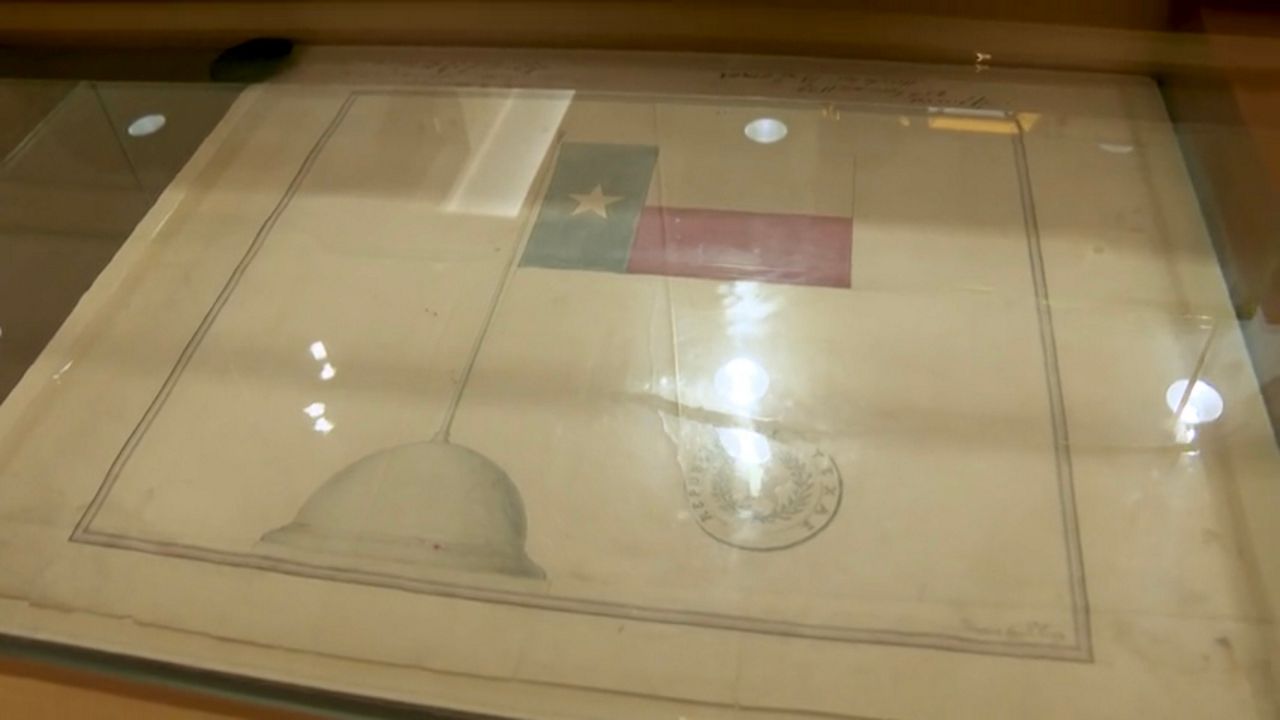
AUSTIN, Texas — Today, the Lone Star flag flies proudly over businesses, schools and homes in Texas, but it all started with a design in a drawing that now sits in the care of Peggy Price and the team at the Texas State Library and Archives in Austin.
“This item here is when it was entered into the Congressional record,” said Price, showing the color drawing of the flag, which now sits in a protective glass case.
The drawing is part of the archives’ celebration of America’s 250th birthday, where an exhibit established in their lobby right next door to the state Capitol shows off important artifacts that have contributed to the story of Texas. The exhibit includes documents like the drawing, the Texas Constitution and even a large American flag from 1846 — the first flag to feature a star for Texas after it became a state.
That drawing of the Texas flag, though, holds a special meaning at the archives and in the state, signifying an essential moment in Texas history.
“The Republic,” said Price. “We were our own country.”
That brings us back to the story of the six flags over Texas — the six nations that planted their flags in the land on the way to U.S. statehood. So far, we looked at the First Nations that began coming to Texas approximately 14,000 years ago, Spain who claimed the land for hundreds of years, France who had a short but impactful stand on the land and Mexico whose rule lead to one of the state’s most well-known historic moments: the Battle of the Alamo.
Following General Sam Houston’s defeat of the Mexican troops at the Battle of San Jacinto, the Texans of 1836 claimed their independence and truly set out on their own. They raised the fourth flag over Texas: the Lone Star flag, originally designed for the Republic of Texas.
“From 1836 to 1945, Texas is going to be its own nation,” said Kathryn Siefker, curator at the Bullock Texas State History Museum in Austin, where artifacts from that period are housed. “This gallery represents the enormity of that task.”
Enormous, Siefker said, is the best word to describe that era. The Texans of the time had just fought in a costly war, claimed their independence and were making the big choice to be their own country. However, they were truly alone in that endeavor.
“They had no money. The only thing they had going for them was their vast land,” said Siefker. “A lot of the… identity of Texas is grounded in this period.”
The Texans of the Republic had to scrap and build from the ground up. The “Lone Star” moniker may have been more real at that time than any other period.
Yet, throughout those nine years, Siefker said many in the Republic were pushing to join the growing United States and become American. In 1845, that happened.
A document at the Texas State Library and Archives shows the original vote tally from the counties in the Republic of Texas, where they voted “yes” to joining the United States. Right next to it is the U.S. resolution that solidified the deal.
“It had to be accepted by the government, and it had to be accepted by the people,” said Price.
Those two documents officially raised the fifth flag over Texas: the American Flag. Texas was the 28th state to join the country and would make countless contributions to the American story.
However, there was one more flag to precede the American flag.
In 1861, fueled by the election of President Abraham Lincoln and signs that a nationwide end to slavery was on the way, 11 states, including Texas, banded together and made the choice to secede from the United States.
“[Texas] withdraws from the United States and joins the Confederacy, which brings us to our sixth flag,” said Siefker, walking into the Confederate exhibit at the Bullock Museum.
It was a period that would only run for approximately four years, but those four years would have massive repercussions. The split would spur the Civil War, which remains the deadliest conflict in American history.
“There were approximately 90,000 Texans who fight in the Civil War on both sides, for the Union and the Confederacy,” said Siefker.
The period divided homes and a country, and it remains a divisive topic for many today. It also remains a part of Texas’ story, remembered at monuments and parks throughout the state, both for what it was and for what followed.
Following the Union’s victory in the Civil War, slavery was abolished and Texas would, again, be the center of an important moment.
“Juneteenth will be declared in Galveston, which will free the remaining enslaved African Americans and end the Civil War for good,” said Siefker.
There was a period of reconstruction as the U.S. came back together, and the reunited country, with Texas in tow, would face plenty of hurdles. Texas remains under the American Flag — what Siefker calls our “Forever Flag.”
The state would slowly grow into the Texas we know today, fueled, Siefker said, by the stories of all those who laid the building blocks for the state.
“The history of Texas is the story of these individuals every day,” she said. “Moving forward, making decisions, shaping their nation, building a better life for them and their families.”
This is obviously a shorthand version of Texas’ story. Historians encourage folks to visit sites like the Bullock Museum, the Alamo and other famous Texas history centers to hear more about the long journey to the Texas of today.