
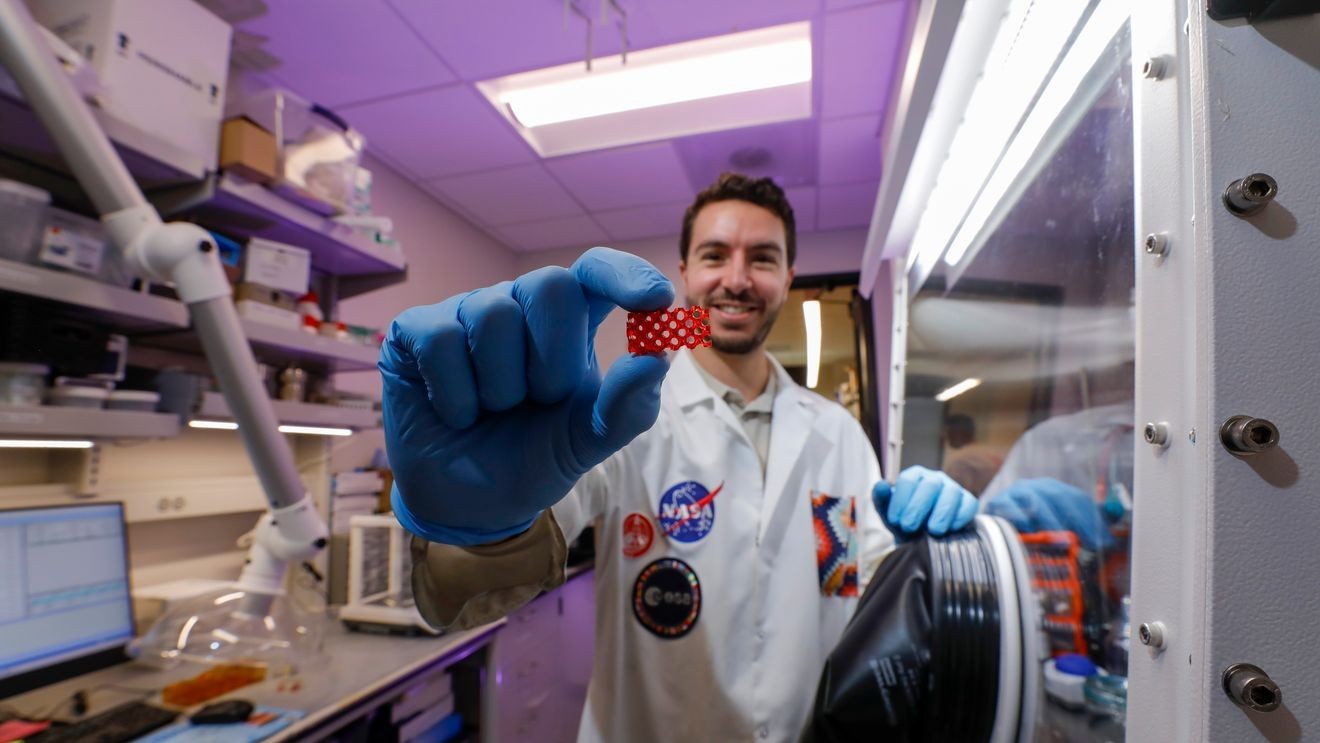
EL PASO, TEXAS (KFOX14/CBS4) — A team of researchers at the University of Texas at El Paso developed a way to 3D-print a key battery component in nearly any shape, a step they say could help free engineers from constraints of standard rechargeable batteries and allow batteries to fit devices better.
The university detailed the work in a study published in the Communications Engineering journal on Tuesday as UTEP scientists led the research in collaboration with Sandia National Laboratories
According to UTEP, the work focuses on gel polymer electrolytes, a material inside a battery that carries ions between the electrodes, the two terminals where chemical reactions occur and electricity enters or leaves the battery.
While conventional electrolytes are liquids that must be sealed inside rigid casings, this design limits battery shapes and raises safety concerns about leaks. In an effort to fix those limits, the UTEP team created a printable gel by combining a light-curable resin with a lithium-based liquid electrolyte, then hardening it layer by layer using a technique called vat photopolymerization.
To demonstrate the design flexibility, the researchers printed simple discs, an open honeycomb lattice and a solid one-centimeter cube, illustrating how future batteries could be shaped to fit a wearable, a medical device or an aerospace part rather than forcing the device to accommodate the battery.
“For years, the shape of a battery has dictated the shape of the device it powers,” said Alexis Maurel, Ph.D., the study’s lead researcher and a faculty member in UTEP’s Department of Metallurgical, Materials and Biomedical Engineering. “We are showing that you can print a high-performing electrolyte battery component with any shape and place it almost anywhere you want. That changes what designers are able to imagine.”
The work also examined how the choice of solvent affects both printability and battery behavior, a topic the authors said had gone largely unexamined in earlier research on printable electrolytes. One formulation proved especially stable during repeated testing, helping the team identify what it described as the most promising path forward.
“This research demonstrates how advanced manufacturing and energy technologies are merging to create entirely new possibilities for battery design,” said Kenith Meissner, Ph.D., dean of the Miguel A. Loya College of Engineering. “By developing a scalable method to 3D-print battery electrolytes in virtually any shape, Dr. Maurel and his collaborators are helping position UTEP at the forefront of next-generation energy storage research while providing our students with hands-on experience in technologies that are critical to the future of aerospace, transportation, and advanced manufacturing.”
The team plans to refine its formulations and work toward incorporating the printed electrolytes into complete battery cells.
The study is part of Maurel’s broader portfolio of 3D-printed battery projects, which includes a workforce development grant from the National Science Foundation’s Research Experiences for Undergraduates program. The funding established a partnership between UTEP and Texas A&M University that offers paid, research-intensive summer internships for students from both institutions.
RECOMMENDED: UTEP study links GLP-1, Ozempic drugs to lower alcohol, opioid, and cocaine disorders
Sign up to receive the top interesting stories from in and around our community once daily in your inbox