
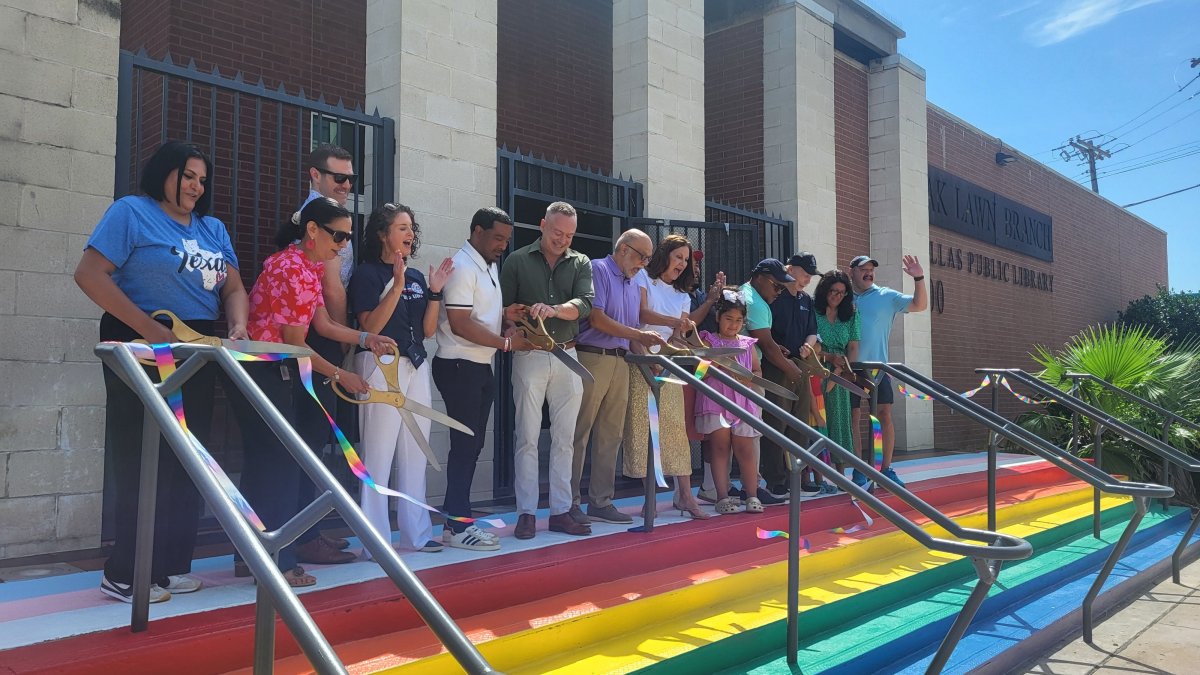
Less than a year after rainbow crosswalks disappeared from Cedar Springs, the neighborhood has found a new symbol of LGBTQ visibility: brightly painted rainbow steps.
Community organizers celebrated the transformation of The Oak Lawn Library steps into a vibrant rainbow installation, culminating with a ribbon-cutting ceremony and dance party on June 27.

Ribbon cutting of the new Oak Lawn Library steps. Image courtesy Lee Daugherty
The colorful steps welcome visitors to Oak Lawn while reinforcing a message of safety, visibility and inclusion in one of Dallas’ historic LGBTQ neighborhoods.
The project grew after the removal of roughly 30 rainbow crosswalks earlier this year after Gov. Greg Abbott directed agencies to eliminate what he described as “non-compliant roadway markings.”
Kevin Miller, president of the Cedar Springs Merchant Association, said the effort grew out of conversations among neighbors after the rainbow crosswalks were removed. Miller said the neighborhood wanted a response that would endure.
“Social media grabbed hold of it and said, let’s do something, let’s go paint the crosswalk at 2 a.m.” said Miller, “But we knew that wasn’t going to really be a lasting measure, so we invited folks to come back to this, to the CSMA meetings and talk about ideas.”
The crosswalks, first painted in 2020 with private funding from community organizations including the Cedar Springs Merchant Association, had been restored only months before they were removed.
After their removal, the city and local community came together to help explore new ways to recognize and celebrate the neighborhood’s identity. In response, rainbow colors spread throughout Cedar Springs.
In October of 2025, the Oak Lawn United Methodist Church painted its front steps in rainbow colors in a defiant show of support to the local LGBTQ community after residents encouraged businesses and institutions to display Pride symbols throughout the neighborhood.
The Dallas Landmark Commission later unanimously approved allowing the steps to remain in place on the historic church property for at least three years.
Businesses have painted storefronts and outdoor spaces, while new public art has continued to appear across the district.
“Some of the barbershops painted their awnings, some bars painted different areas of their bars out front or put on coverings, some made banners,” said Miller.
The newest additions came Monday, when community leaders unveiled four painted bike racks. Speakers at the unveiling also highlighted walkability, transit access and bicycle infrastructure, arguing that welcoming public spaces extend beyond symbolic artwork to include how people safely move through the neighborhood.
Across the district, rainbow-colored public art has become an increasingly visible expression of the neighborhood’s history and identity, each new installation adding to a growing network of landmarks that community members say signal welcome, safety and belonging.
The two sets of painted steps are intended as bookends, marking the beginning and the end of a neighborhood with a long history of advocacy and community support.
“Together, these new library steps and our church steps now bookend a neighborhood that has long been a refuge, a place of resilience, and a home for so many,” said Rev. Ryan Wager, executive pastor at Oak Lawn United Methodist Church.
For advocates in Oak Lawn, cans of paint and public art represent quiet rebellion and a message of unity.
“We celebrate every visible reminder that our LGBTQIA+ neighbors belong in the life of our city. We are so appreciative of everyone that made the rainbow steps happen at the Oak Lawn Library,” said Wager in a written statement. “They are more than public art. They are an invitation. They remind every child, every family, every longtime resident, every visitor, and every person who has ever wondered if there is a place for them that they are seen, valued, and welcomed.”
For Miller, the project is also personal. He grew up on Cedar Springs and said he has watched the neighborhood evolve over decades.
“I grew up on this strip, and I’ve seen two generations of crosswalks come and go,” he said.
Miller has a long history in Cedar Springs; his parents, Gary Miller and Alan Pierce, are owners of the Round Up Saloon and are original members of the Dallas Pride Board of Directors.
“If you know the history of the Round-Up, it’s not just a bar for them,” Miller explained; it was a place where people built community.
As the neighborhood changes, he said the work becomes about reaching the next generation to help continue the legacy of connection through community.
“That’s where I learn, that’s where I grow, is walking around the strip and learning about the stories,” said Miller. “For me, that’s the ever-growing history.”
Community events like the Cedar Springs Wine Walk continue to help fund many of the neighborhood’s public art projects.