
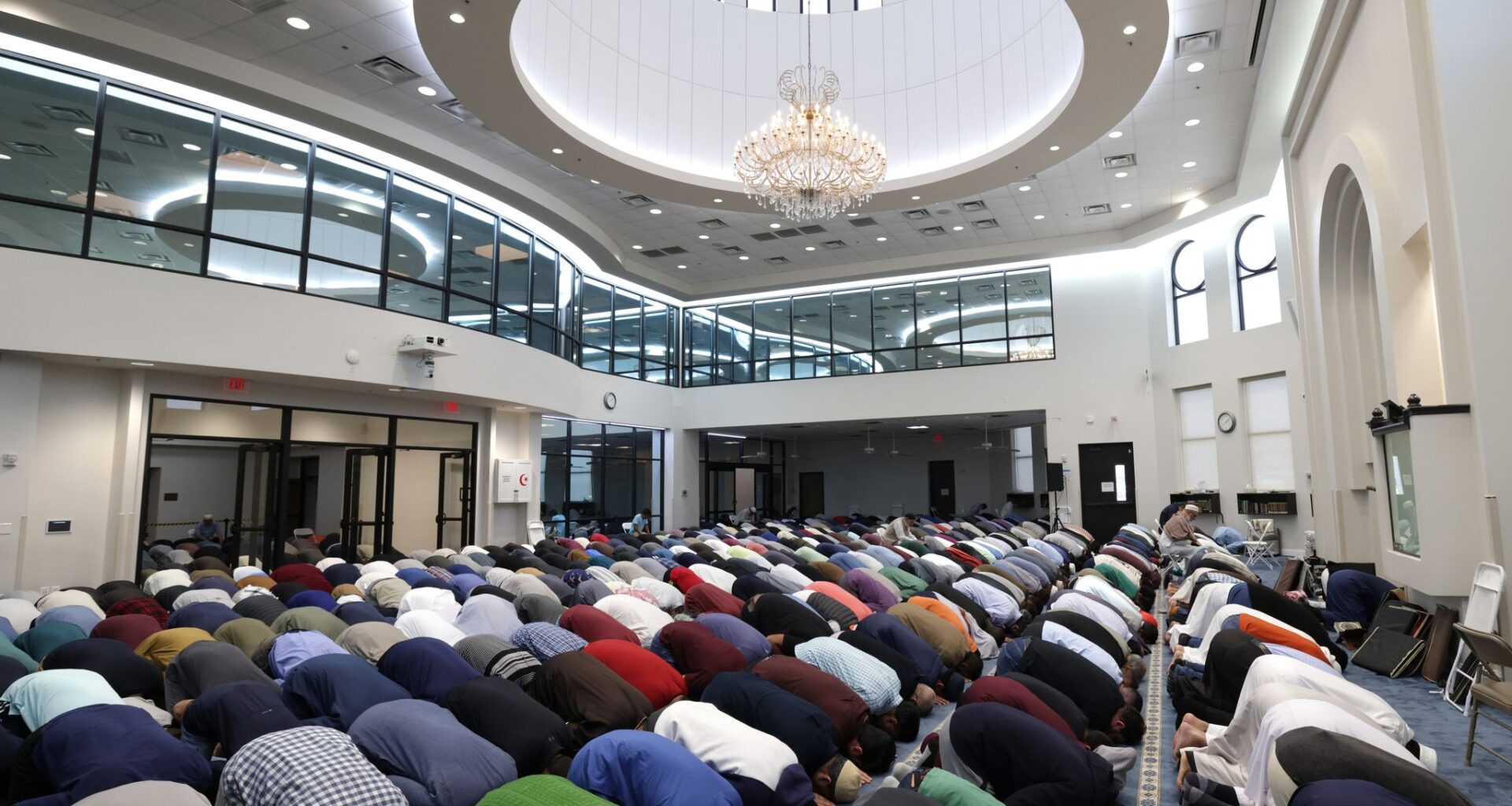
Members of the community hold a daily prayer service at the East Plano Islamic Center in Plano, TX, on Apr 8, 2024. (Jason Janik/Special Contributor)
Jason Janik/Special Contributor
The East Plano Islamic Center’s lawsuit against the Texas agency that regulates funerals can go forward, a federal judge has ruled. The agency had ordered the mosque to halt its religious funeral services last year.

In a 26-page opinion issued last week, the judge denied a request from the former head of the agency to dismiss the lawsuit, finding that EPIC, as the mosque is known, has provided sufficient evidence to allege that its constitutional rights may have been violated.
The judge also wrote that no evidence has been presented to suggest the mosque is conducting burial rites that threaten Texas law.
Article continues below this ad
Attorneys representing the mosque in the case did not immediately respond to requests for comment, nor did the mosque’s religious leader. Attorneys representing the state and the Office of the Attorney General did not respond to messages seeking comment.
The mosque provides religious funeral rites, including washing and shrouding the body and performing the Janaza, an Islamic funeral prayer, court documents said. EPIC, one of the largest mosques in North Texas, said it partners with licensed funeral providers to transport deceased members and provides the rites at no charge.
Related: Ken Paxton files third lawsuit tied to ‘EPIC City’ development
In court documents, EPIC said the rites must be performed promptly after a Muslim person’s death in accordance with Islamic religious tradition.
The Texas Funeral Services Commission regulates the funeral industry in the state.
Article continues below this ad
In March 2025, the funeral commission issued a cease-and-desist letter to the mosque, according to court documents. The commission ordered the mosque to stop what it alleged were unlicensed funeral services, and the commission accused the mosque of operating a funeral home without a license.
EPIC said it was not running a business or embalming, but stopped its religious funeral rites at the time. According to court documents, EPIC said the cease-and-desist letter resulted in at least 11 congregants being buried without receiving Janaza prayers at their home mosque.
Related: EPIC mosque in Plano seeks to meet ‘hatred with love,’ continue outreach despite protests
Citing letters from the commission written in 1987 and 2014, the mosque said it follows longstanding rules for religious organizations. According to the letters, the mosque said, religious organizations in Texas can perform burial-related activities without being a licensed agency as long as they do not receive financial compensation.
The mosque said its constitutional rights under the First Amendment and 14th Amendment were violated, and it is seeking a permanent injunction to keep the state from taking further action against its funeral services. It is seeking an unspecified financial award in damages.
Article continues below this ad
“The Commission’s actions forced EPIC to suspend sacred funeral rites, chilled its exercise of religion, and caused funeral homes to refuse to transport remains to EPIC for religious services—effectively barring Muslim families from practicing their faith in the moments that matter most,” court documents said.
On July 2, 2025, the mosque filed its lawsuit. Court documents say on July 16, 2025, the day before a hearing on the case, the funeral commission sent a letter to the mosque that the agency said sought to clarify its March cease-and-desist order.
That communication said in accordance with “longstanding policy” the mosque, as a religious organization, could engage in certain religious practices as long as the mosque does not take compensation, including performing the Janaza prayer, assisting families with finding a licensed funeral establishment, and washing and shrouding the body.
But the mosque said in court documents it continues to seek relief through the courts.
The funeral commission’s cease-and-desist letter came shortly after Texas politicians, including Gov. Greg Abbott and Attorney General Ken Paxton, began opposing the proposed development of a Muslim-centric neighborhood near Josephine. Previously known as EPIC City, the project, which has stalled due to legal battles, has since been renamed The Meadow.
Article continues below this ad
Members of the EPIC mosque formed the group behind the development.
Related: HUD to investigate planned D-FW Muslim-centric neighborhood
Kristin Tips, the former chair of the commission who is named in the lawsuit, is no longer in her position, the Houston Chronicle reported in April.
Court records list the Office of the Attorney General of Texas as Tips’ legal representation in the case. The office did not respond to a question sent via email asking whether the office is still representing Tips.
Tips did not immediately respond to messages left at her email address and voicemails left at her funeral home business, Mission Park Funeral Chapels, Cemeteries & Crematories. The Texas Funeral Service Commission also did not respond to messages seeking comment.
Article continues below this ad
According to court documents, EPIC argued that Tips demonstrated a hostility to Islam around the time the commission was pursuing enforcement against EPIC when she sent text messages to the commission’s executive director that contained misleading claims about Islam. The text messages were first reported by the Chronicle, which obtained the text messages through a public records request.
“Court finds that the provided context illustrates plausible bias [in] Tips’s alleged targeting of EPIC,” Judge David Ezra, a district judge for the Western District of Texas, wrote. Ezra was appointed by former President Ronald Reagan.
Tips filed a motion to dismiss the lawsuit in January, and Ezra wrote in his opinion that EPIC has “sufficiently alleged” Tips’ personal involvement in the cease-and-desist.
“The Court finds that targeting an organization’s religious funeral rites for prohibition while allowing similar rites by others and departing from long-standing TFSC practice violates EPIC’s Free Exercise and Equal Protection rights,” the judge wrote.
The judge’s ruling is not final in the case, but Ezra wrote that the funeral commission’s cease-and-desist letter lacked explanation for what guidelines or Texas law the mosque allegedly violated. The judge cited the political backlash against the planned neighborhood development and “‘the perceived threat accompanying the rise in the Texan Muslim population” as context to the commission’s order.
Article continues below this ad
In a footnote in his order, Ezra also suggested he rejects claims that say the mosque is practicing so-called “Sharia law” that violates state law.
“Without purporting to be an expert in Islamic teachings, the Court simply notes the absence of any evidence or allegation that Islamic burial rites qualify as ‘Sharia law’ of the sort that threaten Texas law,” Ezra wrote.