
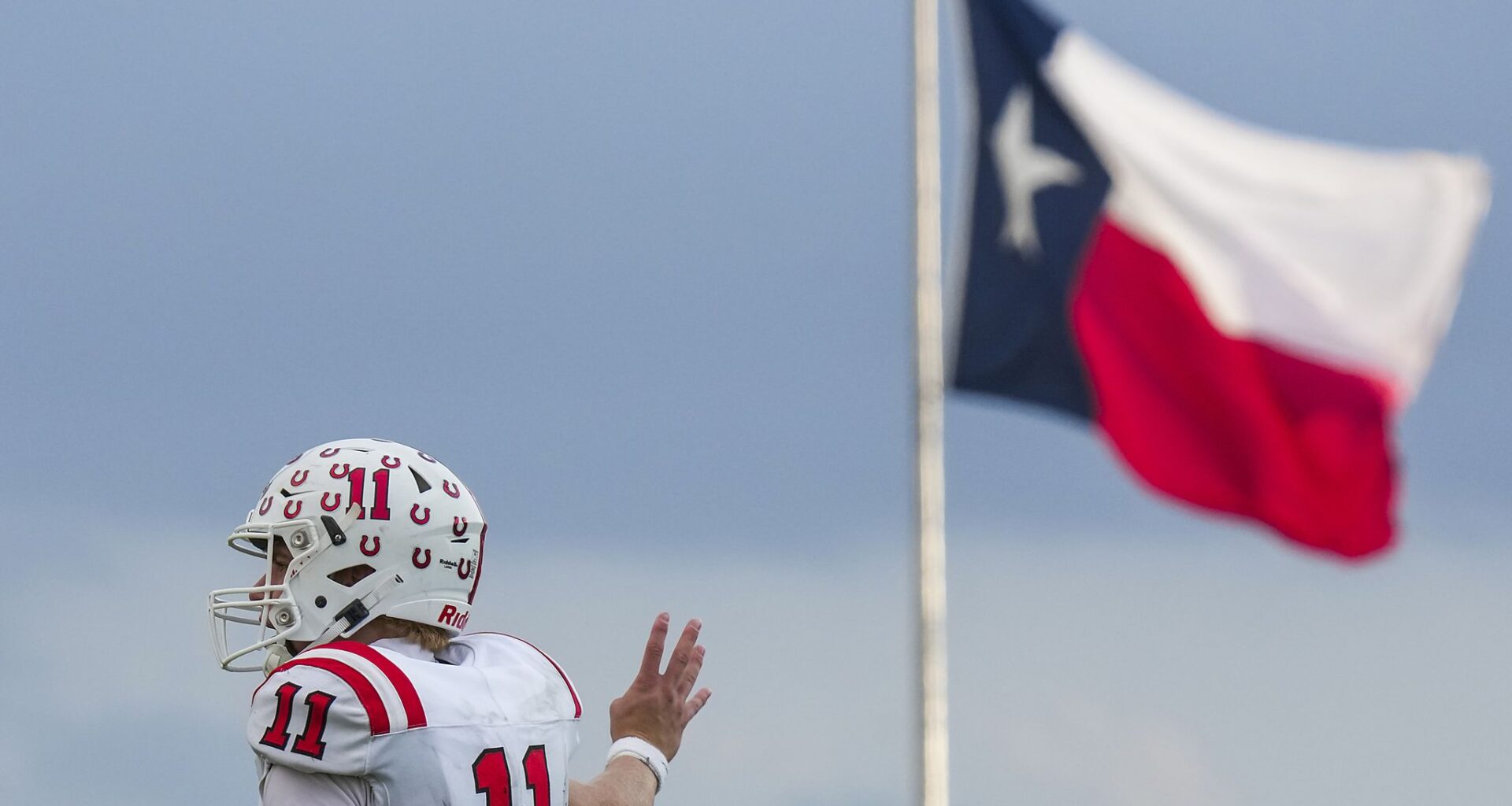
Coppell quarterback Carter Zingelmann motions to the bench during the second half of a Class 6A Division I Region I semifinal high school football playoff game against North Crowley on Saturday, Nov. 29, 2025, in Midlothian.
Smiley N. Pool/Staff Photographer
College sports today celebrate the five-year anniversary of the dawning of the name, image and likeness era, a seminal moment that enabled college athletes for the first time to make money from their brands.

The seismic evolution unfolding ever since has unlocked an athlete financial windfall. The 2026-27 NIL market is projected to reach $4.5 billion, according to data athlete marketplace Opendorse shared with The Dallas Morning News. The average SEC school’s annual budget is now $44.5 million. The going rate for a Power 4 conference starting quarterback is upwards of $2 million.
But as a more professional enterprise takes shape in college athletics, a much different NIL landscape is evolving at the high school level: A patchwork of state laws, colliding political forces, tensions throughout the public school ranks and a broad spectrum of ever-changing regulations.
Article continues below this ad
Yes, high school athletes can make money, if they reside in certain states, but not Texas — for now. Despite a surplus of talent, as much as any state nationwide, Texas has one of the country’s most restrictive NIL laws. A Texas high school athlete who is 17 or older can sign an NIL agreement with a college but cannot receive compensation while competing in University Interscholastic League sports.
Over the next several months, The News will peel back the curtain on this polarizing issue in an occasional series examining the breadth and depth of the Texas high school athlete financial market, the far-reaching implications of the law and the political hurdles standing in the way of more permissive regulations, which some believe Texas needs to enact or risk losing the best talent to states with less restrictive rules.
The series will also explore fundamental questions, such as whether teenage athletes should be permitted to make money from brand deals, what guardrails are necessary and what can be done to increase financial literacy for high school athletes and families.
Consider Beckham Black, the fourth-ranked basketball prospect nationally in the Class of 2027. After his stepfather, David Peavy, coached Duncanville to the 6A Division I state title in 2025, he moved to Florida to coach Southeastern Prep Academy, and Black followed. There, high school athletes can monetize their brands if the deals are not affiliated with teams, schools or the Florida High School Athletic Association.
Article continues below this ad
And the 17-year-old Black certainly has, more than a year before he steps foot on a college campus.
In June, Black signed a first-of-its-kind merchandising deal with ESPN and SportsCenter NEXT, making him one of the faces of ESPN’s new commerce brand.
“Blessed to be one of the first NIL athletes,” said Black, who has an NIL valuation of $1.2 million, according to the recruiting website On3.
But some say the integrity of high school sports is at stake, lest they follow college sports model: an annual free agency where athletes transfer at will to play for the highest bidder.
“You are hopping from program to program or money to money,” said Lee Wiginton, football coach at five-time state champion Allen. “Then there is no sense of community, there is no sense of taking pride in the program that you are playing for, and that would break my heart if it gets to that point.”
Article continues below this ad
Amid a wide range of high school NIL rules state by state, Texas presents a case of dollars deferred. Nationally, it’s a land of confusion.
“Families of elite prospects certainly face a confusing environment because their rights often depend entirely on where they live,” Syracuse, N.Y.-based Daniel Greene, a leading NIL attorney with a focus on high school laws and athlete representation, told The News.
“In some states, high school athletes can monetize their name, image and likeness while maintaining eligibility. In others, NIL is prohibited altogether. And in still others, rules continue to change as legislatures and state athletic associations wrestle over what high school NIL should look like.”
NIL changed everything in Texas
It is hard to beat the level of high school talent in Texas, especially in football.
Article continues below this ad
The state possesses 12 of the top 100 recruits in the Class of 2027, the most for any state and one more than Florida and three more than California.
The nation’s top two recruits reside in the Dallas area — Cedar Hill defensive lineman Jalen Brewster (committed to Texas Tech) and North Crowley cornerback John Meredith III (committed to Texas). It is the second straight recruiting class in which Texas has the nation’s No. 1 player, and it is the fourth in a row in which a top-five national recruit has been from the Lone Star State.
Cedar Hill running back Jalen Brewster (32) celebrates after scoring a touchdown during the second half of a district 11-6A game against Lancaster, Friday, Sept. 27, 2024, in Lancaster, Texas. Lancaster defeated Cedar Hill 41-35 in overtime.
Elías Valverde II/Staff Photographer
Texas high schools led all states with 33 players selected in April’s NFL draft, and Austin Westlake was one of 11 high schools nationwide that had multiple players drafted (two). It is the fourth time since 2020 that Texas finished with the most players selected, according to MaxPreps, and over the past nine NFL drafts (2018-26), high schools from Florida (269 players) and Texas (266) have had the most players selected.
Flashback just a few years, when top Dallas-area basketball players were choosing to remain in Texas.
Article continues below this ad
Tyrese Maxey of South Garland, now a two-time NBA All-Star for the Philadelphia 76ers, turned down opportunities in Virginia, Florida, Kansas, Nevada and Indiana and stayed at his hometown public school. Future NBA players RJ Hampton of Little Elm and Jahmi’us Ramsey of Duncanville also spurned offers from basketball-centric schools.
But along came the NIL era, which prompted some to move to states where they can start making dollars off their brands in high school.
In 2024, Texas high school basketball expert Craig Smith compiled a list of 13 elite boys basketball recruits in the Class of 2025 and 2026 who left Texas to transfer to schools in Florida, Missouri, Kansas, California and Arizona. All 13 went to states that allow some form of NIL at the high school level.
Among the most prominent was five-star Texas basketball signee Tre Johnson, who went from 2023 Class 6A state champion Lake Highlands to Link Academy in Missouri. Johnson, now with the Washington Wizards, moved to a state where NIL is permitted and quickly signed an agreement with Irving-based Panini, a trading card company that sells licensed collectibles.
High school athletics is big business and can put dollars in the pockets of the elite athletes themselves — if they reside in the right state.
Article continues below this ad
“Obviously there are a lot of concerns associated with giving access to that kind of money to high school students, but I believe the way to manage those risks is not by outlawing it but by trying to manage it,” Sam Ehrlich, a Boise State sports law professor and one of Silver Waves Media’s top 80 most influential figures in the NIL space, told The News.
“Coogan-like laws are necessary at this point,” he added, referring to a law requiring 15% of a child’s earnings from entertainment-related work to be placed in a blocked trust account.
Texas guard Tre Johnson (20) dunks against Xavier forward Zach Freemantle (32) during the first half of a First Four college basketball game in the NCAA Tournament, Wednesday, March 19, 2025, in Dayton, Ohio. (AP Photo/Jeff Dean)
Jeff Dean/AP
‘An important shift nationally’
Almost all states — except for Alabama, Wyoming, Hawaii and Mississippi — allow some form of high school NIL. Indiana in May became one of the latest states to allow some opportunities, beginning in 2026-27.
But considerable variation exists from state to state.
As the NIL attorney Greene detailed, differences include who is eligible, when compensation may be received, what types of agreements are allowed, what restrictions apply, and whether governing rules are established by state law or by the state’s high school athletic association.
For the past several years, Greene was among industry experts who believed it was only a matter of time before every state permitted some form of high school NIL. The driving force behind that prediction? Competition.
Interscholastic athletic associations have long tried to keep talent from leaving the state. And there was a growing belief that ones with NIL prohibitions would feel pressure to relax their rules so they would stop losing top prospects to neighboring states that allowed athletes to monetize their brands.
That seemed to be the natural trajectory, Greene said, but developments this year suggest the winds of change are blowing in a different direction.
In South Carolina, for example, when House Bill 4163 goes into effect next year, interscholastic athletic associations will not be allowed to serve public schools unless they have a rule prohibiting NIL. Wyoming’s Senate File 53, which took effect Wednesday, bans NIL statewide.
After the Ohio High School Athletic Association voted last year to permit high school NIL, lawmakers became divided. The takeaway: The debate is no longer confined to athletic associations. It has become a legislative issue.
“That is an important shift nationally,” Greene said. “Historically, most states have addressed high school NIL through their state high school athletic associations, which generally have broad authority to establish eligibility rules. Increasingly, however, some state legislatures appear to view NIL as too significant a policy issue to leave solely to those governing bodies.
“Whether the legislature is expanding NIL rights, restricting them, or prohibiting them altogether, elected officials are increasingly asserting control.”
Duncanville’s Beckham Black (0) and Christopher Hunt Jr celebrate their victory over Allen, 77-74 in the UIL Class 6A Division I state semilfinal boys basketball game played on March 4, 2025 at Coppell high school in Coppell. (Steve Nurenberg / Special Contributor)
‘This is not amateur athletics anymore’
Texas lawmakers have faced a tricky environment as the NIL era progressed in recent years.
Elite prospects were increasingly leaving Texas to play in states with more permissive rules. At the same time, some believed the law needed safeguards to prevent NIL from becoming a recruiting tool for high schools.
Tarrant County Rep. David Lowe has been among the most outspoken advocates for allowing high school NIL.
“The world of athletics is changing,” the North Richland Hills Republican said in a statement to KBTX News. “NIL rights are here to stay, and Texas cannot afford to be left behind.”
After the Texas Legislature approved the narrow NIL law last year, Brandon Creighton, a former state senator and now the chancellor of the Texas Tech University System, emphasized guardrails. He contends that restrictions help prevent recruiting abuses.
“We are creating some common sense … making sure that no athletes under 17 years of age will be eligible for an NIL agreement,” Creighton told FOX 4 News.
Texas provides a case study in nuances that can exist even in states that recognize some form of high school NIL.
Rather than broadly allowing or banning high school NIL, Greene said, Texas adopted the narrow approach. It permits certain 17-year-old high school athletes to enter into NIL agreements but generally delays compensation, if they want to play in UIL competition, until after they enroll in college and begin participating on their college sports teams.
For elite Texas prospects who are receiving significant and often highly complex NIL agreements, Greene said, these “statutory nuances can have enormous legal consequences.” All the more reason, he said, why legal counsel and careful analysis of contracts are critical.
Shifting sands of NIL a slippery slope
Leading figures in Texas high school football are steadfast about drawing a line in the shifting NIL sands.
Joe Martin, the Texas High School Coaches Association executive director, does not have an issue with athletes making money from their brands, but only if they are in college. He opposes Texas law changing to allow that at the high school level.
“This is not amateur athletics anymore, and we are trying to keep and maintain that amateur status at the high school level,” Martin told The News last year. “I do believe that kids ought to be paid to play collegiately. I do believe in the new [Texas] law that was established with NIL where a high school senior that is 17 years old and soon to graduate can negotiate a contract.”
RELATED: Texas football coaches worry about NIL at high school level, but it might be inevitable
North Forney football coach Marcus Shavers said he is fine with NIL, but only if it allows an athlete to earn money only from their NIL. He doesn’t want to see high school sports turn into the college version of NIL and revenue-share contracts.
Beginning last summer, colleges were permitted for the first time to share as much as $20.5 million annually with their athletes, which will increase to $21.3 million next season. This financial allotment is in addition to other NIL deals college athletes can secure.
“It has taken a different turn on the college level, and now it’s more of a pay-for-play, as opposed to being paid for my name, image and likeness,” Shavers said. “I would not be a fan of it if there weren’t some type of overbearing, universal rules that would allow us to preserve what it is that we have, which is the greatest high school football in the United States of America [in Texas].”
Wiginton, the Allen coach, said he can’t wrap his mind around what NIL would look like in Texas.
“I’m trying to stay under a rock until it happens,” he joked. “I’ve got to think that once you start NIL, you probably start stuff like a one-time transfer, and now all of a sudden you are in the transfer portal.”
Allen head coach Lee Wiginton looks on from the sidelines during the first half of a Class 6A Division I state semifinal.high school football playoff game against Duncanville on Saturday, Dec. 13, 2025, in Mesquite.
Smiley N. Pool/Staff Photographer
In the high school ranks, confusion and inscrutable, ever-changing regulations rule the day. For the can’t-miss prospects, money can be big, implications can be far-reaching. But it all depends on where one resides.
And in talent-rich Texas, athletes confront NIL regulations as limiting as almost any state nationwide. Barring Congressional legislation regulating NIL, Greene doesn’t anticipate a level playing field taking hold nationally anytime soon.
“Until then, education remains the single most important component of successfully navigating the high school NIL era,” Greene said. “Athletes, parents, coaches, schools, and businesses all need to understand the applicable state laws, athletic association rules, and contractual obligations because those legal nuances can make the difference between a compliant NIL opportunity and one that jeopardizes eligibility.”