
Physicist Michael Fausnaugh works with other physicists to identify new planet through
NASA’s TESS mission.
CREATORS

Michael Fausnaugh, assistant professor in the Department of Physics & Astronomy at Texas Tech University, is part of a group of researchers who have identified a planet orbiting a distant
star, according to a news release from NASA.
Fausnaugh and astronomers from the University of New Mexico are authors of a paper
explaining the findings, which were made possible through the use of NASA’s TESS (Transiting
Exoplanet Survey Satellite). The planet, called Gaia23bra b, was initially discovered
in 2023 using the European Space Agency’s now-retired Gaia space telescope and is
described as a super Jupiter orbiting far from its host star.
“We had a background star with a foreground star in front of it magnifying its light,”
Fausnaugh said. “If there’s a planet orbiting the foreground star, you can see the
signature of the planet through gravitational microlensing. The technique is well-established,
but we had never done it with TESS, and the unique thing about TESS is it takes images
every couple of minutes.”
After Gaia had initially flagged a star brightening, researchers went back through
the archived TESS data and found the event had been captured there as well.
The team’s analysis is scheduled to be published in The Astrophysical Journal Letters. According to the findings, the planet orbits an orange dwarf star that’s about 80
percent of the sun’s mass and is nearly 40,000 light-years away from Earth.
“In order to find planets, we have very limited ways of detecting them, and most of
the planets we’ve found so far have been what you might consider the easy planets
to find,” Fausnaugh said. “The problem is those planets are close to the stars, and
they go around the stars very quickly.
 Texas Tech University physicist Michael Farsnaugh is part of an international research
team that used NASA’s TESS satellite in a new way to help confirm the existence of
a distant “super Jupiter” exoplanet nearly 40,000 light-years from Earth. The discovery demonstrates the
potential of combining gravitational microlensing with TESS observations to detect
planets more closely resembling those in our own solar system, expanding astronomers’
ability to study previously hard-to-find worlds.
“Then there’s others that are Jupiter size, but they’re so close to the star that
they are also very hot. They don’t match what we have in our solar system.”
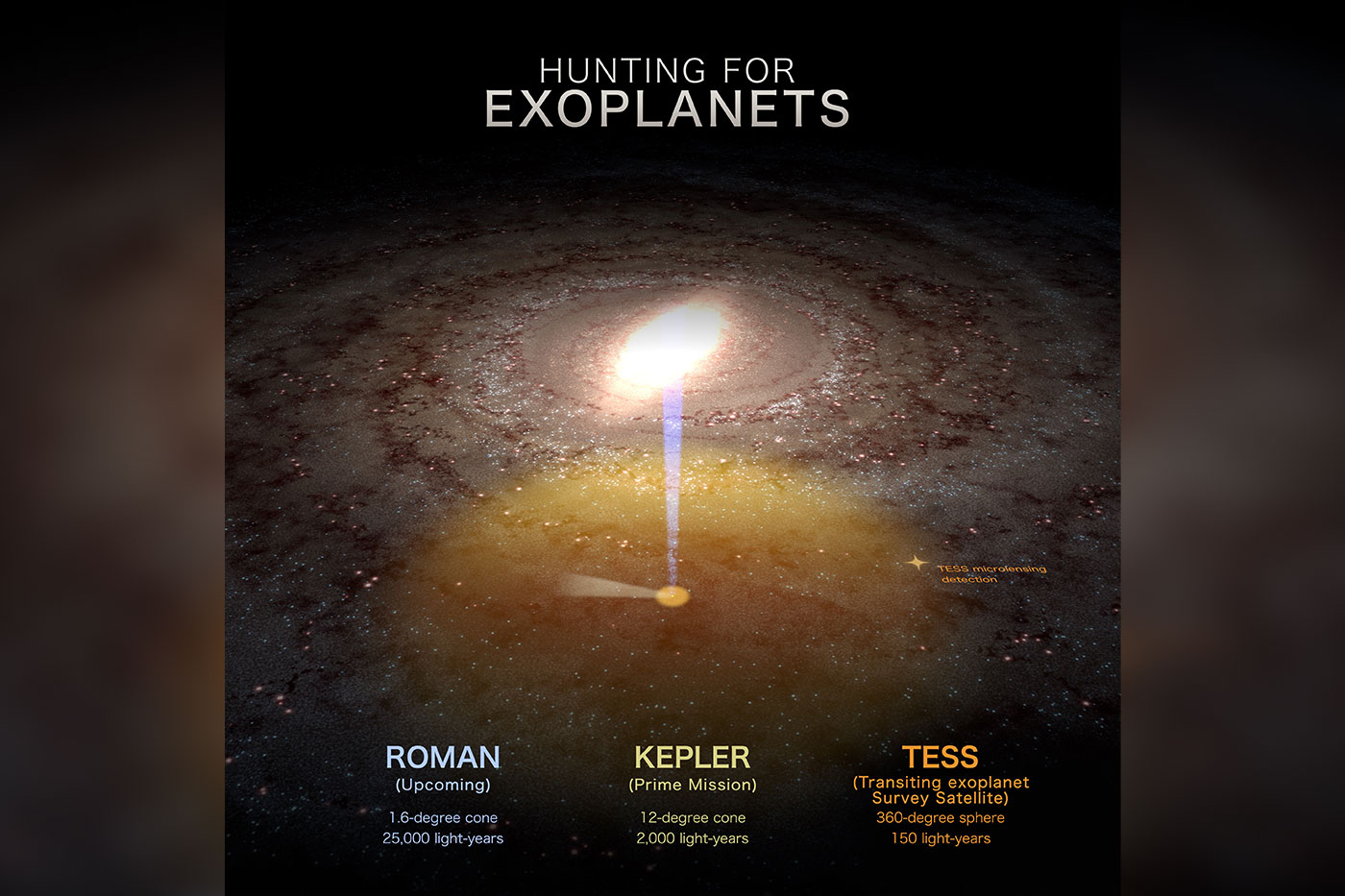
Out of more than 6,000 known exoplanets, worlds outside our solar system, about 75%
were discovered through the transit method, the typical technique employed by TESS.
Astronomers monitor numerous stars looking for those that periodically dim as orbiting
planets cross in front of them. This is known as a transit.
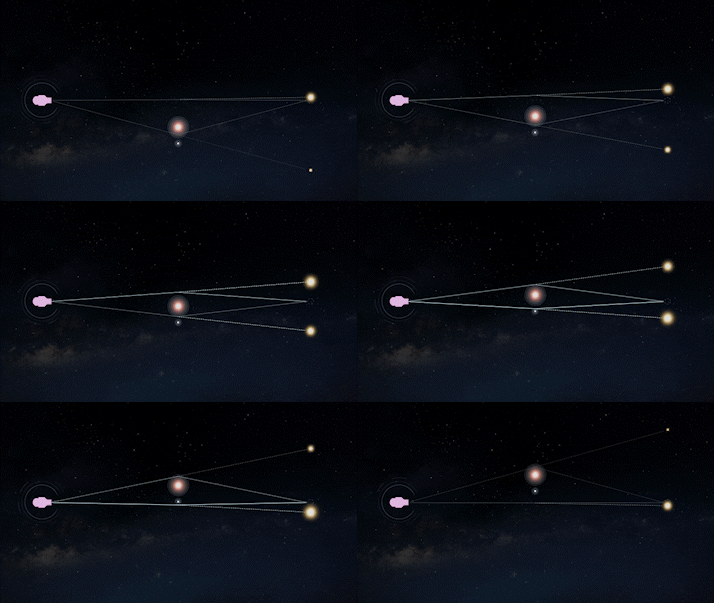
Meanwhile, microlensing has revealed less than 5% of known exoplanets. This occurs
when two stars align closely with light from the more distant star curving as it travels
through the warped space time caused by the nearer star’s miss. If the alignment is
especially close, the nearer star acts like a lens, focusing and magnifying light
from the background star.
The transit method is best at finding large planets orbiting very close to their host
stars; large planets block the most starlight, while close-in planets are more likely
to pass in front of the host star. These extremely hot worlds are fascinating to scientists,
but astronomers want to find planets like those in our solar system, too. Gravitational
microlensing is best at detecting planets like Jupiter and Saturn, which are massive
and orbit further from their host stars.”
“Astronomy really sparks the imagination,” Fausnaugh said. “There’s always this gap
between the data and the interpretation. It can be a complicated and technical process,
but here, our best physical description of this star system says, ‘There’s a planet
up there.’”