
LUBBOCK, Texas (KCBD) – A Texas Tech University physicist is part of an international research team that used NASA’s planet-hunting satellite in a new way to confirm the existence of a distant exoplanet nearly 40,000 light-years from Earth.
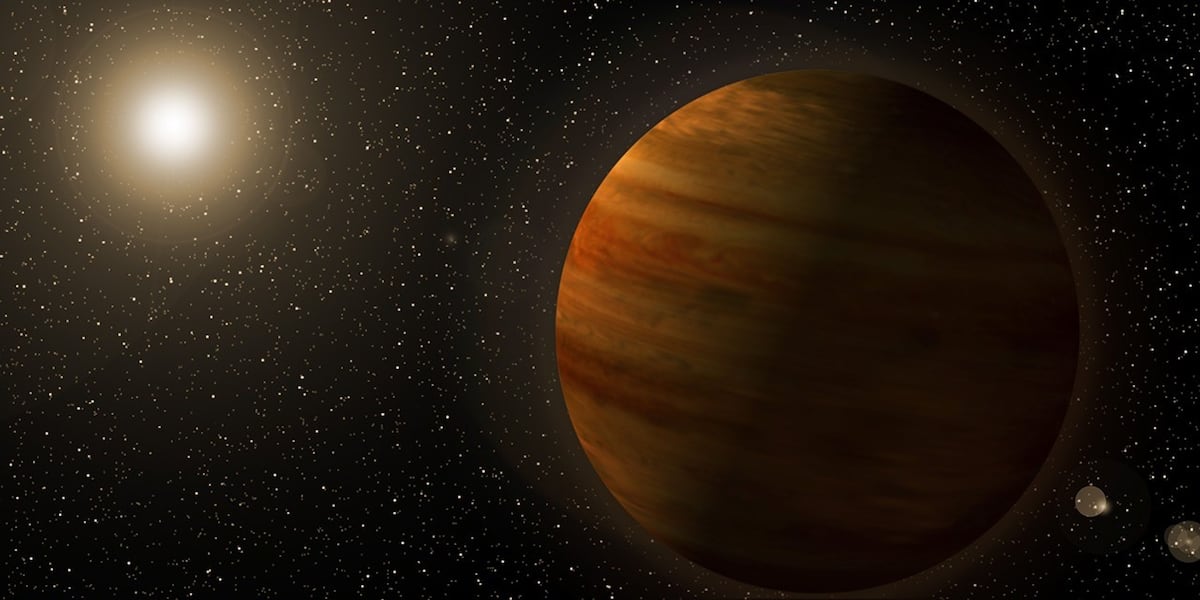
Michael Fausnaugh, an assistant professor in the Department of Physics & Astronomy, and astronomers from the University of New Mexico used NASA’s TESS — the Transiting Exoplanet Survey Satellite — to help confirm a planet initially flagged by the European Space Agency’s now-retired Gaia space telescope in 2023. The planet, called Gaia23bra b, is described as a super Jupiter orbiting far from its host star. The team’s findings are scheduled to be published in The Astrophysical Journal Letters.
The detection relied on gravitational microlensing, a technique that uses the gravitational pull of a foreground star to magnify light from a more distant background star. If a planet orbits the foreground star, its presence can be detected through that magnification.
“We had a background star with a foreground star in front of it magnifying its light,” Fausnaugh said. “If there’s a planet orbiting the foreground star, you can see the signature of the planet through gravitational microlensing. The technique is well-established, but we had never done it with TESS, and the unique thing about TESS is it takes images every couple of minutes.”
After Gaia flagged a star brightening, researchers searched archived TESS data and found the event had been captured there as well.
The planet orbits an orange dwarf star estimated at about 80% of the sun’s mass. According to the findings, the system is nearly 40,000 light-years from Earth.
Of more than 6,000 known exoplanets, about 75% were discovered through the transit method — the technique TESS typically uses — in which astronomers monitor stars for periodic dimming caused by an orbiting planet passing in front of them. Microlensing has revealed less than 5% of known exoplanets.
The transit method is most effective at finding large planets orbiting close to their host stars. Gravitational microlensing is better suited to detecting planets like Jupiter and Saturn — massive worlds that orbit farther from their stars.
“In order to find planets, we have very limited ways of detecting them, and most of the planets we’ve found so far have been what you might consider the easy planets to find,” Fausnaugh said. “The problem is those planets are close to the stars, and they go around the stars very quickly. Then there’s others that are Jupiter size, but they’re so close to the star that they are also very hot. They don’t match what we have in our solar system.”
Fausnaugh said the discovery reflects the broader significance of the work.
“Astronomy really sparks the imagination,” he said. “There’s always this gap between the data and the interpretation. It can be a complicated and technical process, but here, our best physical description of this star system says, ‘There’s a planet up there.’”
Copyright 2026 KCBD. All rights reserved.