
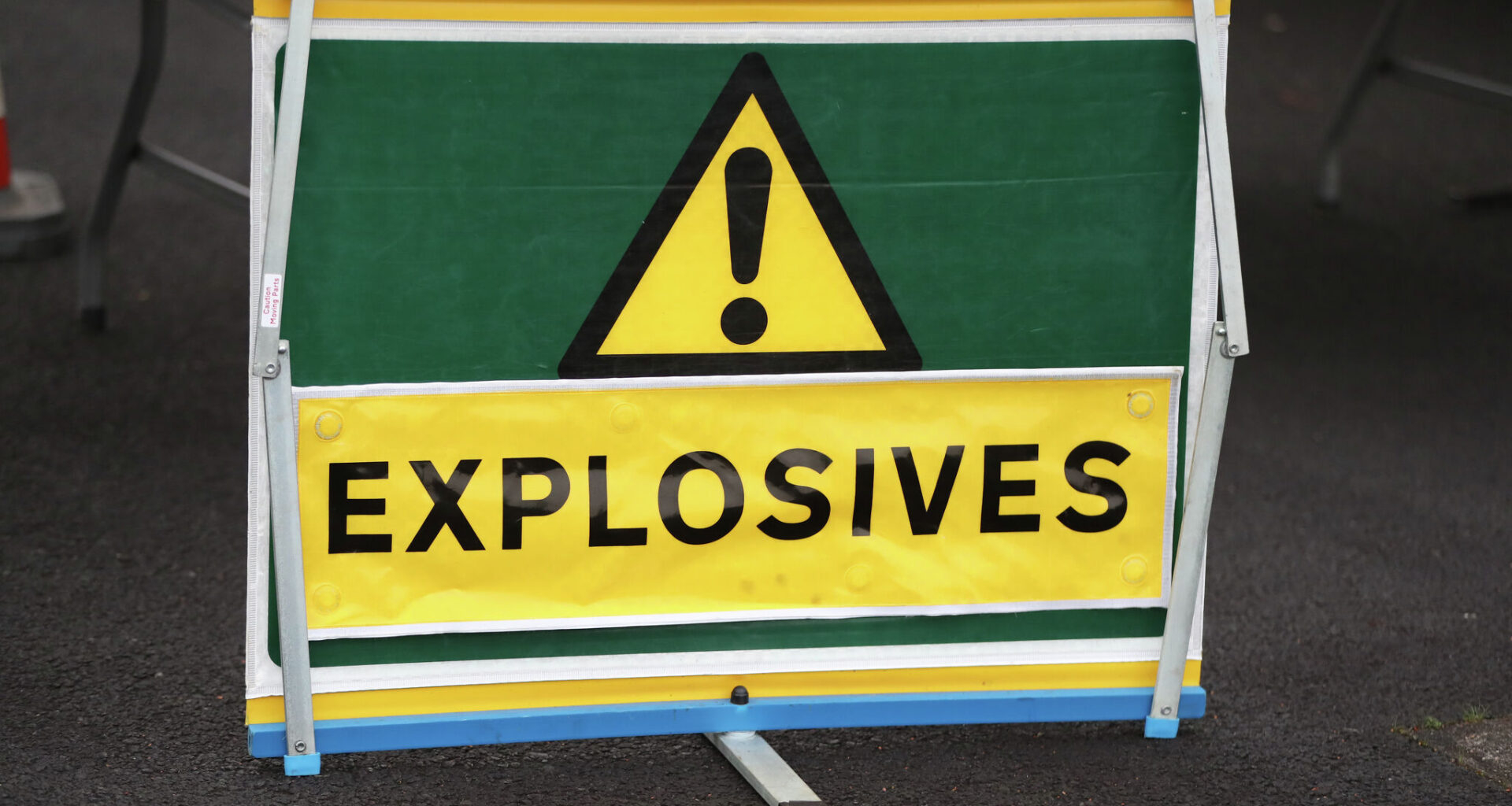
An sign denoting potential explosives. Did an old naval mine wash up on a beach near Galveston, Texas recently?
Niall Carson – PA Images/PA Images via Getty Images
As internet time sucks go, one of the stickiest we’ve seen lately is the subreddit r/whatisit. Here, users post images of unidentified objects and others attempt to identify them, often hilariously.

A few days ago, user @Livid_View_6363 posted a photo of a vaguely football-shaped object with two bands of spike-like protrusions, which demolition experts would recognize as contact horns. Sometimes they’re called Hertz horns or chemical horns, but whatever the term, they’re what trigger a mine’s explosive charges. The only information the Redditor chose to share was that it had been “found on the beach in Texas near Galveston.”
Article continues below this ad
In the comments, the prevailing opinion was that the object was indeed an undersea mine. Still, @ButterscotchOdd8257 suggested, “If it’s not a mine, and they don’t take it and blow it up or confiscate it, call your local historical society.”
A member of the Royal Canadian Navy’s mine-disposal team in 1942
Toronto Star Archives/Toronto Star/Getty Images
Anyway, “near Galveston” does a lot of heavy lifting. Absent further details, the purported mine could have also been found near Crystal Beach, San Luis Pass, or Surfside. Chron inquired with Visit Galveston, the city’s tourism division, which passed our questions over to the Galveston Island Beach Patrol.
Its chief, Lt. Austin Kirwin, told us no one has reported any antique, unexploded naval weaponry lately, at least not at any of the beaches his lifeguards supervise.
Article continues below this ad
“I hope they called the bomb squad,” Visit Galveston Director of Communications Chris Stanley added, echoing quite a few Reddit users.
On a whim, Chron ran the photo through Google Images. Some of the better suggestions included a vintage Gregorian copper hammered candle holder; a “robot pumpkin” steampunk Halloween decor; and our favorite, a bronze ‘mythical beast-form’ censer (i.e. incense burner) from Sotheby’s with an estimated worth between $3,000 and $5,000. There were a couple of ancient-looking mines in there, too.
Eventually, the image migrated over to a different subreddit, r/EOD. ‘EOD’ stands for Explosive Ordnance Disposal, and its users seemed to know their stuff. Their opinions were blunt and exacting.
Article continues below this ad
“Looks like some bullshit to me—like someone tried to make an object that looked like a sea mine from memory,” the subreddit’s moderator, @Initial_Success, offered. “I don’t see any type of extender or any arm/disarm mechanism. No anchoring system (at least from this angle). Horns look whack [sic] and neither tilt nor chemical [other types of detonators].”
“To my untrained eyes, this looks like a prop,” agreed @PandorasFlame1. “Someone saw naval mines and mashed them together with a pineapple grenade to create a scary object.”
Equipped with a single mine, a primitive undersea craft known as a “Turtle” was deployed—unsuccessfully—during the Revolutionary War.
Photo12/Universal Images Group/Getty Images
“Would be hard pressed to call it ordnance,” added fellow mod @bkit627, whose screen name added USN EOD, aka Navy demolitions. “S–t welds and those don’t appear to be any chem/contact horn I’ve ever seen.”
Article continues below this ad
Chron reached out to @Livid_View_6363 but hasn’t heard back (perhaps understandably). This mine, if that’s what it was supposed to be, might not have been real, but according to two Texas A&M oceanographers, it certainly could have been.
In September 2012, A&M professors William Bryant and Neil Slowey estimated that millions of pounds of unexploded bombs and other ordnance remained in the Gulf of Mexico, as well as offshore of at least 16 U.S. coastal states including Hawaii and New Jersey. The professors were preparing to speak at the International Dialogue on Underwater Munitions, a conference in Puerto Rico organized by the Canadian nongovernmental organization of the same name.
Mine-shaped memorial at the Norwegian Maritime Museum
PHAS/Universal Images Group/Getty Images
Bryant told the Texas A&M Stories website that unexploded undersea ordnance was—and, presumably, still is—so commonplace that he initially thought it had caused the Deepwater Horizon explosion, then still fresh in people’s minds after nearly two and a half years. He estimated that at least 31 million pounds of unexploded materiel had been dumped in the Gulf since World War II, but also admitted “that could be a very conservative estimate.”
Article continues below this ad
The practice was finally banned in 1970, but not before an untold amount of munitions, including chemical weapons, had been abandoned on the sea floor. Bryant had personally visited several dump sites between 60 and 100 miles off the Texas coast, he said, and another not far from the Mississippi River delta where shrimpers had recovered drums of mustard gas in their nets.
Some of this unexploded ordnance, UXO in military-speak, weighed between 250 and 1,000 pounds (the larger bombs could be the size of filing cabinets). Perhaps most troublingly, no one kept track of UXO discarded outside the military’s designated dumping areas, but that definitely happened.
“Record keeping of these dump sites seems to be sketchy and incomplete at best,” Bryant said. “Even the military people don’t know where all of them are, and if they don’t know, that means no one really knows.”
Article continues below this ad