
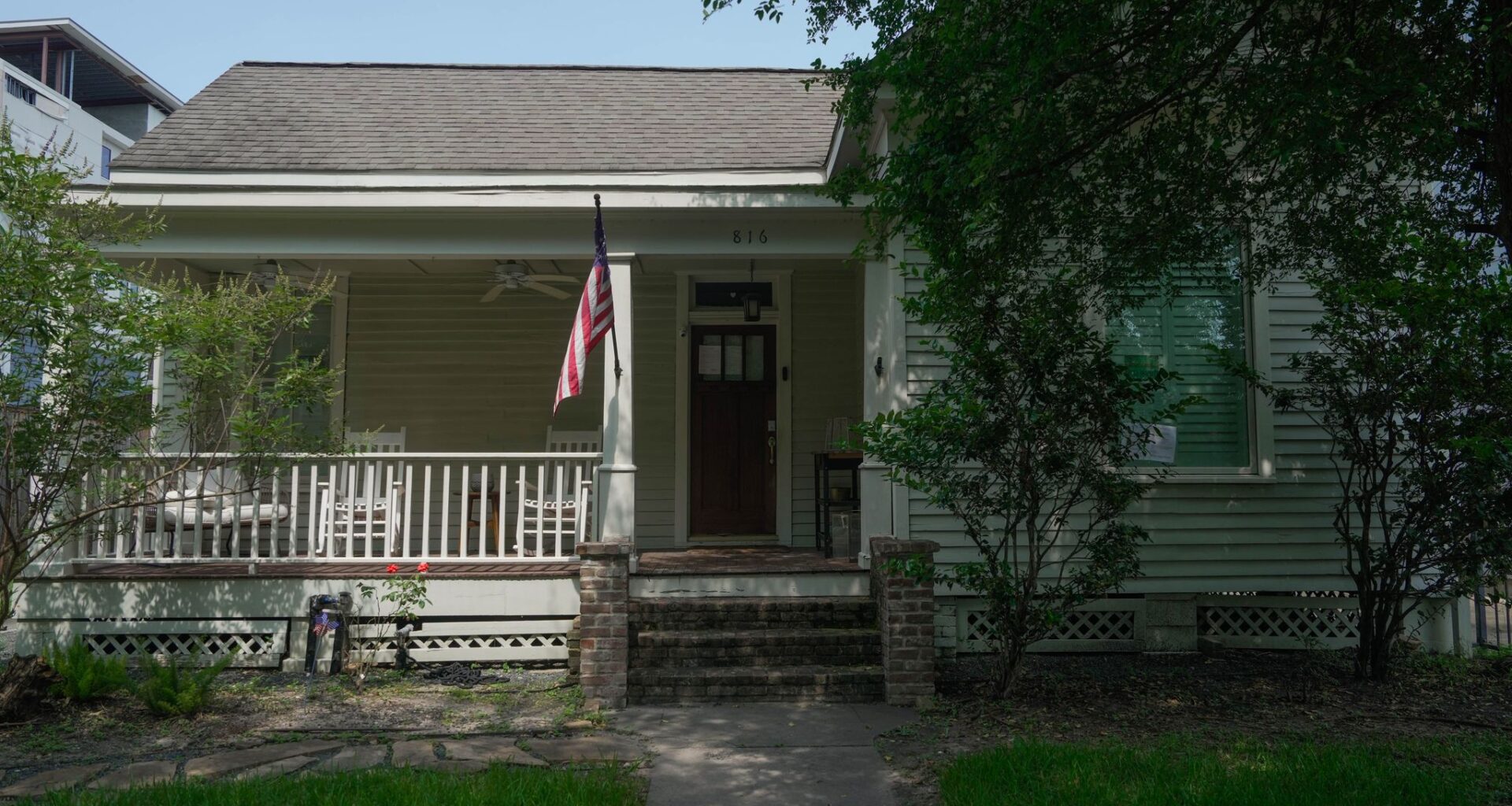
Documents pertaining to a squatting dispute appear in the windows and doorway of Lee Gilley’s residence on Thursday, June 25, 2026, at 816 Allston Street.
Raquel Natalicchio/Houston Chronicle
Mourners gather during a candlelight vigil honoring Christa Gilley at Marmion Park in the Heights on Tuesday, Oct. 15, 2024, in Houston.
Karen Warren/Staff photographer
Houston Police tow a vehicle as they execute a search warrent at Lee Gilley’s home in Houston on Wednesday, May 6, 2026. Gilley, who sought asylum in Italy, faces the murder charges for his wife, Christa.
Elizabeth Conley/Houston Chronicle
A security camera outside of the home that Matthew Jackson exerted ownership of in 2025 is pictured on June 25, 2026, in the 8200 block of Glen Valley Drive.
Raquel Natalicchio/Houston Chronicle
A home that Matthew Jackson exerted ownership of in 2025 is pictured on June 25, 2026, in the 8200 block of Glen Valley Drive.
Raquel Natalicchio/Houston Chronicle
The house on Allston Street had changed since Christopher Bauer left it in May.
No one had lived at the century-old Heights home since its lone occupant, Lee Gilley, fled the country on May 1 to seek asylum in Italy ahead of his capital murder trial. After that, the home where police said Gilley killed his pregnant wife — Bauer’s daughter Christa Gilley — in October 2024 garnered at least one visit from authorities to learn more about his escape.
Bauer checked on the home on May 13 as he braced for the possibility that a judge would force his grandchildren to return to Houston as part of a bitter child custody dispute. When the South Carolina restaurateur returned on June 17, he discovered someone had entered the home.
Article continues below this ad
Makeshift signs had been posted to the windows and doors from the inside, announcing new ownership and warning intruders to stay away. The locks had also been changed.
LEE GILLEY’S ESCAPE: Gaps in Harris County’s ankle monitor program helped Lee Gilley flee unnoticed
When a Houston police officer pounded on the door to see if anyone was inside, a voice through a generic doorbell camera that wasn’t there before claimed to be someone named Matthew Jackson — and the new owner of the house, Bauer testified at a recent court hearing in Harris County.
Court records reveal the takeover of the Gilley house was not an isolated occurrence.
Article continues below this ad
A dozen Harris County properties have been pursued by Jackson through a web of legal filings, according to a Houston Chronicle review of property records. The properties range in value from a $130,000 home to an apartment complex worth $17 million.
At least two homes are tied to homicide victims. They include the Gilley house in the Heights, and the River Oaks townhome where Travelers Table co-owners Matthew and Thy Mitchell died May 4 in a murder-suicide with their children.
Documents pertaining to a squatting dispute appear in the windows and doorway of Lee Gilley’s residence on Thursday, June 25, 2026, at 816 Allston Street.
Raquel Natalicchio/Houston Chronicle
The records show Jackson filed with the Harris County Clerk’s Office what he deemed to be affidavits of adverse possession on multiple homes — colloquially called squatter’s rights. He identified himself as a representative of out-of-state limited liability companies Save a Life Homes, Global World Enterprises and Nolan Realty Concierge.
The Gilley home had been empty for less than a week before Jackson had his affidavit of adverse possession notarized. He filed it with the county clerk’s office on May 21.
Article continues below this ad
It was another four weeks until Bauer returned to the home and discovered what had happened.
Jackson filed his affidavit on the Mitchell townhome on the same day as the Gilley property. The townhome was void of signage or outside interference last Thursday, unlike the Gilley house.
Documents pertaining to a squatting dispute appear in the windows and doorway of Lee Gilley’s residence on Thursday, June 25, 2026, at 816 Allston Street.
Raquel Natalicchio/Houston Chronicle
No one came to the door or answered the doorbell camera when the Chronicle visited the Gilley home. An attorney for Bauer, the administrator of Christa Gilley’s estate, attached an affidavit of his own to the door to give law enforcement permission to enter the home and force anyone out who shouldn’t be there.
‘Unsuspecting homeowners’
The possessions stem from a legal principle that one party can occupy land that another party owns and claim it as their own after a period of consistent use — typically 10 years.
Article continues below this ad
A former Harris County prosecutor who frequently handled land-theft cases in criminal court said the schemes are common.
“Oftentimes, when homes are abandoned, the house just sits,” said Valerie Turner, now a Fort Bend County prosecutor. “When they’re unoccupied, they’re in danger of an adverse possession claim or forged deed.”
To take possession of a house, someone must not only live there for the required time — without intervention — but also pay the taxes and take care of the property, Turner said. After all that, they can file suit with any potential owner of the property to obtain a judge’s ruling to complete the claim and take legal possession of the home.
MORE COVERAGE: Houston’s restaurant community remembers Thy Mitchell: connector, supporter, ‘little ball of energy’
If someone doesn’t follow that path, they can face criminal prosecution. The Harris County Attorney’s Office can also investigate reports of fraud for potential civil claims — as they are now in Jackson’s case, County Attorney Abbie Kamin said.
Article continues below this ad
One of Kamin’s predecessors filed a lawsuit in 2025 against a couple who claimed ownership of at least 37 properties with fraudulent deeds filed with the clerk’s office only to then sell the homes to unsuspecting buyers.
A judge voided the deeds and barred the duo from filing property documents in the future, records show. One of them pleaded guilty to felony theft last month and was sentenced to five years imprisonment in connection with some of those homes.
“There’s a level of sophistication, preying upon unsuspecting homeowners,” Kamin said. “We’ve been seeing issues whether it’s in Pasadena, Sunnyside or the Heights.”
To prevent deed fraud from happening to others, Kamin recommended changes through the state legislature. Until that happens, homeowners with reports of deed fraud are advised to contact her office and consider hiring a lawyer.
Lee Mongerson Gilley and his defense attorney, Ed McClees, right, are shown in the 497th District Court at the Harris County Justice Center, 1201 Franklin, Thursday, Oct. 17, 2024, in Houston. He is charged with capital murder in death of his wife, Christa Gilley.
Melissa Phillip/Staff Photographer
David Tarantella, a retired justice of the peace, said the best remedy for the Gilley house is for someone with an interest in the property to pursue an eviction case. In this situation, that may be the current homeowner, Lee Gilley, whose timely return to the U.S. to stand trial remains uncertain.
“I think the only person who essentially has the title to the property is awaiting trial — I think he’s the only one who can get the ball moving,” Tarantella said.
A persistent litigant
Records show that Jackson frequently represents himself when it comes to taking over homes through various legal venues ranging from justices of the peace to the federal government.
A review of Jackson’s social media shows he started pitching himself as a financial counselor following his release from prison in 2020 on an earlier Bexar County aggravated robbery with a deadly weapon conviction. He fought the conviction before and after his release — sometimes with the help of a lawyer but more often without.
He posted about attending at least one real estate event in 2022, sharing screenshots of foreclosure lists in Harris County and surrounding counties. In 2025, he said authorities kicked him out of the Harris County law library in downtown Houston.
He’s also faced criminal allegations related to potential land grabs. Police arrested Jackson in Houston last year and again as recently as April in connection with trespassing onto other people’s properties.
A renter stumbled upon Jackson on May 31, 2025, inside a home in the 600 block of Edgebrook Drive when she returned to pick up her belongings before her lease ended. She had left about two weeks earlier as police investigated the disappearance of Victor Soliz, whose skeletal remains were found inside the home. His death was declared a homicide.
When the renter returned, the locks were broken and Jackson was inside with an unidentified man — neither of whom she knew. They refused to leave.
Police determined that neither of the men had permission to be there, but only Jackson was arrested. Prosecutors dismissed the case in October after Jackson completed 16 hours of community service and took a “decision making” educational course, according to court records.
He was booked again six months later on misdemeanor charges in connection to the Villa De Prado apartments in the 9300 block of Tallyho Road — which is home to around 100 units, including one where his mother lives in southeast Houston. He gained access to the leasing office on April 19 by showing a locksmith a purported trespassing affidavit, warranty deed and his identification before having him swap out the dead bolt.
The locksmith later told police that Jackson claimed to be the new owner of the apartment complex and that he had fired the property manager over email, according to court records.
Jackson moved to dismiss the charges of criminal trespass and mischief against himself on April 24, citing a lack of probable cause, before an attorney, Stuart Ladner, was appointed to represent him. He attempted to exert his ownership over the apartments that same week through the civil courts to no avail.
He is due back in court on July 23. His bond conditions in the new case require him to not commit another crime or “engage in any conduct that could result in his arrest.”
Following his latest arrest, Jackson listed a home on the National Register of Historic Places — a colonial revival home in Houston’s gated Courtlandt Place Historic District — as his address on bail paperwork.
Affidavits and lawsuits
It’s not known if Jackson attempted to possess the Edgebrook home through property records as he did with other properties.
His first documented attempt at a residential takeover in Harris County started in August 2025 and continues with legal proceedings in federal court. The home in question — a ranch-style in the 8200 block of Glen Valley Drive — used to belong to a man named Rogelio Villafana, who has since died.
A home that Matthew Jackson exerted ownership of in 2025 is pictured on June 25, 2026, in the 8200 block of Glen Valley Drive.
Raquel Natalicchio/Houston Chronicle
Jackson said he took possession of the home two years earlier after finding it listed on websites for vacant, foreclosed or abandoned homes, according to his affidavit of adverse possession. He claimed he began maintaining the yard, living at the home and securing utilities in his name.
His mother appeared to sign another affidavit standing by Jackson’s word.
No one appeared to be home Thursday when the Chronicle knocked and rang the same type of door camera found at the Gilley home, but a porch light soon turned on.
A car in the driveway that neighbors said had been stationary for months had a flat tire. And unlike the front yard, the backyard was overgrown with vegetation. A portion of the home that was visible from a neighbor’s property was in disarray — the backdoor was off its hinges and on the ground.
A home that Matthew Jackson exerted ownership of in 2025 is pictured on June 25, 2026, in the 8200 block of Glen Valley Drive.
Raquel Natalicchio/Houston Chronicle
Neither the city of Houston nor Harris County recognizes Jackson as the property’s rightful owner — that title belongs to a woman who tried but failed to challenge Jackson in August 2025 through the eviction process. She asked Jackson to leave the property with a note from Villafana’s daughter. Constable deputies attempted to serve Jackson at the home days later before posting an eviction order to the door.
Both sides appeared before Justice of the Peace Jo Ann Delgado for trial in September 2025, only for the judge to dismiss the case over jurisdictional issues.
Despite the dismissal, the homeowner now owes more than $12,000 in taxes on the property and is the target of a federal suit — along with the city and other authorities — lodged by Jackson as he continues to exert ownership over the property, records show.
Pattern of possession
City lawyers declared that the Glen Valley house was part of Jackson’s pattern of taking possession of properties without the lawful means to do so and have asked the federal judge hearing his suit to dismiss the claims against them.
The lawyers assert Jackson uses improper adverse possession methods to pursue the properties. In the case of the Glen Valley property, he didn’t live there long enough to qualify for adverse possession. He established water service at the home in July 2025 — about a year later than Jackson said he did in his affidavit, officials said.
The lawful owner “requested that water service be turned off and the meter locked because there was an authorized occupant residing in her home,” according to the city’s dismissal request. The city, however, re-established the utilities in the name of Save a Life Homes about a month later after Jackson somehow changed the ownership through the Harris County Appraisal District and provided Houston Public Works a copy of the warranty deed he earlier filed, according to court documents.
The city pointed to another home Jackson targeted around the same time as the Glen Valley property.
Police were dispatched to an Aug. 23, 2025, report of a suspicious person in the 11000 block of Prairie Walk Drive after a neighbor spotted a man at a home that had been vacant for five months. The officers detained Larry Henson at gunpoint. He said he had been homeless when Jackson found him living behind a washateria, according to an offense report filed by the city.
Jackson agreed to drop Henson off at a home if he paid him $800 rent and the water bill.
The officers attempted to reach Jackson through paperwork posted to the door. Other officers reviewed a since-suspended website for Jackson’s Save a Life Homes and deemed it “shady” and a “likely scam,” the police report stated.
The officers released Henson as they had no way to prove or disprove his right to be there and told him any rental agreement he had with Jackson’s company was “most likely not legitimate.”
Police returned a week later after the homeowner, who had moved out, learned from her real estate agent that Henson had been living inside the Prairie Walk residence for more than a month and refusing to leave. This time, the officers spoke to Jackson and called the Harris County District Attorney’s Office.
The prosecutor at intake initially accepted a criminal trespass charge against Henson but reversed that decision when Jackson sent the officer what he said was proof of ownership for the home.
Police suggested the homeowner could try evicting Henson through the courts, but that strategy was never pursued.
The home was foreclosed in March, with Henson still living there as of April, according to county records as part of a financial institution’s eviction effort.
A justice of the peace dismissed the eviction case on jurisdictional grounds after Jackson entered the suit as an interested party.
Despite the efforts of police, the homeowner, and a mortgage servicer, nothing has stopped Jackson from turning yet another empty home into an opportunity.