
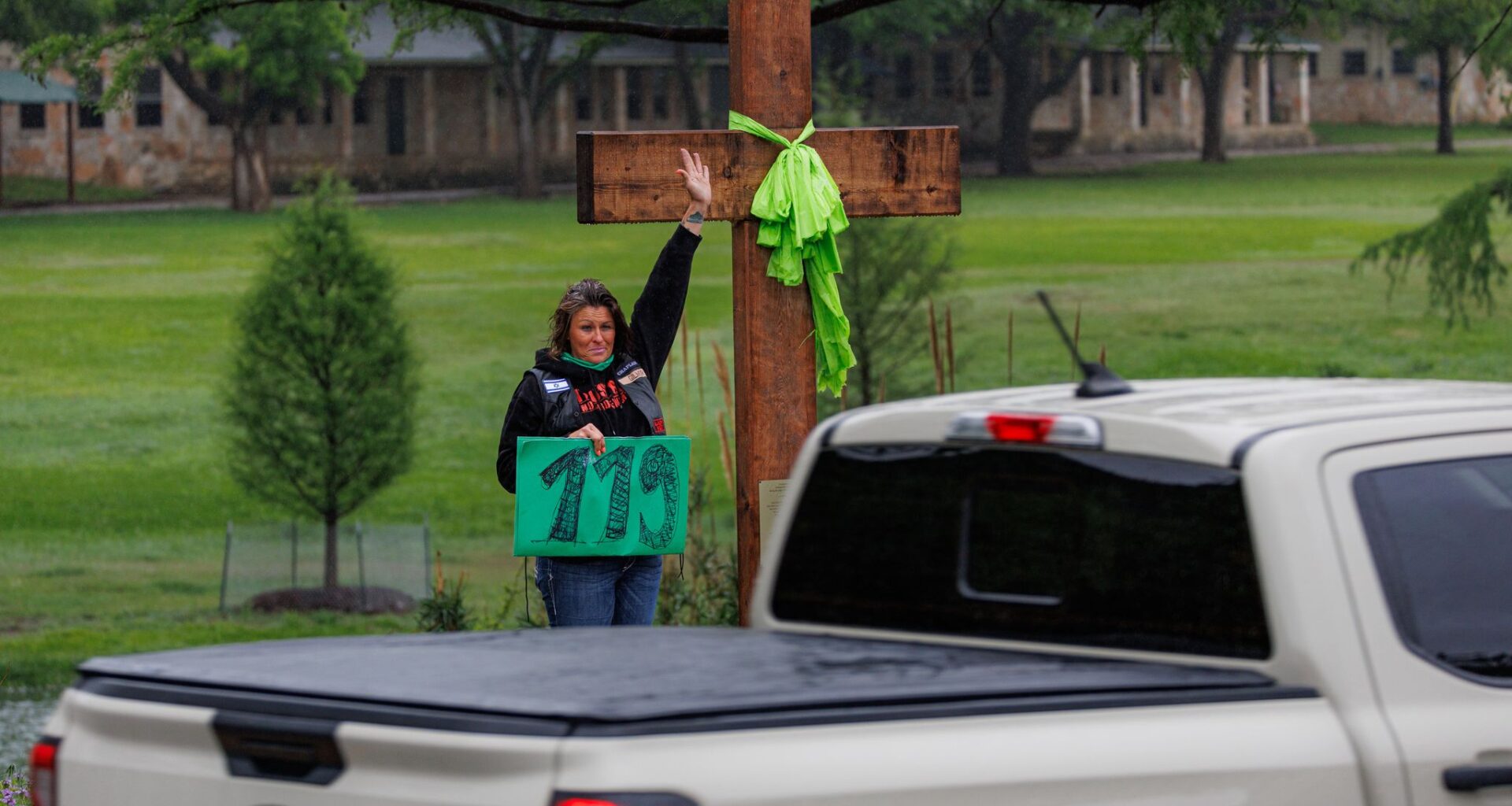
Kerr County residents stood along Highway 39 as legislators drove to Camp Mystic. They held signs memorializing all 119 who died in the county.
Sam Owens/San Antonio Express-News
The post popped up on Alicia Baker’s Facebook newsfeed when she was scrolling on her phone. By the time she looked, it already had dozens of comments, some from people she recognized.
“It’s been nearly a year since a devastating flood along the Guadalupe River killed more than 100 people in Kerr County,” read the post from a local Fox affiliate in early June. “Over the next 27 days, FOX 4 will share 27 updates on the children who died and how their legacy lives on.”
Baker read through the responses.
“There were 119 tragic losses!!!!!!!” one person wrote.
“I’ll remind you of their names,” someone else said, “since you can’t seem to remember.”
“You should fix your headline and stop acting like the politicians that have forgotten about the rest of our community.”
Article continues below this ad
Baker typed her own comment.
“Other children died, including my daughter who was 11,” she said. “This sentiment is wonderful but you’ve left out a whole group of people whose families are also grieving and ensuring their legacies live on.”
LOVE STORY: She hadn’t spoken to her ex-husband in 50 years. Then came the flood.
The 27 campers and counselors whom the television station promised to commemorate all died at Camp Mystic, the storied girls’ camp on the banks of the Guadalupe River. Their deaths became the focal point of national attention after the July 4 flood that killed 119 people in Kerr County and at least 135 across Texas.
Nearly a year later, many people in Kerr County say that the focus has come at an unintended cost. They don’t begrudge the attention paid to Camp Mystic or the girls who died there; many have their own history at the camp, or loved one of the lost. But they worry that a disaster that unfolded for miles along the river has come to be remembered as the tragedy of one place.
Article continues below this ad
The flood left almost no one in Kerr County untouched. People either knew someone who died or narrowly escaped the floodwaters. Or they themselves barely survived. Or they searched the riverbanks for survivors and, as the hot days wore on, recovered bodies. Or they organized volunteers, cooked breakfast tacos for families shivering in fire departments or pulled belongings, thick with mud, from the river to return home.
Many survivors say they have come to feel like footnotes in their own trauma. They’ve responded by pushing for further investigations to prevent future heartbreak and with everyday acts of intentional remembrance, carrying the people they lost into the rituals of everyday life so that they can keep on living.
Penelope “Penny” Jeffrey, Emlyn Jeffrey and their granddaughter, 11-year-old Madelyn Jeffrey, died at their cabin along the river.
Courtesy of Rebecca Jeffrey Thom
On July 2, 2025, Baker’s parents drove to their cabin with her 11-year-old daughter, Madelyn — Emmy to family, Maddy to friends, a confident girl who knew the name of just about every kid in her school, wanted to join every club and loved to dance to the radio in the back seat of her mother’s car, her arms flying. Baker’s parents lived just down the road; her mother would walk to the bus stop to say hello, and her father would call on the way home from his golf games to say a 30-second I love you.
Baker, her husband and their baby intended to join them along the river for a daytrip.
Article continues below this ad
All three died in the flood.
When Baker was getting her nails painted pink in June, the nail technician asked how many children she had. Baker said: Her older daughter died in the July floods. Oh, the woman said, at the camp? No, Baker said, her daughter died in a cabin with her grandparents.
She’s had to make the correction before. She doesn’t mind doing it.
Alicia Baker cries as she gives testimony at a July 2025 hearing in Kerrville.
Sam Owens/San Antonio Express-News
When Elizabeth Schneider saw the FOX 4 post, she messaged the station directly. There were 15 other children who died in Kerr County, she pointed out. She sent links to their memorials and foundations. She noted: It should not have been on Baker — a grieving mother — to point that out.
(In response to a request for comment, a Fox spokesperson sent links to the station’s other flood anniversary coverage.)
Article continues below this ad
“We love the 27,” Schneider said. “We’re so sad about the 27. But when you look at, you know, another half-mile stretch of river, 24 people died. Look at another quarter mile, 38 people died. It’s just so aggravating — I mean, I’ve seen people just refer now to our flood as the ‘Camp Mystic tragedy.’”
FOUND ON THE RIVER: The last days of a Hill Country warehouse
Schneider moved to Ingram from Austin. Her husband is from the area, and they were drawn to the region’s beauty and the appeal of raising their three children in a close-knit community. Her daughter spent six summers at Camp Mystic. Schneider is the kind of person who not only likes to volunteer, but winds up as the head of whatever committee she’s working.
In the early hours of the morning of July 4, Schneider woke up at home to the rain. Thunder boomed. She started to reach out to friends. One didn’t answer. Half an hour later, she got a reply. It was her friend’s son. They weren’t OK.
Schneider called.
He was in a tree as the water rushed beneath him.
Article continues below this ad
Many trees along the Guadalupe were bent in the floodwaters.
Sam Owens/San Antonio Express-News
“He said, ‘My mom’s in a tree, and I don’t know where my dad is,’” she said. “And I said, ‘OK, are you safe? ’ And he said, ‘I feel safe here,’ and I said, ‘Do not move. Do you need to get off the phone and not use your other hand? ’ He said, ‘Please, I don’t wanna feel like I’m alone.’”
She stayed on the phone with him for an hour and a half. They all survived. After the waters receded, she quickly learned how many people hadn’t.
Officials descended on Kerr County. They promised answers, accountability. At the beginning of September, the Texas Senate passed a resolution creating an investigative committee to “make a complete and thorough examination of the facts and circumstances surrounding the flooding events.”
On March 11, Pete Flores — the area’s state senator and the chair of the Senate committee — spoke at a Rotary Club of Kerrville meeting. (Flores declined to comment.)
The lieutenant governor, he told the group, had instructed the committee to investigate a three-hour window at Camp Mystic.
“From that, we’ll see what worked and didn’t work,” he said.
As word of the meeting spread and the audio of Flores’ comments made its way around the county, Schneider wondered: Why was the investigation limited to Camp Mystic? What about everyone else?
People created memorials around Kerr County in the days after the flood.
Sam Owens / San Antonio Express-News
Callie Earnest was skeptical when she and her then-husband moved to Kerrville. It was smaller than anywhere she’d lived before.
Kerr County has just over 52,000 people spread across about 1,000 square miles. The Guadalupe winds through the western part of the county, traced by the two-lane Highway 39 — the one road in or out on that side of the water — that leads from Ingram to Hunt, which has a 1,000 people most of the year and about three times that during camp season.
As Earnest drove up and down the highway, the Guadalupe winking through the cypress trees, she decided it didn’t feel too small at all.
On the evening of July 4, Earnest learned that her friends’ 8-year-old daughter, Renee Smajstrla, died at Camp Mystic. The next morning, she walked to pray at the cross at the top of a hill, left over from when the neighborhood was summer homes for Methodist ministers. The rain hadn’t let up. Helicopters whirred. She noticed a tiny, heart-shaped rock. It felt like a sign from God.
She picked up the stone and said a prayer for her friends’ daughter, for the first responders, for everyone in the community she’d come to love. She scanned the ground for more.
By the time she walked back down the hill, both pockets bulged.
Callie Earnest first started collecting heart-shaped rocks as she walked to the cross in her neighborhood.
Courtesy / Callie Earnest
Searching for heart-shaped rocks quieted her mind. No matter how tired she was, Earnest would clip her dog’s leash on and walk up the hill to pray, glancing down along the way.
Earnest has always had strong faith, but she’s struggled to hold on to it since the flood. She’s come to realize it’s like the rocks: Some days, she’ll find dozens. Some days, she won’t find any. But even when she can’t find one, she knows they’re there.
She kept a running list of victims as they were announced. As she reached for a new rock, she said a prayer for each name. When she got home, she wrote the initials of the person on the back before gently placing it in a basket with the others.
Months later, at the end of her workday, she took a walk along the newly reopened river trail in Kerrville. She bent to pick up so many rocks that she turned her jacket into a sling. On her walk back to her car, she passed a spot where she knew bodies had been recovered. She said a prayer and left a small pile of stones.
Now, whenever she goes somewhere she knows people died or bodies were found, she places a heart-shaped rock. She reaches out to the families who have spoken publicly about their loved ones. Some don’t reply, and she’s not looking for a response. But others do, and Earnest has exchanged so many messages with Baker that she considers her a friend.
“They’re a part of our community forever, and we guard that and hold that very dear and very close to us,” she said. “And so I think that kind of just reverberates out through us, wanting to make sure that the family members, to the extent that we can, know that we are thinking of them.”
When Earnest reads a name from the 119, the details that defined a life step forward in her mind.
Jane Ragsdale ran the Heart o’ The Hills Camp for Girls. She died in the flood.
Sam Owens / San Antonio Express-News
Lila Bonner was a Mystic Camper who wanted to open an animal rescue. Bill Huston loved his dog, Sage. Ronald Duke owned a sporting goods store and worked to preserve the Guadalupe. Deana Hillock was the person her family leaned on for any task that required research.
Jane Ragsdale knew she wanted to run a camp since high school. Her parents, Silas and Kathy Ragsdale, owned Camp Stewart. But her parents did not believe a boys’ camp should be run entirely by a girl, so they bought her Heart o’ The Hills Camp. Jane prized efficiency so much that she used to practice her guitar while she went to the bathroom. She once said to Kathy: Do you realize how much time you’ve wasted in your life shaving your legs?
Wherever Earnest goes, she carries a heart-shaped rock.
It rained in Kerr County on April 20 as the state legislators drove Highway 39.
They drove past the tree one woman clung to for hours, screaming her dog’s name after the water ripped him from her arms. Past the slab that once held a house where a family huddled on the roof and called 911 before they drowned. Past the fenced yard where a 21-year-old, her high school sweetheart and two of their best friends ate burgers for dinner on the night of July 3.
The state legislators were there to see Camp Mystic.
Dozens of people stood along the side of the road in their rain gear, holding signs as the cars went by.
“119.”
“All 119 lives deserve answers.”
Ahead of Texas legislators visiting Camp Mystic, Kerr County residents made signs commemorating all 119 people who died in the county during the July floods.
Sam Owens/San Antonio Express-News
In March, not long after Flores’ remarks at the rotary meeting, Schneider had begun a petition, demanding that legislators expand the scope of the investigation. Within a week, she’d gathered over 1,000 signatures. She highlighted in green everyone who’d survived the flood or lost family members before hand-delivering it to Flores’ Kerrville office.
“We all deserve answers about systemic failures that occurred during an unprecedented flood,” she wrote.
On April 2, Schneider sent the petition to Gov. Greg Abbott and Lt. Gov. Dan Patrick, requesting a meeting. They didn’t respond. (“We honor every life lost and remain committed to helping Kerr County heal and rebuild,” Abbott’s press secretary, Andrew Mahaleris, said in an emailed statement. Patrick’s office did not respond to a request for comment.)
When Schneider heard about the visit to Camp Mystic, she’d joked with her husband that she wished she could be there, hiding in a bush. He said: What if they were?
“I hope these legislators are seeing the devastation to our community and recognize that it wasn’t just a small section of the river,” Schneider told a local TV station as cars whizzed by, a green ribbon pin snug on her white raincoat. “That it was all of us that were impacted by the flood.”
A sign marks the spot where 26 people died. Residents organized a demonstration to commemorate all 119 people who died in Kerr County when state legislators came to tour Camp Mystic.
Sam Owens/San Antonio Express-News
Sara Virdell first kept the list of names on her notes app. All 119 people who died in Kerr County, their ages, where they were from. She will run one mile for each name.
Her husband is one of the area’s state representatives. On the morning of the flood, they sped through the rain to Kerrville. The next day, they stopped at the funeral home. She saw tiny body bags. She heard the wail of a parent who had to identify their young daughter.
Before she runs, Virdell reads each person’s obituary. As she circles a high school’s outdoor track or winds through town, she tries to recall the specifics of their lives. She prays for the person’s friends and family. She documents her journey on Facebook, and her friend made a memorial website.
“People that are grieving, I think what they want is just an acknowledgment this person was a human, this person was loved, this person lived in this world,” she said. “You think, ‘What was his job? What did they enjoy doing in life? ‘ You think about them because they were human, and it matters.”
She runs for Carol Andrews, who moved to the area to be closer to her daughter. Sally Graves, a hostess who could make anyone feel welcome. Jayda Floyd and her fiance, Bailey Martin, a police officer from Odessa who liked 1960s rock, Star Wars and military history; his “bonus mother,” Amanda, who never saw a cactus she didn’t like, and his father, Robert, who was happiest when he was hiking or camping.
One day, after she ran for someone, a family member saw Virdell’s post and said they felt blessed because she’d run on the person’s birthday.
When Virdell runs miles 52, 53 and 54 for Alicia Baker’s daughter and father and mother, the sky is bright cerulean, the clouds hazy. The road stretches ahead, each mile making room for another name.
A memorial honoring the victims grew in the days after the flood.
Sam Owens/San Antonio Express-News
At the end of April, Schneider and several other Kerr County residents drove to Austin to attend the investigative committee’s hearing. They took a picture of the buttons they’d brought under the Capitol Dome:
“298 DAYS STILL NO ANSWERS.”
“KERR COUNTY DESERVES ANSWERS”
“119”
The two-day hearing focused largely on Camp Mystic. When the investigator hired by the committee presented her report, she said she had been specifically charged with limiting the scope of her work to Mystic.
“I don’t have to tell you that there’s a lot of people that want the investigation to be more wide-ranging,” she said. “Obviously, I leave that up to the legislature to take care of. I just want to make clear that our marching orders were to focus on the scope that you gave us.”
Texas Senator Pete Flores listens during the flood investigating committee hearing in April.
Aaron E. Martinez/Austin American-Statesman
Kevin Cahill’s daughter was the baby of the family, and she had celebrated her 21st birthday in March 2025 by rushing to Buc-ee’s and buying wine. A twist-off top, she said when her father asked.
She had been with her boyfriend, Aidan Heartfield, for six years.
Ella, Aidan, and two of their best friends, Reese Manchaca and Joyce Catherine Badon, were spending the holiday weekend at Aidan’s family’s home along the river. On Thursday, July 3, Cahill and his fiancé drove to their new home in Fredericksburg. He talked to Ella that night. They decided she and Aidan would come for dinner soon. Before he hung up, he said, Be careful. I love you. I’ll see you Sunday.
At around 4 a.m. Aidan called his father. There was water in the house.
About a minute later, his phone died.
Cahill drove from Beaumont to look for his daughter. He found a young boy in the bushes. He found a young man in a tree. Three days later, the Texas Rangers said they found Ella.
“As a father, I buried my daughter,” he said. “And I can’t change that. I can make sure her name is spoken, her life is honored, and these people’s lives — their names need to be spoken. Their lives need to be honored.”
Aidan Heartfield, 22, and his girlfriend, Ella Rose Cahill, 21, had been together for six years.
Courtesy of Thad Heartfield
He should, he said, be able to sit in front of the governor and the lieutenant governor and his state legislators and tell them this story, one out of 119 that could help them understand what happened here and what needs to change.
The concrete slab where the house once stood has become a memorial. Cahill walks down the stone stairs to the riverbank and gazes across to the stripped-down cypress trees, the bone-colored rocks. He hears the water bubbling, and he thinks about how the river was a part of Ella and Aidan’s love story just as much as he feels the terror of what it did.
Straightening the stone angel or replacing the fabric flowers or brushing dirt from the white cross with Ella’s name on it gives his love somewhere tangible to go.
He prefers to visit at night. He can imagine the lightning and the thunder and the cracks as centuries-old cypress trees snapped. The people who thought they were going to die. The 119 who did.
But lanterns wait for him in the dark. The light matters. It is a small way of saying: They are not forgotten.
He knows Ella can hear him there. Sometimes, he prays. Sometimes he says he’s sorry he couldn’t stop what happened. Sometimes he tells her he’s fighting for her to be known as a name, not one of 92 others who also died. Sometimes he just says: I love you.
A fabric banner stands between the white crosses, screen-pressed with a photo of Ella and Aidan on a trip to Florence. Cahill likes it because it shows them as they were: happy, in love, at the beginning of a lifetime together. It was taken from behind as they strolled along a tree-lined path in the evening.
As Cahill looks at the picture, illuminated by the glow of the lanterns, it looks like Aidan is about to take Ella’s hand as they walk into the night.
A memorial grew in Kerrville in the days after the flood.
Sam Owens/San Antonio Express-News