
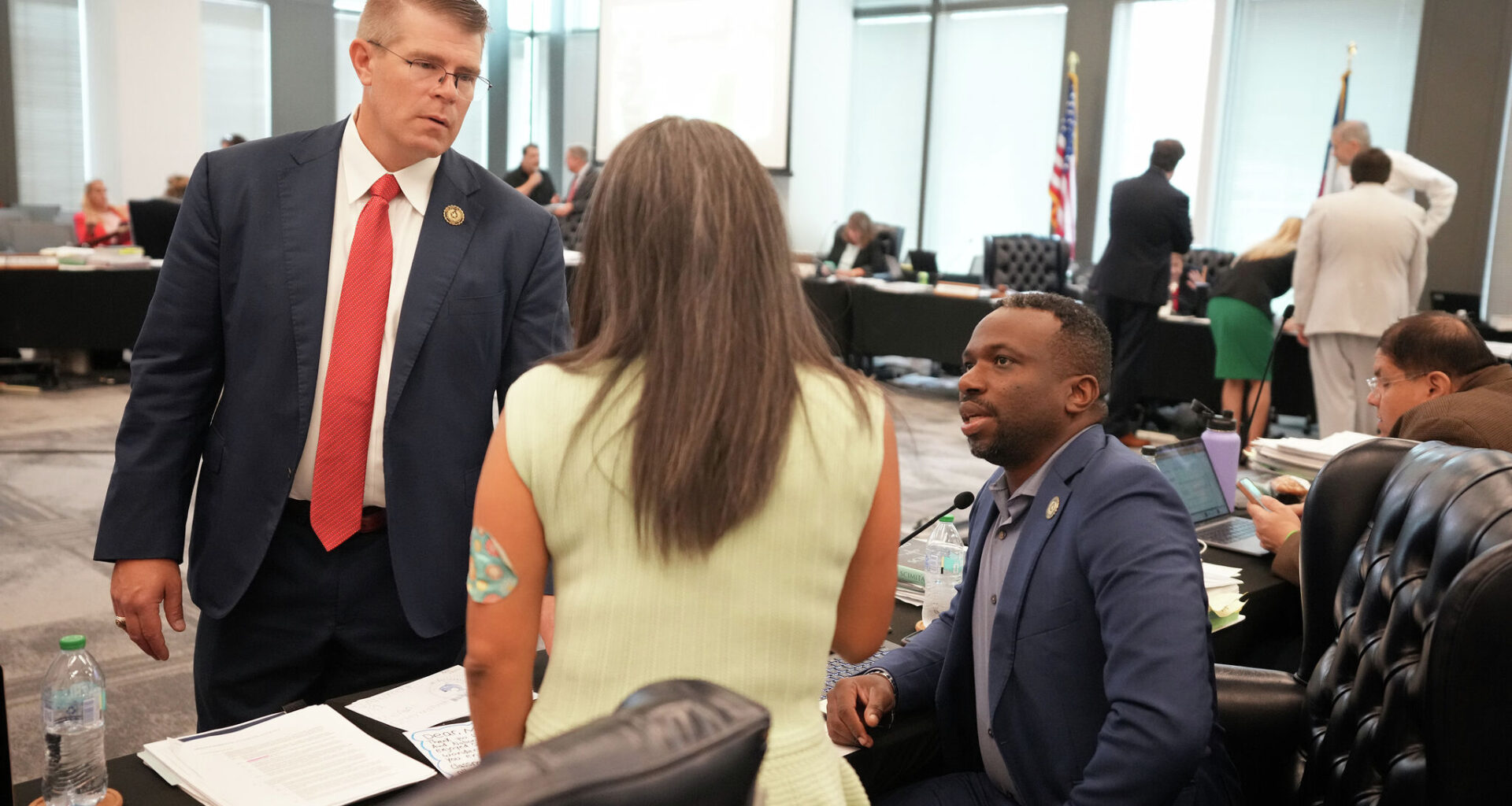
State Board of Education Chair Aaron Kinsey, left, members Marisa Perez-Diaz and LJ Francis talk during a meeting on social studies standards at the Barbara Jordan Building in Austin on Friday, June 26, 2026. The board is considering revisions that would place greater emphasis on Christian history and biblical content in public school classrooms.
Jay Janner/Austin American-Statesman
Over the last decade, Texas has approved a steady beat of new charter schools — four per year, on average.
But for the second time in 30 years, just one charter district made it through the state’s lengthy application process, as the State Board of Education approved a new charter operator at last week’s meeting.
Critics already questioned creating new charter school districts as public school enrollment falls and charter schools close due to low performance. But now they say the proposed school raises financial concerns, too. The new charter plans to send public taxpayer dollars to an out-of-state, for-profit company with private equity backing to operate its Texas schools.
Article continues below this ad
Charter schools can be run by nonprofits — like YES Prep, KIPP and other flagship networks — or by private companies. In both cases, they receive public funding and operate with more flexibility than traditional public schools. Charters educated about 446,600 Texas students in the 2025-26 school year and just over 99,000 students in the Houston region, according to state data.
Patti Everett, an independent education policy researcher, told the State Board of Education last week that if they approved the charter’s management structure, it would represent a “paradigm shift” for charters in Texas.
NEWS: 7 Texas charter schools will close before next year, impacting 2,000 students
“This application raises many, many red flags, conflicts of interest, and it sets precedents that I think should give us all pause, even if you generally support charter schools,” Everett said. “The idea that taxpayer dollars would go to investors instead of to students, especially at-risk students, is a concerning precedent.”
Article continues below this ad
The new charter, Texas School for Dropout Prevention, Inc., has a contract with a private company, Second Mile Education, to operate the school, alongside an independent board and superintendent. Second Mile, which operates 27 schools across the United States, is owned by the private equity firm Satori Capital. The charter school applied last year for Texas approval but didn’t make it to the final rounds.
The State Board of Education, whose members are chosen in partisan elections, approved the new charter application in a 9-5-1 vote last week, with board member Patti Little, a Republican from North Texas, abstaining. The vote was mostly along party lines. However, one Democratic representative voted for the charter, Staci Childs from Houston, and one Republican representative who voted against it, Evelyn Brooks of Frisco.
Texas Education Commissioner Mike Morath recommended the charter for approval, praising its application and emphasizing the state’s commitment to school choice.
ALSO READ: Two new charter schools approved for Houston, focusing on arts and achievement gaps
“It’s a very, very rigorous vetting process to set up a new charter entity,” Morath said. “These are the ones that we think can run an effective school based upon our processes. We do the best with the information that we have. We want to vet, hold a high bar. One of them made it through this year.”
Article continues below this ad
The school’s plan
The new charter district will open Texas High School of Accelerated Learning, in north Houston, between Aldine and Spring ISDs. Leaders expect to open in the 2027-28 school year and enroll about 200 students. They want to grow that to 900 students by its fifth year serving grades 9-12, according to the school’s application.
The school aims to support students who’ve dropped out before finishing high school. Nearby school districts, however, say they already offer robust options for at-risk students.
The charter’s founding board president, Gregory Meyers, told the state board that Houston needs more dropout recovery high schools because so many students in the Houston area have left high school without graduating in recent years. (Meyers served on HISD’s elected board of trustees for over a decade before leaving in 2016.)
“These are young people with talent, determination, and aspirations, yet too many are left behind without a pathway that works for them. That’s why this board came together,” Meyers said at the meeting.
Article continues below this ad
He added that the board evaluated bids from many charter operators and they chose Second Mile Education because of its existing programs. He said another benefit of the for-profit operator was its $2 million upfront commitment.
ALSO READ: The TEA tried to close Houston’s sports-focused charter school. The community fought back.
That funding allows them to operate a “fully resourced school from day one,” said the school’s superintendent, Lizette Fernandez.
A former student from Florida, Gisele Ramirez, told board members that another school operated by Second Mile — Aloma High School — helped her graduate.
“Not long ago, I felt like an academic failure and didn’t think I was good enough to even try. Today, I have goals, and I know I can reach them. I finished high school and I’m proud,” Ramirez said.
Article continues below this ad
Ties to private equity
In a video from January, Wes Blair, an executive coach in residence for Satori, detailed the partnership between Second Mile Education and Satori Capital. Blair said that most private equity firms will get rid of a team that built a business after they acquire a company, but he said their plan with Second Mile was to “coach the team that’s there and bring them along.”
In the video, Satori’s co-founder, Sunny Vanderbeck, called it a “win-win” for their private equity firm and the education company. The group’s website calls it “conscious capitalism.”
“I grew up being taught to leave the world better than you found it, and that’s what we’ve done here. We sat in that room and looked at each other and said, ‘We’re gonna go build something different, and someday we’ll have companies like this,’” Vanderbeck said in the video. “Well, that someday is today, and that company is Second Mile.”
Existing dropout recovery options
Leaders from Aldine ISD traveled to Austin to testify against the proposed charter, saying it could siphon students away from their other dropout recovery programs. Those include a specific dropout recovery high school, Hall Success Academy.
RELATED: Houston-area districts closed 26 schools over the past year. Here’s a look.
“I worry that opening a new alternative campus in the North Houston area that duplicates existing services will just divert critical public education funding from programs that are already working,” said Marcie Strahan, executive director of mental health and student support at Aldine ISD.
Strahan previously was the principal at Hall Success Academy, which she said works every day to “re-engage” students and help them graduate.
An analysis by Our Schools Our Democracy, an advocacy group for public schools, found that six other dropout recovery high schools already operate in the area, including programs in traditional ISDs and other charter schools.
Meyers and Fernandez with the new charter pushed back on those concerns, arguing the area has more dropout students than Aldine ISD’s recovery school can serve.
Other state board members who raised concerns discussed a “non-disparagement” clause in the charter’s contract with its managing organization, which prohibits staff from the charter holder and the charter management organization from making negative remarks online, in the media or in other public forums.
“The language appears to prohibit employees from making statements that would damage the reputation of the school or the management company. I worry about whether such provisions could discourage employees from reporting misconduct, misuse of funds, or other concerns that deserve public attention,” said board member Gustavo Reveles, a Democrat who represents El Paso.
The new charter school is now in what the state calls a “contingency period,” where contracts may be altered before being finalized, according to the Texas Education Agency.