
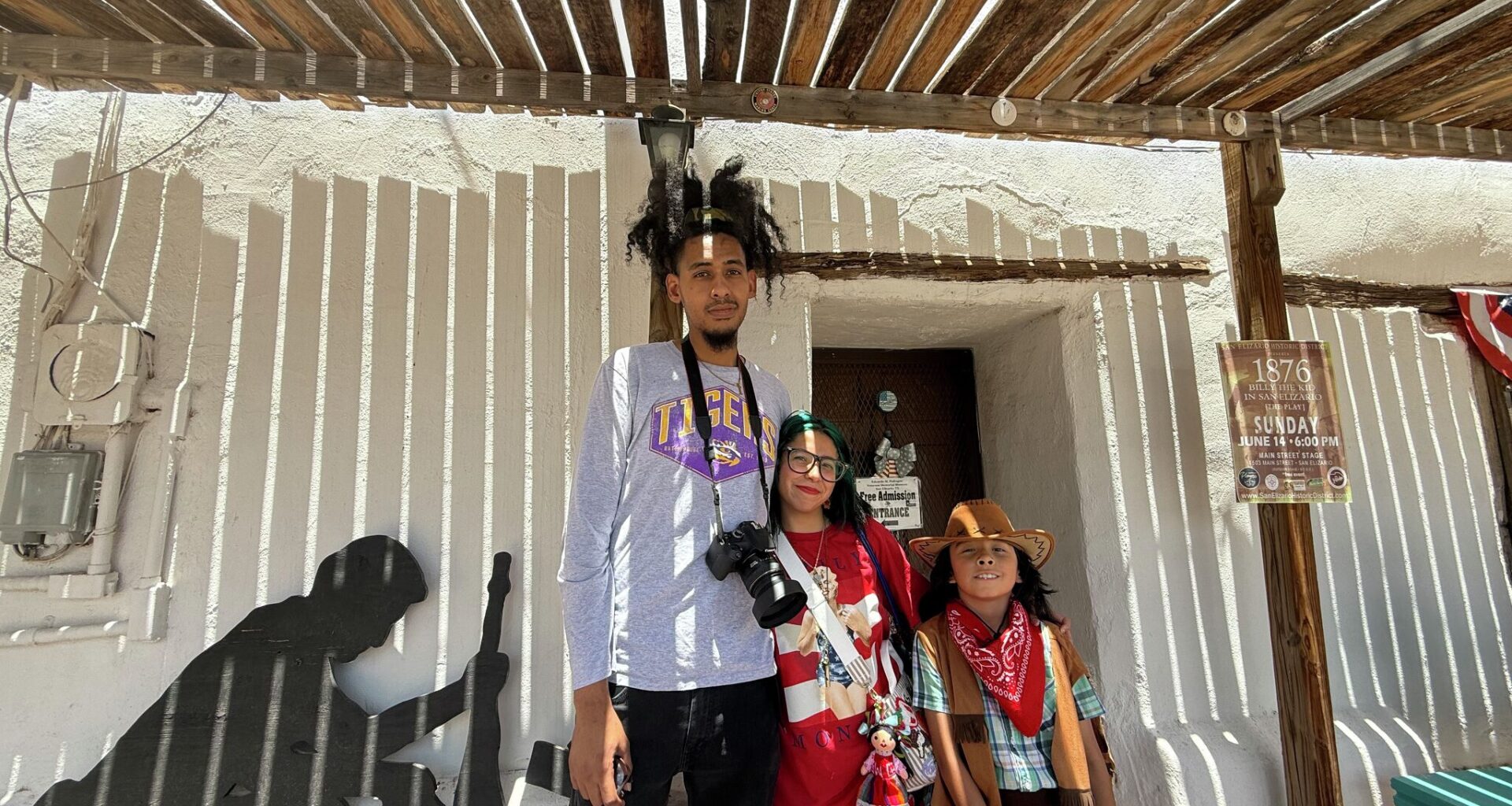
Joshua Kelly, Itzel Dominguez and Ramesses drove from El Paso to watch the reenactment of outlaw Billy the Kid breaking into the old county jail.
Leah Binkovitz
San Elizario claims a special, little-known spot in United States history. It’s the site where, in 1598, Spanish explorers crossed the Rio Grande and declared sovereignty over the land north of the river. The feast that took place on April 30 is officially considered the First Thanksgiving by the state of Texas. Visitors can still see reenactments of that day.
But that’s not why nine-year-old Ramesses is there. Wearing a cowboy hat and a red bandana tired around his neck, he’s there to see an actor portray the infamous outlaw Billy the Kid when he broke into the old county jail to free his buddy.
America’s story is often told east to west often starting with the Pilgrims landing at Plymouth. But San Elizario flips that. The truth is, we can and should imagine the story of America starting in a million different places, even here in a far corner of Texas that barely considers itself Texas. Here, we get a story of America that was and still is a site of exchange and of welcoming plus a bit of banditry and rebellion. What could be more American than a kid dressed up as a gun-slinging outlaw?
Article continues below this ad
Leah Binkovitz
San Elizario’s claim to the first Thanksgiving started with a dumb decision. The Spanish had good luck conquering the Aztec some 70 years earlier, but after costly battles with England they needed to replenish the royal coffers. The north called with rumors of gold. Fellow Spaniards had already traveled along the Rio Conchos through the Sierra Madre toward the Rio Grande but Juan de Oñate had another idea. He would cut straight across the Chihuahuan Desert. So with permission from the Spanish king, Oñate led a four-mile long party of hundreds of soldiers, families and livestock trudging across the sand dunes for 50 days.
It went about as well as you’d expect. Food supplies didn’t last. They survived off berries and roots and weeds. Clothes and shoes went threadbare. They burned their feet on the hot earth. Their tongues swelled in want of water.
By the time they reached the Rio Grande, at least two horses drank so much, so fast that their sides burst open. The group rested for ten days, recovering. Finally, on April 30, Oñate had the friars lead a mass and invited the people already living there.
Article continues below this ad
Every American schoolkid knows a version of what happened next. The Europeans broke bread with the local Indigenous community. Usually, though, the Thanksgiving story takes place somewhere else. And 23 years later. Yet in a land that would become modern-day Texas, hapless Europeans benefited from the helping hand of Indigenous peoples and carried on their conquest as a result. Oñate would actually become one of the few people tried and punished for his abuses of Indigenous people.
The Texas story of the first Thanksgiving — ahem, the real one — is a reminder that this country was not a blank United States-shaped outline filled in right to left, but a dynamic crossroads of peoples from around the world.
It’s also a reminder that our nation has never been one singular thing. It doesn’t start in one place with one people or one language. The “America” whose birth we now celebrate in its 250th year wasn’t even one singular nation. Historians know it’s a wonder those 13 colonies even got organized enough to host their own little revolution.
The Houston Chronicle editorial board has published this series, Declaring Independence, to encourage Texans to find more stories, more characters, more allegories. Texas is big and we shouldn’t settle for a narrow history.
History, it turns out, is a mess.
Article continues below this ad
“There are 29 different cities that claim the first thanksgiving, many of them before this one,” history professor Yolanda Leyva explained.
Though it may not be the real first Thanksgiving, we should remember the 1598 event, as the state’s new social studies curriculum does. But we should be honest about its complicated legacy. Some even call it a thanks-taking. Leyva was one of the content advisors fighting for more inclusive history in the new curriculum approved in June. She didn’t have much luck. The standard for the Texas Thanksgiving story “leaves out the American Indians who showed the expedition where and how to cross the river,” Leyva wrote in her feedback.
History is about choices. We choose where to start telling the story. We choose the characters. We choose the allegories.
Which is why it’s so disappointing to see the underwhelming 250th celebration taking place in Washington now. And so disappointing to see the doctrinaire, partisan version of Texas history coming out of the State Board of Education.
The material for an inclusive, Texas-sized story is there. The vision is not. Americans deserve better. Texans deserve better. We can be honest about our often troubling past and proud of those who fought hard to expand freedom for all.
Article continues below this ad
More immigrants than Ellis Island
El Pasoans sometimes still don’t consider themselves part of Texas. The local news stations give the weather for “the Borderlands” and daily rush hour traffic includes a steady to and fro across the border. When the editorial board visited, the World Cup games added to the flow of people. El Pasoans headed to Juarez to watch Mexico’s World Cup team on its home soil. And Juarenses trekked north to the U.S. side to watch their neighbors on their home soil. It’s an imperfect but usually easy-going kind of exchange where one can see, as we did, an American-jerseyed man ask his partner, “Que es un loading zone?” as he parked his red Toyota at the curb ahead of the match.
That sense of movement, interaction, contradiction, even, defines the region. It offers a better, more accurate origin story of the country than the more boring one of arrival, conquest and homogenizing assimilation.
The reality is that El Paso has welcomed more newcomers than Ellis Island.
But further east, where Texas usually traces its origins as a Republic and later state, Stephen F. Austin was also an immigrant. And many of the Anglo-Americans who followed in his footsteps were illegal immigrants, entering what was then Mexico without permission.
Article continues below this ad
They didn’t speak the same language. They weren’t the same religion. They didn’t have the same values. And they wouldn’t stop coming.
Mexican officials tried to keep guard against the threat of invasion. Laws changed constantly. Only a select group would have permission to stay. They’d be charged special tariffs. Some people were deported. A familiar playbook.
But these invaders only seemed to grow in number. Finally, the government passed its strictest law yet. Only people with special passports and permission could enter the country. The immigrants from the United States were incensed.
When performers today reenact the Battle of San Jacinto that won Texas its independence from Mexico, the man dressed up as Antonio López de Santa Anna gives a rousing speech (over a chorus of boos) promising “to drive out the illegals.”
‘This has always been a crossing’
These days, immigrants are still an easy target, though the tables have turned. El Paso knows intimately well the challenges of living on the border — the reality behind photos of crowds of shivering people on the street.
Those images from 2022 helped galvanize anti-immigrant rhetoric and elect Donald Trump to a second term on a platform of mass deportations, which has proved less popular in practice than he hoped.
El Paso also knows that, like its history, it matters where you place the frame. Just outside the view of those photographs of crowds of hopeless looking immigrants were crowds of people wanting to help. The response from El Pasoans was overwhelmingly generous.
“We began as a city of moving people, traveling people, migrating people,” explained Council Member Chris Canales. “And we’re still that today.”
Like other El Pasoan kids, Canales learned the Texas Thanksgiving story, with its sheen of harmonious coexistence. While he knows that wasn’t the full story, the kernel of truth is still there. El Paso is a welcoming city. He crosses the border almost every week for a museum exhibit or gallery show with his wife.
He remembers the 2022 surge of border crossings.
“That did happen,” he said. “But we also just have this baseline immigration that we are used to here.”
“So many people in El Paso have family in Juarez and they’re there every day or on the weekends.”
El Pasoans cherish that welcoming reputation.
“This has always been a crossing,” Leyva said at a coffee shop near the University of Texas at El Paso where she teaches. “I can see Juarez from my front porch. I can see Juarez from campus.”
In many ways, El Paso has figured it out. The city manages tremendous flows of international travel every day and is one of the safest places in the country. And yet, few in Texas let alone the rest of the country listen to the city about what works. U.S. Rep. Veronica Escobar, who represents El Paso, proposed the DIGNITY Act, which would go a long way toward reforming many of the issues lawmakers have disastrously kicked down the road for decades. It would strengthen border enforcement, create humanitarian hubs to help process asylum seekers quickly, expand e-verify for employers, provide a pathway to legal status for DACA recipients and more. It has bipartisan support. This administration seems uninterested, but the American people are hungry for real solutions.
Nine-year-old Ramesses stands in front of a statue of Billy the Kid in San Elizario, Texas.
Leah Binkovitz
All mixed up
“Mama, mama,” Ramesses calls. “A Billy the Kid poster!”
Stapled to a faded square of plywood, a crinkled, browning flyer announces that Billy the Kid is “Wanted” by Sheriff Kerber for a $500 reward.
Once upon a time, Billy the Kid posed as a Texas Ranger and broke his buddy out of the old county jail here. It was the only time the young outlaw ever broke into jail, the pamphlets proudly declare. Visitors can still see the steel cages where his friend was held and a little bed made up with a sepia-toned cardboard cutout of Billy the Kid by the door. We love our outlaws just as much as if not more than our lawmakers apparently.
Ramesses is so enamored that he’s persuaded his family to drive from El Paso for the break-in reenactment. The performers don’t flee all the way to Mexico, like the outlaw did back then. But they could. It’s not far.
There is a charming buoyancy to the American mythos, afloat all the way in this far corner of the country that, in some ways, is really the center of it all.
Ramesses’ mother, Itzel Dominguez, is from El Paso. She wants her son to be proud of his Mexican heritage, to recognize the Indigenous roots of his people. But she knows that El Paso is easier for some than others. Citizens have a huge advantage. That easy flow of rush hour traffic to get into Mexico is a lot slower-going coming back. A Global Entry pass goes a long way. Her husband, Joshua Kelly, experiences other invisible borders as a Black Mexican man. His family is from Juarez and Baton Rouge, Louisiana. Some of them insist he’s not really Mexican.
“Everything is all mixed up,” Kelly explained.
Even the border. The Treaty of Guadalupe set the Rio Grande as the border in 1848. But the thing is, the river moves. It floods and shifts as all big rivers do. In a region of movement, nothing stands still. Forcing people to is unnatural. And, as El Paso shows us, unnecessary. This is the story of Texas — the story of us. We’re dynamic and complicated — and big — and we shouldn’t shy away from that just because some politicians today want us to be small enough to fit into their partisan-friendly talking points. Be proud, Texans, of who we are. Be proud of our history and defend it against those who want to pretend it is something lesser.