
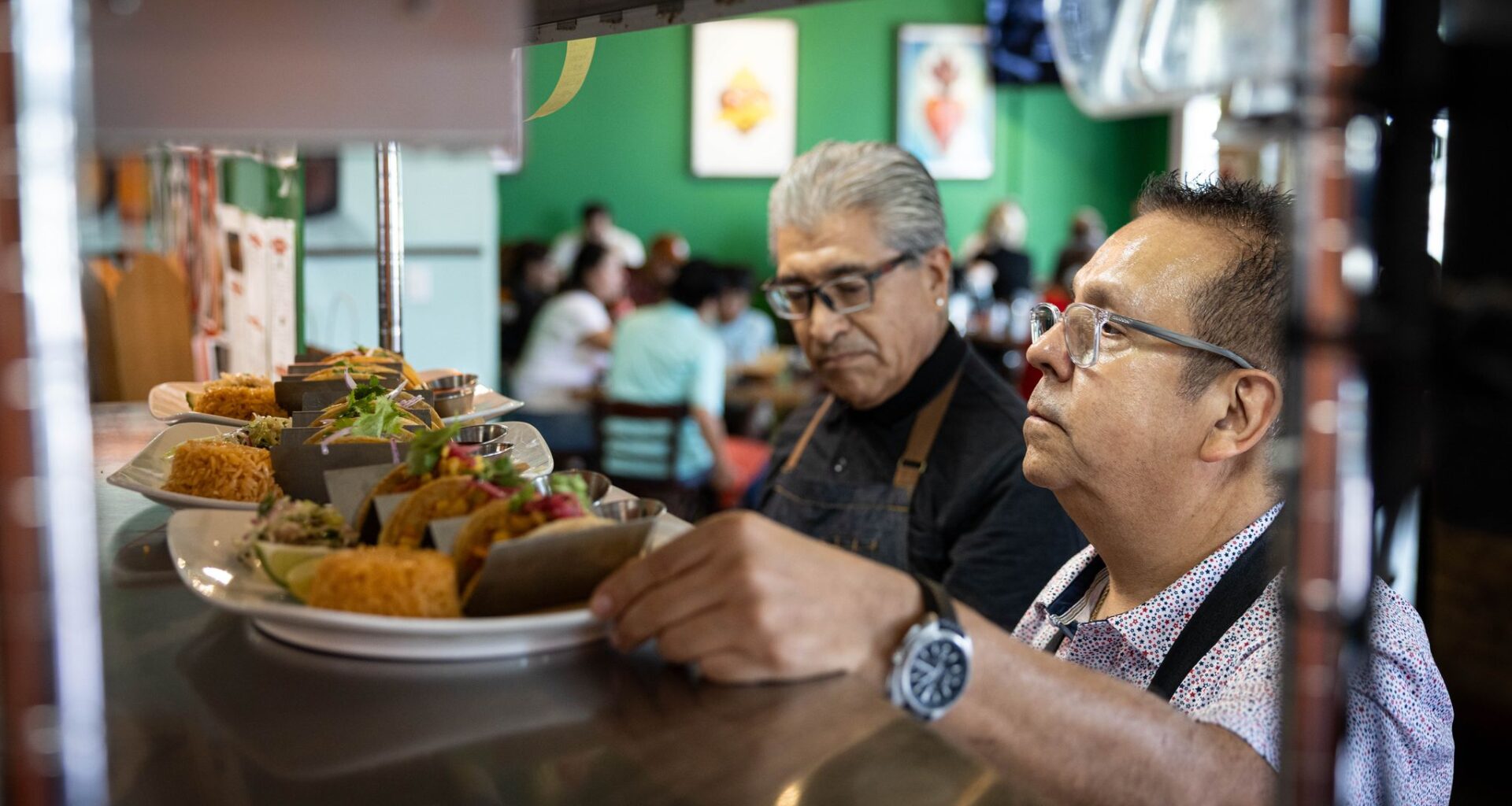
Nearly every table was full at Milagro Tacos Cantina on the last Friday afternoon in June.

Servers wove between families balancing plates of tacos and margaritas at the West Dallas establishment. When a group arrived, owner Jesus Carmona pushed two tables together to make room. Spanish and English drifted through the restaurant with painted hearts covering the walls as chatter and “Procura” by Dominican musician Chichi Peralta filled the air.
The crowd represented more than a busy lunch service.
Carmona, a 56-year-old restaurateur, was born in Mexico City and arrived in the United States in 1986 when he was 17. He started work as a busboy. Over decades, he waited tables, opened restaurants, and built a reputation as one of Dallas’ best-known taco entrepreneurs. He still sees North Texas as a place where effort can pay off.
Article continues below this ad
“It’s the American Dream,” Carmona said. “When you work hard, you have a goal, and you focus, things will come along.”
His restaurant, whose name translates to “miracle,” stands in a part of Dallas that has transformed dramatically during the past decade. New apartments and businesses have reshaped the neighborhood, known as Trinity Groves, drawing customers from across North Texas.
As the United States turns 250 years old, few states have attracted as many newcomers as Texas, where people arrive in search of greater opportunity.
Article continues below this ad
People have come to North Texas for generations. They’ve arrived from other countries, states and neighboring communities, drawn by the promise of jobs, homeownership and upward mobility. It’s a bet that historically has paid off, though not for everyone. Different generations and communities have faced different barriers to the American Dream that Carmona is realizing.
Census data shows the region’s population has grown nearly 30% since 2010, roughly three times the national rate, underscoring why questions about opportunity and affordability have become increasingly urgent.
Longtime residents, immigrants, newer arrivals and experts say the American Dream is evolving. Rising housing, childcare and healthcare costs are reshaping what economic stability looks like, even as people continue arriving in search of a better future.
They came to Texas looking for a better shot
Donald Payton, a local genealogist, historian and civil rights activist, traces his family’s North Texas roots back generations. His ancestors were among the first enslaved people brought to present-day Dallas in the mid-1840s.
Article continues below this ad
Payton’s own story begins in the mid-1950s, when his parents moved from Cleveland to Dallas and settled in Hamilton Park, one of the city’s historic Black neighborhoods. At the time, teachers, pastors, postal workers and other professionals owned homes in the new enclave.
The neighborhood’s schools, churches and civic organizations reinforced the idea that Black families could build wealth, establish roots and create opportunities for the next generation.
“Hamilton Park was the first Black suburbia built brand-new for Black folks in America,” he said. “We had teachers that spoke 15 languages, chemists and all these kinds of people. It was a great neighborhood to grow up in.”
Donald Payton’s ancestors were among the people enslaved by William Brown Miller in Dallas. They helped build the Millermore House, which is now located at Dallas Heritage Village. Payton speaks with The Dallas Morning News inside the house in 2018 beside portraits of William Brown Miller and Minnie Miller.
Andy Jacobsohn/Staff Photographer
Garland City Councilman Jimmy Tran‘s family arrived in North Texas as refugees after the Vietnam War. Tran’s father, an officer in the South Vietnamese army, spent seven years in a re-education camp after the communist takeover. When Tran’s family arrived in the United States in 1994, they settled in the Dallas area and began rebuilding their lives from scratch.
Article continues below this ad
In those early years, daily life revolved around work, language barriers and unfamiliar systems of school and transportation, Tran said.
During his family’s first months in the United States, Tran rode three buses each way to a minimum-wage assembly job in Fort Worth before he enrolled in high school and began the educational journey that eventually led him into software engineering and public service.
“America opened its arms to welcome refugees like my family,” he said.
Garland’s Vietnamese population has grown since Tran’s family arrived. About 2,000 of its residents identified as Vietnamese in 1990. By 2020, nearly 14,700 residents identified as Vietnamese alone or in combination with another race.
Tran is the first Asian American elected to the Garland City Council, where he helps shape policies affecting families pursuing the same opportunities that brought his family to North Texas.
Article continues below this ad
Dallas College Chancellor Justin Lonon (right) speaks alongside Josh Skolnick, Dallas College Foundation Executive Director, as they accept the Economic Mobility Champion Award during the Dallas County Economic Mobility Summit at the Dallas Museum of Art, Monday, Oct. 6, 2025, in Dallas.
Elías Valverde II/Staff Photographer
Josh Skolnick, executive director of the Dallas College Foundation, arrived in North Texas from New York in 2021, drawn by family, growth and what he saw as a region invested in its future.
“Dallas was a place that was still growing, that was still thinking about the future,” he said. “People were excited about the future of Dallas.”
Timothy Bray, director of the Institute for Urban Policy Research at the University of Texas at Dallas, described North Texas’ longstanding appeal as a product of jobs, innovation and a “frontier spirit” that has repeatedly drawn people to the region.
That belief remains one of North Texas’ greatest strengths. But whether it delivers equally is a more difficult question.
Article continues below this ad
A place for the American Dream
When Lisa Morris Amiel thinks back on her childhood in Mesquite during the 1960s, the chair of Historic Mesquite Inc.’s board of directors remembers an enchanting experience.
“It was magical,” she said. “We all got on our bikes and met at this little tree in the road.”
Parents throughout the neighborhood looked after one another’s children, Amiel said, creating what felt like a village.
A photo taken in front of Lisa Morris Amiel’s first childhood home in Mesquite, circa 1962. Left is Jana Beth (Wilcox) LaDue (Amiel’s sister) and right is Lisa (Wilcox) Morris Amiel.
Courtesy of Lisa Morris Amiel
Post-World War II growth transformed Mesquite into a quintessential North Texas suburb, Amiel said. Families gathered around neighborhood schools, churches and civic organizations. Children spent afternoons outdoors. Parents believed their opportunities were growing alongside their communities.
Schools sat at the center of that world, she said. They offered extracurricular activities, arts programs, and pathways into college, trades and careers. Families believed hard work, combined with strong institutions, would help them get ahead.
Catherine Cuellar, CEO of Social Venture Partners Dallas, sees that reflected in Dallas’ broader evolution as a land of opportunity.
She points to investments in transportation, education and civic infrastructure that help connect residents to jobs and opportunity. The growth of institutions such as the Dallas Arts District, major public schools and regional transportation networks reflected a broader belief that communities could improve themselves through long-term investment.
“I’m the woman and the leader I am in our community because of all of the opportunity that my excellent public education and the Dallas community has afforded to me and my family,” Cuellar said.
For much of the post-World War II era, the pathway toward economic mobility in North Texas followed a relatively direct formula. Find stable work, buy a home, invest in education, and trust the next generation would move further ahead than the last.
However, the formula has become harder to follow.
Who gets to participate in American prosperity?
North Texas has benefited from a reputation as a place where economic opportunity and affordability went hand in hand. Families could find jobs, buy homes and build wealth at a lower cost than in many coastal cities.
That affordability advantage has narrowed.
Living Wage Institute research found the family-sustaining cost of living in the Dallas-Fort Worth area increased 22% between 2021 and 2025, while median wages rose just 13%. The share of workers earning enough to support a family of four declined to 47% from 51% during the same period.
“The gap means families can afford less with their dollars today than just a few years ago,” said Misael Galdámez, the Living Wage Institute’s data manager. “Their paychecks have grown, but not nearly fast enough to keep up with the cost of living.”
Housing has become one of the clearest examples.
Ted Wilson, president of Residential Strategies Inc., said Dallas-Fort Worth attracted families because the region offered lower housing costs than many coastal markets while still providing access to jobs and economic growth.
That affordability advantage, too, has narrowed, widening a gap that has become one of the defining economic pressures facing the region.
Median home prices in North Texas have climbed much faster than median incomes in recent years, according to an analysis by The Dallas Morning News’ Future of North Texas initiative. Since 2011, housing affordability has declined substantially, and by 2025 about half of Dallas-area households still could not comfortably afford a median-priced home. As of April 2026, the median home price in Dallas-Fort Worth was about $390,000, according to the MetroTex Association of Realtors.
Wilson said the typical first-time home buyer is now significantly older than in previous generations. What was once commonly achieved around age 30 increasingly happens closer to age 40 as rising home prices and mortgage rates make ownership harder to reach.
Between 2015 and 2025, the share of Dallas-area homes priced below $400,000 fell by at least 35 percentage points, while the share priced above $1 million increased.
“The math simply doesn’t work for a lot of younger families,” Wilson said. “Incomes haven’t kept pace with where home prices and mortgage rates have climbed to.”
Galdámez’s research found housing costs added roughly $6,605 to family budgets in Dallas-Fort Worth between 2021 and 2026.
Housing is not the only pressure.
Childcare costs have added another $3,411. Healthcare expenses increased by about $1,854 over the same period.
“Our data shows that nearly half of workers in the metro don’t earn enough to cover basic needs for a family of four,” Galdámez said. “The path to economic stability depends much more on what sector you work in and what your employer offers than it did six years ago.”
Steven Pedigo, a professor at the LBJ School of Public Affairs at the University of Texas at Austin, believes North Texas has reached an inflection point.
“You’ve kind of created a party,” Pedigo said. “Now the question for you is, who gets to come to the party?”
“The affordability advantage that Texas had is no longer there,” Pedigo added.
Hamilton Park resident Taler Jefferson, 36, said those changes have twisted the 250-year-old American Dream into an “American nightmare” for people like her who continue struggling despite working hard.
“They’re not paying us nowhere near what we should be making in order to live sustainably in North Texas,” Jefferson said. “The economy is going up, but y’all are not compensating us on the back end for that.”
Jefferson said her grandparents’ generation benefited from opportunities that feel increasingly difficult to reach today.
“Absolutely not,” she said when asked whether younger generations have the same opportunities previous generations enjoyed. “The dollar was able to stretch.”
Taler Jefferson poses for a portrait during a tour of Hamilton Park neighborhood, on Saturday, March 8, 2025, in Dallas.
Shafkat Anowar/Staff Photographer
Opportunity remains abundant, but the path has changed
As the traditional path to economic mobility becomes more expensive, North Texans are adapting. Some are pursuing new credentials and workforce training. Others rely on community organizations, mentorship and second chances to reach the stability previous generations often achieved through a more straightforward path.
Opportunity remains abundant, said Tom Kim, for those willing to develop new skills and adapt to changing conditions.
“I definitely believe that the American Dream is achievable,” said Kim, the University of Texas at Dallas’ assistant dean of career management in the Naveen Jindal School of Business. “The definition of the American Dream has changed.”
He sees students preparing for a labor market that demands adaptability as much as expertise. A degree alone is no longer enough, Kim said. Technical skills still matter, but so do internships, communication skills and the ability to move between industries as economic conditions change.
UTD assistant sociology professor Brenda Gambol, sees a similar shift.
The traditional formula of graduating high school, earning a four-year degree and securing a stable career still exists, she said, but it is no longer the only route into the middle class.
Community colleges, apprenticeships, workforce certifications and employer-linked training programs increasingly serve as alternate pathways to economic mobility and the middle class.
Armando Cantu, founder of the CARDBoard Project, said adaptation begins with something even more fundamental: Access.
Through his nonprofit, Cantu works with residents who struggle to apply for jobs, complete training programs or access services because they lack devices, internet access or digital skills.
“Opportunities should not be based on your ZIP code,” Cantu said.
Cantu pointed to research showing 92% of jobs now require at least one digital skill. Yet many residents remain disconnected from the tools needed to compete in the modern economy.
A Dallas Morning News analysis shows broadband access remains uneven across the region, particularly among lower-income households, reinforcing Cantu’s argument that digital access increasingly shapes economic opportunity.
Dallas resident Evelyn Salazar represents another form of adaptation and sees opportunity as a series of second chances.
The daughter of immigrant parents, Salazar said sacrifice has shaped her family’s story for generations. She watched her parents leave Mexico in search of greater opportunity. Years later, after completing an earlier medical assistant program, she returned to workforce training determined to build a more stable future for her own family.
“To me, it means sacrifice,” Salazar said when asked what the American Dream represents.
Elizabeth Henry reached a similar conclusion after recovering from a devastating car accident and eventually rebuilding her career through a workforce training program.
She cautioned against viewing economic mobility as a one-time achievement.
“The American Dream, whatever that may look like for you, is not just one and done,” Henry said. “Dreams can change.”
For her, it means “being financially free.”
From left to right: Karina Olivares’ mother, Morena Carranza, her father Ildefonso Carranza, her sister Angie, and Olivares in the purple and white stripe shirt. Taken in Garland in Spring 1980.
Courtesy of Karina Olivares
Karina Olivares, president of the Garland Chamber of Commerce, sees the dream through the lens of her own family’s journey.
Born in El Salvador, she moved to Garland as a child in 1980 and often served as translator for her parents while navigating school and daily life. She became the first in her family to graduate from college and eventually worked her way from a part-time internship to leading the Garland Chamber.
“We’re celebrating 250 years of America, and the dream is a better future,” Olivares said. “What that better is, is individualized.”
Olivares said achieving that future still requires sacrifice, education and persistence. She also believes North Texas still offers opportunities for people willing to pursue them.
Sofía Núñez, founder of Empower the Voice, hears similar aspirations from immigrant families across North Texas. Her family moved to North Texas from Honduras in 2011.
“Knowing that working hard will bring a benefit in the future,” Núñez said, is central to how many immigrant families define the American Dream. Families hope to achieve economic stability, homeownership and better opportunities for their children, she said, but many struggle to navigate an unfamiliar education system and workforce.
Núñez said expanding opportunity means making sure families have trusted information and relationships that help them find those pathways. However, she also worries about widening inequality.
That concern echoes broader trends across North Texas. Rising housing costs, persistent food insecurity and growing financial pressures have made it harder for many families to achieve stability.
“My major concern is the growing gap between the haves and the have-nots,” she said.
Family Portrait taken at Sofía Núñez’s son’s high school graduation at SMU: Juan Carlos Zelaya, Juan Fernando Zelaya, and Sofía Núñez in 2024.
EMMANUEL VARGAS/Courtesy of Sofía Núñez
Education unlocks mobility
Tran said the American Dream is still achievable using the message his parents repeated after arriving in the United States.
“Education, education, education,” he said.
The answer is still more complicated for newer arrivals. Rising costs, Skolnick said, mean success is no longer as straightforward as it may have appeared a decade ago.
People still want stable work, Cantu said, and a home, the ability to support their families and confidence their children will have more opportunities than they did. They just need an updated map.
“They just need to be guided, let them know that there is hope,” he said. “You can have that American Dream.”
Still building
Milagro Tacos Cantina owner, Jesus Carmona, helps friend and restaurant patron Bonnie Itzing with her order in Dallas, Tuesday, June 23, 2026.
Angela Piazza/The Dallas Morning News
Back at Milagro, Carmona is still building his dream. Maybe another restaurant. Or a larger presence at the State Fair of Texas.
Even after decades in the restaurant business, national television appearances and recognition from Dallas food critics, Carmona insists he has more to do.
“I still haven’t achieved everything I want to, but I will get there,” he said.
Carmona said he wants to create more jobs and continue building opportunities for the employees he considers family. And for himself.
“Next year, I might get a house,” he said.
This reporting is part of the Future of North Texas, a community-funded journalism initiative supported by the Commit Partnership, Communities Foundation of Texas, The Dallas Foundation, the Dallas Mavericks, the Dallas Regional Chamber, Deedie Rose, Lisa and Charles Siegel, the McCune-Losinger Family Fund, The Meadows Foundation, the Perot Foundation, the United Way of Metropolitan Dallas and the University of Texas at Dallas. The News retains full editorial control of this coverage.