
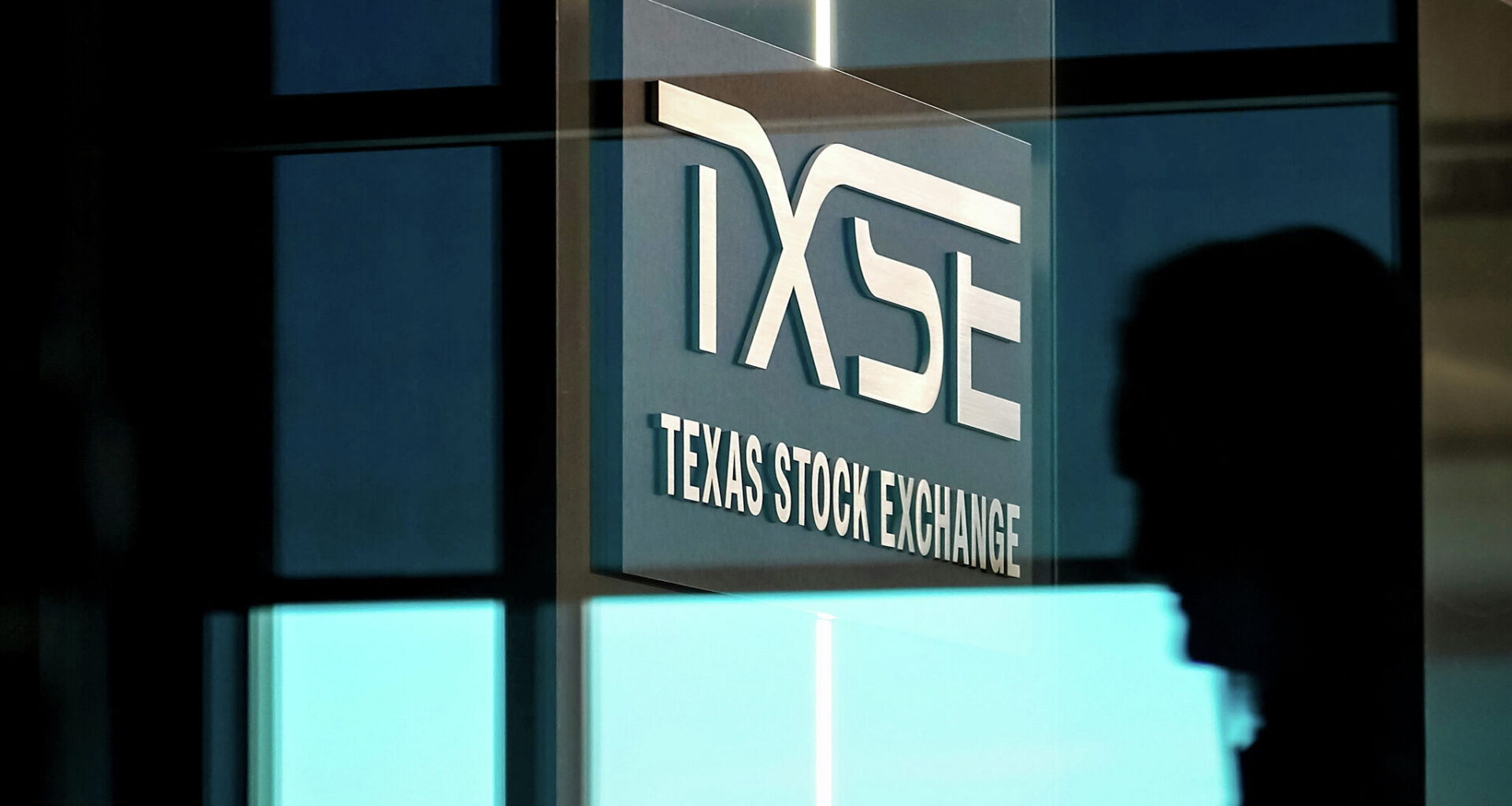
Texas Stock Exchange offices seen in July in Dallas. The exchange will open trading to its members on Monday.
Smiley Pool/Dallas Morning News
The Texas Stock Exchange will start trading on Monday, kick-starting the first real test of one of the most well-funded new exchanges to launch in decades.

The exchange, a Dallas-based startup, will initiate a phased rollout to take place over the course of July. On Monday, the exchange will open to TXSE members, including approved broker-dealers, banks and trading firms, to trade test stocks initially, then the symbols for thousands of stocks and other equities will come online over the course of the month, allowing the public to start trading.
Article continues below this ad
By the third quarter, exchange officials hope to have exchange-traded products, or ETPs, listed, according to the exchange. Unlike an individual company stock, ETPs allow investors to buy into an entire market, like the S&P 500, oil or gold. The exchange said it expects to add corporate listings during the fourth quarter of this year.
Both Texas state government and exchange officials hope the TXSE launch will solidify Dallas’ quest to become a national financial hub and boost the Texas economy by growing the state’s financial services industry and making money for any Texas companies and investors that are doing business through the exchange.
“With the start of full production trading, any last notions that TXSE is theoretical are instantly swept away,” a TXSE official wrote in a statement.
Trading test run like rollout of a new car
Monday’s start of trading is critically important to test-run and demonstrate to companies interested in listing on TXSE that it can provide a viable alternative to the New York Stock Exchange and Nasdaq Stock Market, said Sriram Villupuram, a University of Texas at Arlington associate professor of finance.
Article continues below this ad
Texas Stock Exchange will open trading Monday to its members, who will be able to trade test stocks. The symbols for thousands of stocks and other equities will come online over the course of the month, during which trading will open to the public.
Smiley N. Pool/Staff Photographer
“Basic technical things, hopefully will work well,” Villupuram said. “This is the first demonstration. It’s like a new car, a brand-new company pushing out their first car. I think they’ll get through it fine, but things can go wrong. This is a high-tech exchange at the end of the day.”
San Antonio Express News Logo
Make us a Preferred Source on Google to see more of us when you search.
Add Preferred Source
While most trading is now done electronically, the location of a stock exchange still matters, said Ray Perryman, president of the Waco-based economic research company the Perryman Group.
Article continues below this ad
Investors tend to hold stocks in and trade more on nearby companies, and Texas has both ingredients for a successful exchange — a rapidly growing pool of investors via the growth of the financial sector in the Dallas area, as well as Fortune 500 companies headquartered in the state that they can invest in, he said.
“A homegrown national exchange means more jobs, more investment and more growth opportunities for businesses and communities across the Lone Star State,” said Gabriela von zur Muehlen, senior vice president and chief policy officer at the Texas Association of Business.
Hype around TXSE has been building since the June 2024 announcement that the exchange intended to launch with $120 million in backing from large investment firms such as BlackRock and Citadel Securities. In the time since that announcement, anticipation has only grown as the exchange received federal approval and further investments from some of the largest financial institutions in the world, now totaling $275 million.
Y’all Street growth
At the same time, financial services in the Dallas area have continued to grow. JP Morgan Chase, Goldman Sachs and Charles Schwab now have thousands of employees based in the region, coined “Y’all Street.”
Article continues below this ad
“The center of gravity for American capitalism is now headquartered in the boom belt,” Gov. Greg Abbott said during a TXSE event in April. “The Texas Stock Exchange is the natural extension of that capitalism.”
Abbott and other state officials have cited the strength of the Texas economy, the eighth-largest in the world if it were its own country, as the reason TXSE will succeed where previous exchanges have failed. The state has the second-most headquarters of Fortune 500 companies in the U.S., leading New York and closely trailing California.
The U.S. investment system has long been centered around the NYSE and the Nasdaq, both private exchanges based in New York City.
Perryman said decades of consolidation among regional exchanges have led to what is effectively a NYSE and Nasdaq duopoly for companies that wish to be publicly traded.
Article continues below this ad
Since TXSE announced its intention to launch in Dallas, both the NYSE and Nasdaq have created branches of their exchanges in Texas: NYSE Texas and Nasdaq Texas. TXSE officials say those moves validate TXSE’s efforts and show Wall Street is paying attention to the upstart exchange and the strength of Dallas’ growing financial sector.
The creation of NYSE Texas and Nasdaq Texas, rather, are validations of Texas’ economic strength and the size of the financial sector in the Dallas area, Villupuram added.
“There is genuinely business to be made here, and part of it can also be a fear of missing out,” Villupuram said.
Over the past 20 years, New York has seen a 16% growth in investment banking jobs, compared with an increase of 111% in Texas. Across the entire financial services sector, Texas has more jobs — 939,600 — than New York or California, Perryman said.
Article continues below this ad
“Texas has evolved from being primarily a back-office location into a major hub for technology, operations, wealth management, trading support, and increasingly, some front-office and investment banking functions,” Perryman said.
In advance of its opening, the Texas Stock Exchange launched an ad campaign with TV spots and digital display ads in Victory Park. The exchange will open trading to its members on Monday.
Courtesy of the Texas Stock Exchange/Dallas Morning News
Villupuram said it will take years of effort before TXSE is a true competitor to NYSE and Nasdaq because of each companies’ decades of expertise and reputation among companies that want to be publicly traded.
Drawing corporate listings to the exchange will be crucial to TXSE’s long-term survival, Villupuram said. Stock exchanges primarily generate revenue through listing fees collected by companies on an exchange, he added.
Article continues below this ad
Both NYSE and Nasdaq have strict requirements companies must meet to be listed on the exchanges, including benchmarks for financial solvency, corporate transparency and regulatory compliance. That’s a high bar for companies to meet and achieving those requirements shows a company’s maturity, Villupuram said, but it also can effectively limit the ability of smaller companies to access investors through the NYSE and Nasdaq duopoly.
The $275 million in startup funds is a significant amount of money for a new exchange, Villupuram said, but he also noted that the technology to start and operate an exchange is incredibly expensive. Hundreds of billions of dollars flow through the NYSE and Nasdaq on any given day that markets are open.
“There will be several years and years of slowly growing, attracting more listings,” Villupuram said. “So compared to those big ones, it’s maybe not a lot, but from where TXSE is starting and investing, it’s significant.”
TXSE is starting slow with the goal of building toward solvency over time.
Article continues below this ad
All National Market System symbols — such as TSLA for Tesla Inc. — should be available to be traded on TXSE by the end of July as they are slowly rolled out, a TXSE official said. There are more than 12,000 publicly traded stocks available to investors in the U.S., according to financial services company Motley Fool.
Although the ringing of a bell typically symbolizes the start of the trading day in a stock exchange, there will be no bell ringing on Monday in Dallas. If all things go as planned this month, exchange officials hope to have one on hand during a celebration in the near future.
The Texas Tribune is a nonprofit, nonpartisan media organization that informs Texans about public policy, politics, government and statewide issues.