
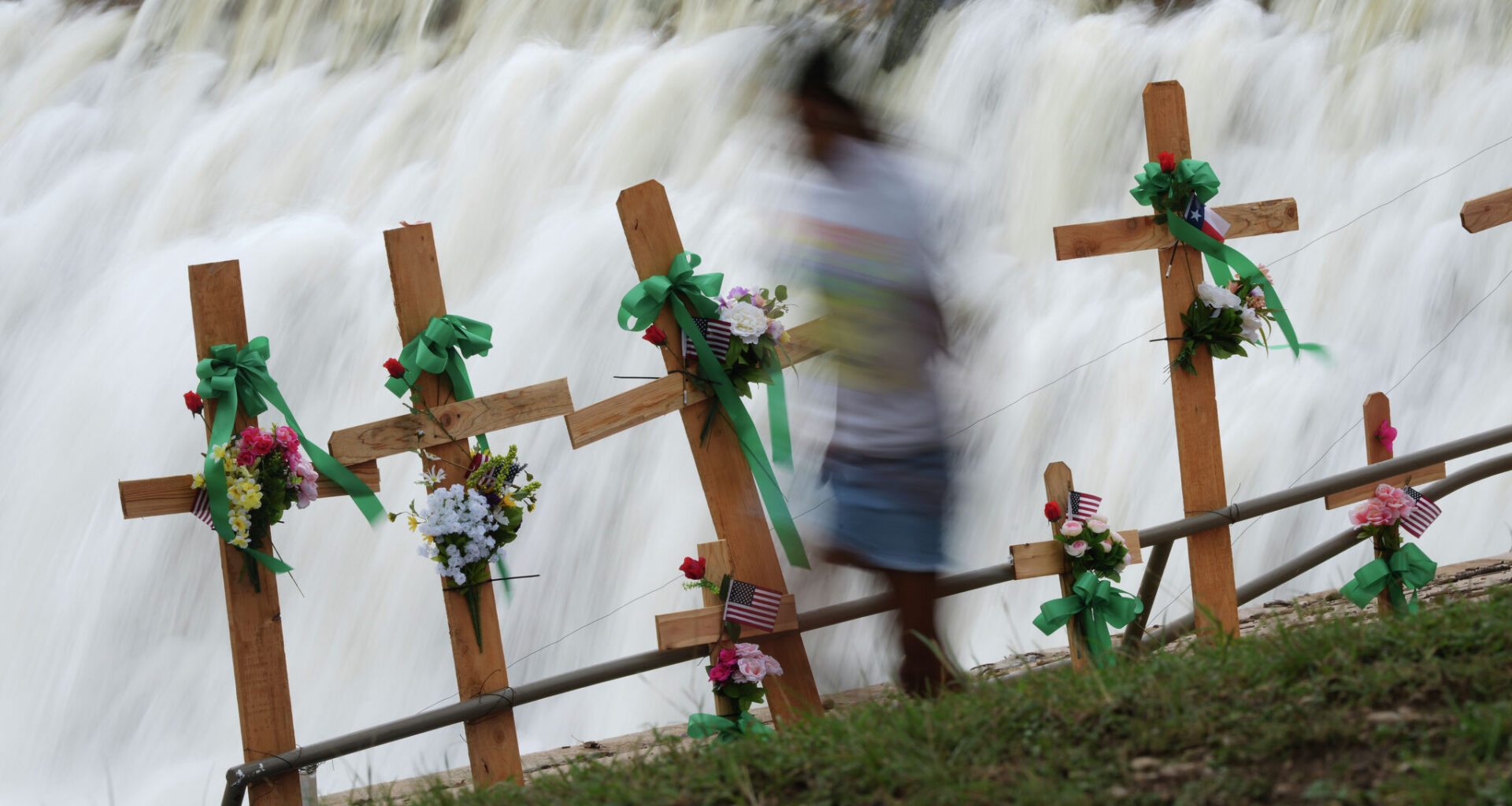
A young girl runs past crosses at a makeshift memorial honoring flood victims in the Texas city of Kerrville. The anniversary of the tragedy will be for most a day marked by large-scale national celebration. For those whose lives have been changed forever by the death of a beloved child, it will be something altogether different, writes Julie Yarbrough.
Eric Gay/AP
One year ago, over 135 women, men and children, including 25 young girls along with two teenage counselors, died in a senseless, life-shattering tragedy. Since then, countless parents, siblings, grandparents, godparents and friends in our community and across the world have struggled to find an answer to the “why” within the grief and sorrow of death.
The one-year anniversary of the tragedy will be for most a day marked by large-scale national celebration. For those whose lives have been changed forever by the death of a beloved child, it will be something altogether different. When young, vibrant lives overflowing with promise and wonder abruptly come to an end, for those who survive and grieve, time stands still. A year is nothing.
Though factual, objective accounts have explained the cause of the event, the “how” of what happened, those who survive and grieve will never know on this side of heaven the reason why their child had to die.
Article continues below this ad
Despite the sorrow, sadness and pain of death, the reason we grieve is this — we grieve because we love. If we did not love, our hearts would not be broken by death. This is the love that never dies.
As we navigate the twists and turns of the journey through grief, over time we learn that grief is not an experience of emotional surrender or existential catastrophe. Rather, grief can be the most honest and faithful place we will ever stand to find the true meaning of hope. In the will to hope, we find the strength to live and the courage to die.
The challenge for bystanders to the grief of others or those who walk alongside family or friends who grieve is finding a way to be present to those whose grief inevitably will be renewed and refreshed not only today but every year hereafter.
A few weeks after the life-altering disaster, a perplexed acquaintance voiced this question somewhere into the universe, “How am I supposed to understand the incomprehensible death of so many innocent victims?” Her emotional confusion describes how many of us react to senseless death.
Article continues below this ad
The answer lies within the mystery of life and death. As human beings we are not endowed with the ability to understand death. Nor are we provided with a logical explanation of the “why” of death. When tragic events occur in our lives, we do not have access to that which will remain forever beyond the emotional and intellectual gifts of humankind.
As a community, we have grieved together for almost a year. We have shown support and solidarity with yard signs, ribbons on trees and street signs, and other public expressions of remembrance and tribute.
One grieving mother recently remarked to a friend that it added to her sadness to see the many tattered, ragged ribbons still on display in some neighborhoods. When a well-intentioned yard sign is lost within a jumble of school and event signs, its sacred significance is diminished, reduced to thoughtless advertising rather than a declaration of solemn remembrance. To this mother, forlorn remembrances no longer honor her beloved daughter. They suggest that she is somehow forgotten.
It is the nature of human life and endeavor that at some time we see but do not see visual cues meant to remind us of the heartache and sadness of others. Though most who grieve will never be “over it” or “back to normal,” as a community we can offer the sensitivity and caring kindness of removing painful reminders that no longer serve their intended purpose.
Perhaps the highest and most heartfelt way we can honor those who cherish the memory of a beloved child who died last year is with the faithful presence, quiet comfort and tireless love of compassion. Whatever our faith conviction, may we continue to pray that in time, on the other side of grief, each broken heart will be restored to peace, love and fullness of joy.
Article continues below this ad
Julie Yarbrough is author of several books on grief, including Beyond the Broken Heart and Grief Light.
Have thoughts about this? Send a letter to the editor using our letters form or email letters@dallasnews.com. Letters should be no more than 200 words and include the first and last name of the writer and city of residence.