
Second of two columns
Last Sunday’s column was about the origins of Terrell Heights – the North San Antonio neighborhood, not Terrell Hills, the older, independent municipality, though they’re next-door neighbors.
The first building permits there were issued Aug. 14, 1946, to the Sims Co. for construction of 10 $6,000 homes in the 100 block of Chevy Chase Drive in Terrell Heights, platted earlier that year. “A large-scale building project in that area is planned,” said the San Antonio Light, Aug. 14, 1946. With several construction companies at work, development of new homes continued into the early 1950s.
The resulting community of Terrell Heights is north of Terrell Hills and east of Alamo Heights. As described in the Express-News, April 6, 2005, the neighborhood is “bounded by Eisenhauer Road on the north, North Vandiver Road on the east, Rittiman Road and Austin Highway on the south and North New Braunfels Avenue on the west.”
Reader Cara Nichols, thinking about the possibility of a Terrell Heights “history walk or talk,” also asked whether the nearby Sunset Ridge Church had “a connection to Mr. Tiffany” because of a Tiffany stained-glass window that had long graced the church and whether there was “a TB hospital built where the apartments on Brees (Boulevard) currently are.”
The connection of both window and church was to a fraternal organization, the Woodmen of the World, a benefit society that provided insurance (now known as WoodmenLife).
It was commissioned from Louis Comfort Tiffany by the organization in 1917 to honor its founder, Joseph Cullen Root, and was known as the Root Memorial Window when it was installed at Woodmen headquarters in Omaha, Nebraska. Depicting a woodland scene, it was designed by glass artist Agnes Northrop to capture light as it changes in the course of a day.
RELATED: Randolph chapel memorial stained glass
That was the window’s first home. Meanwhile, the Woodmen set about an ambitious project – to build a hospital for its members suffering from tuberculosis or TB, then known as the “white plague” for its high rates of contagion and mortality. There wasn’t much that could be done for sufferers other than rest, fresh food and clean air, so the Woodmen settled on San Antonio for accessibility by rail, its not-so-damp climate and not-so-industrialized air.
In 1922, the organization bought 269 acres of property north of downtown San Antonio – land that was then well outside the city limits – and after a protracted struggle with chary business owners and neighbors, built a $1 million, three-story hospital that provided free care to ailing Woodmen. The hospital was completed in 1923, but its chapel wasn’t finished until 1931.
RELATED: Lutheran cathedral” stained glass
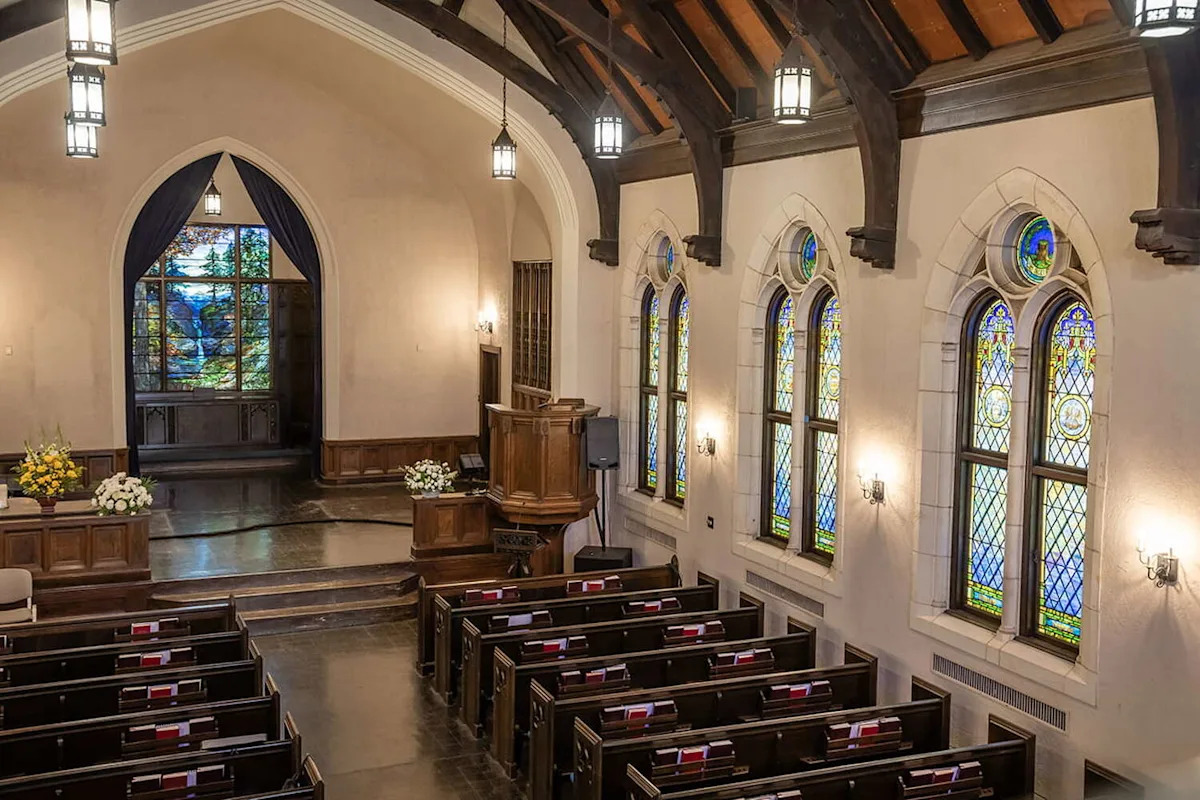
Known as the Fraser Chapel, it was named after William A. Fraser, then “sovereign” or head of the Woodmen, who took a personal interest in its design and furnishings. To appease the forces of not-in-my-backyard, the organization hired local architects and construction crews and built the $150,000 chapel of limestone quarried near Boerne.
For other inspiration, Fraser went to Europe. He purchased a baptismal font of Carrara marble from an old church in Rome, said the San Antonio Express, Jan. 29, 1931, and the overall effect of the chapel, inside and out, was to recall a “traditional English chapel.” The altar window – “The River of Life” – came from Tiffany in New York, by way of Omaha.
As grand as the hospital plant and its chapel were, it served patients only from 1923 until 1956, when antibiotic therapy – drugs that could be administered at home – for TB made its original mission obsolete. The former hospital property was sold to H.B. Zachry, razed and developed into Meadowood (also Meadow Wood) Estates. It was an “ultra-modern subdivision of finest homes” platted in 1957 for 115 lots on 35 acres, just south of the Sunset Ridge shopping center, that opened in 1951.
Only the hospital’s chapel survived. The Sunset Ridge Church of Christ bought the chapel and its grounds in 1959, “agreeing to maintain (it) in as close to the original condition as possible,” says a history in an undated church brochure provided by the San Antonio Conservation Society library. While additions have been made, “all attempts have been made to keep these additions in harmony with the original design.”
One big change has been made to what is now the Sunset Ridge Church & Collective at 95 Brees Blvd. “The River of Life” window was moved in 2025 to the Crystal Bridges Museum of American Art in Bentonville, Arkansas.
The decision to part with the window wasn’t easy, said Taylor Bates, deputy director. It was “more than a valuable artifact; it was part of our spiritual landscape. But it also required a level of preservation, security, insurance, and specialized care that had grown beyond our ability to responsibly provide.”
At Crystal Bridges, the Tiffany window is now on display in a new gallery, along with an Arkansas window, one of several that represented states where the Woodmen operated. “We believed its future would be best served in a major public art museum where it could be professionally conserved and experienced by a much broader audience,” Bates said, noting that Crystal Bridges offers free admission to more than 850,000 annual visitors.
Since its removal from Sunset Ridge Church, “we have commissioned a local San Antonio artist to create a replica that will be installed in its place.
RELATED: Convention Center stained glass
Reader Nichols also had heard that a house on Irvington Drive in Terrell Heights “was used to portray (singer Selena Quintanilla’s) home in the movie “Selena” and wondered if that was true.
Express-News reporter Rene Guzman, who wrote an April 16, 2024, story about locations used in the 1997 biographical film “had heard about a house on the South Side used for exterior shots, but not a house in Terrell Heights.”
But there might be something to it, since a former resident, who lived in the 300 block of Irvington Drive and was quoted in the 2005 neighborhood story said her dog “made it into the movie.”
Anyone with suggestions about Terrell Heights lore and landmarks may respond to this column. All replies will be forwarded and may appear in a future column.
Thanks to Beth Standifird of the San Antonio Conservation Society Foundation library and Debbie Countess of the San Antonio Public Library’s Texana/Genealogy Department for research help.
historycolumn@yahoo.com | X: @sahistorycolumn | Facebook: SanAntoniohistorycolumn
Subscribe
There’s more to San Antonio with the Express-News. Subscribe today for just 25¢.
This article originally published at Tiffany window has been treasured in three settings.