
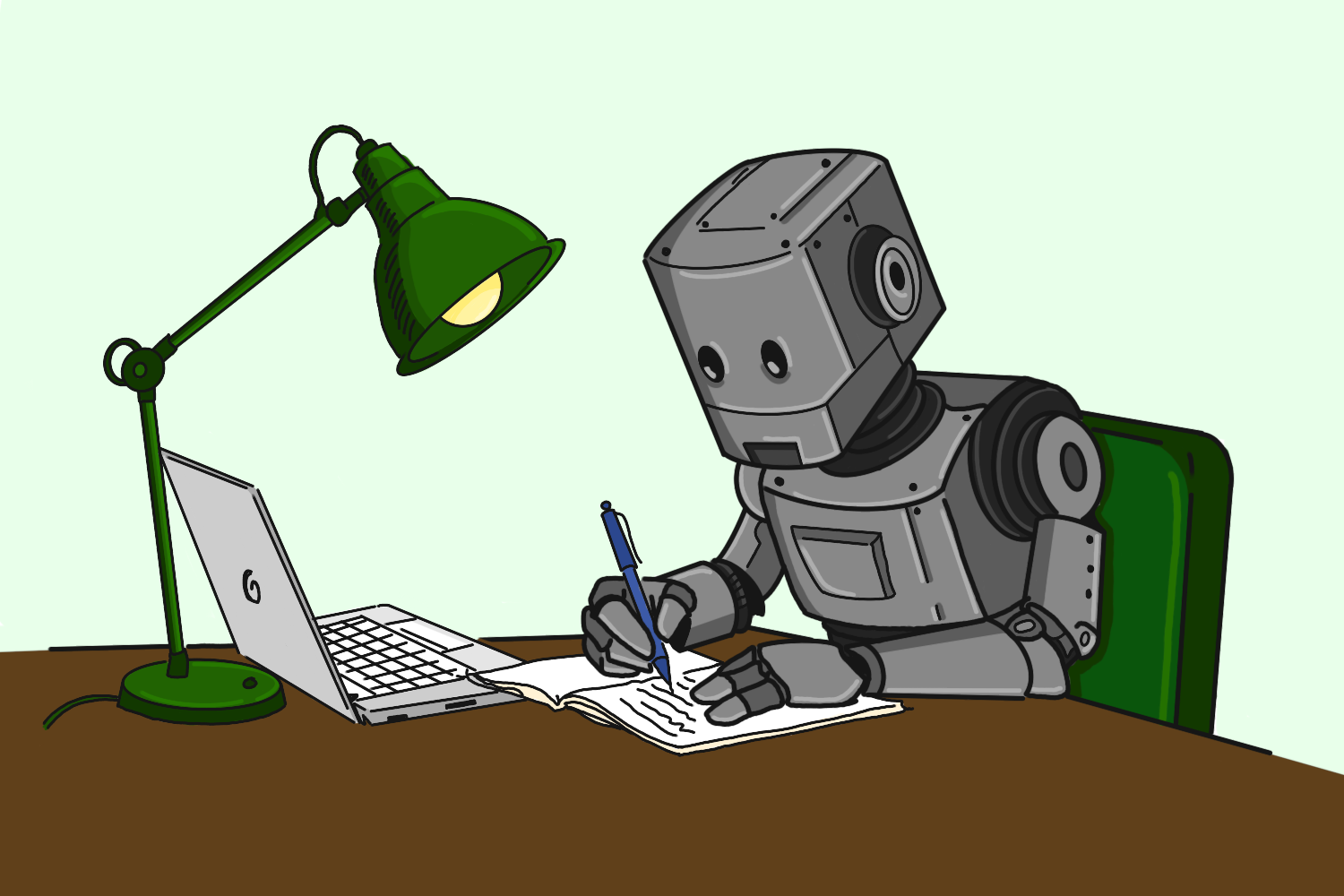
UT announced last month that students and faculty would receive free access to Anthropic Claude EDU and ChatGPT EDU. While having premium tools to assist with homework — or maybe even do it for you — is something that students may be excited to use, blanket access to these powerful tools threatens the development of students’ critical thinking.
The idea that “AI is here to stay” has dominated discussions surrounding AI’s integration in higher education. Technological determinism is the theory that suggests technology shapes the cultural, social, political and economic changes beyond human control. This theory, however, is not universally accepted. In “Technology Matters (2006),” historian David E. Nye argues that the adoption of technology is a choice guided by cultural priorities and made by institutions and people, who then bear responsibility for the consequences of those choices.
A 2026 survey of 1,055 U.K. students found that 46% of undergraduates worry that not using AI puts them at a competitive disadvantage. Students may not be explicitly forced to use AI, but the university’s endorsement of these applications puts pressure on students who choose not to use these tools.
Julie Schell, assistant vice provost of academic technology, supports AI use to “augment learning.” However, though Schell is a proponent of using AI to delegate tasks, she argues using AI to complete assignments from start to finish can affect learning.
“You’re giving away analytical skills, you’re giving away quality assurance … you’re giving away pulling information from your memory — which is called retrieval — you’re giving away practice and iteration … and transferring your knowledge,” Schell said. “That can really create atrophy.”
Tutors and simple search engines don’t do this, so when an institution makes this option free, students are simply working within the parameters the university has allowed them to — something a few sentences on a syllabus cannot stop.
Keri Stephens, organizational communications professor and co-director of the Technology & Information Policy Institute, has used her Crisis Communication class to teach students about both the uses and the shortcomings of AI. Her midterm asks students to use AI to draft a crisis plan, then critique and rewrite it to promote “humans staying clearly in the loop.” Even so, she has heard students say, “I’m only a 22-year-old college student. Why would I not believe everything that AI gives me?”
A 2025 survey conducted by The American Association of Colleges and Universities and Elon University found that 90% of college faculty surveyed believe generative AI will diminish the students’ critical thinking skills.
“(People) say, ‘Oh, I’ve had such a good conversation with this system. I can treat it just like a person,’” said Raymond Mooney, a retiring professor in computer science who has studied AI for around 40 years. “It’s not a person. … In some ways, it might seem very smart, but in some ways, it’s still quite stupid.”
Rather than handing students free access to powerful AI tools, UT should place an emphasis on teaching students to scrutinize it. Students should be aware of how it hallucinates and how it erodes the skills they came to UT to build. If we hand out premium access without a foundation of AI literacy, believing students will handle it beneficially is wishful thinking.
“Tell people to be skeptical, check the sources before they just believe something,” Mooney said.
Mooney describes the current state of AI with a Charles Dickens quote: “It was the best of times, it was the worst of times.”
That difference is made by institutions like UT, which made their choice last month. Let’s hope they make a different one soon.
Chatterjee is a government junior from Allen, Texas.