
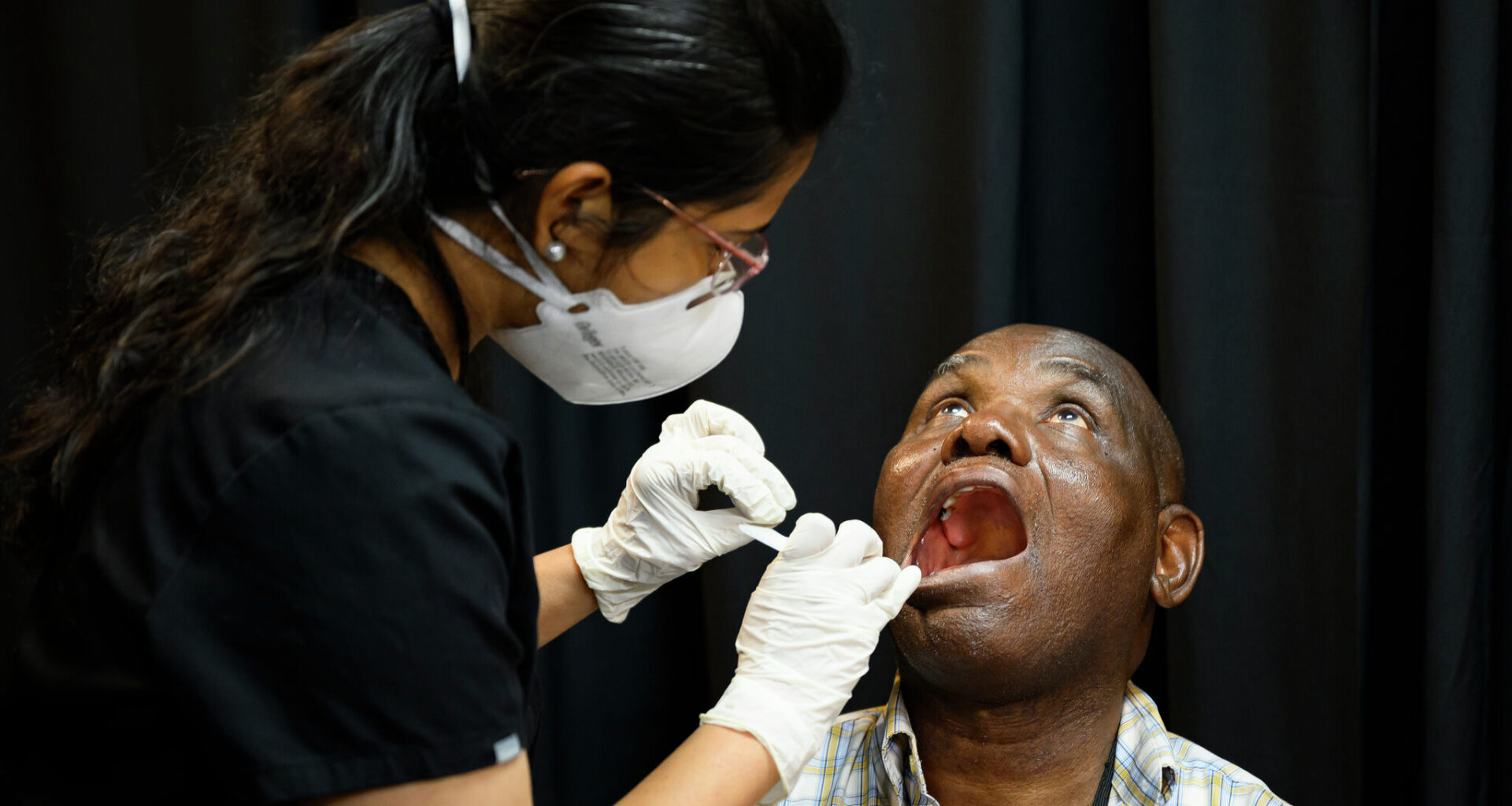
Javier Cortilo talks with a member of the nonprofit Health Collaborative at the collaborative’s monthly Neighborhood Preventive Health Clinic.
Ethan E. Rocke/Contributor
Javier Cortilo, 59, who is unhoused, uninsured and has had five heart attacks, said free health clinics like the ones offered monthly by the San Antonio-based nonprofit Health Collaborative can be “lifesaving.”

“A heart attack doesn’t forgive,” he said in Spanish. “But with this help they’re giving here, I know I have a place to come to.”
Article continues below this ad
The West and South sides of Bexar County are among the areas of the region facing healthcare provider shortages; residents often “would need to arrange transportation to get to another part of the County to see their doctors and specialists, or they would miss out on healthcare altogether,” according to the 2025 Bexar County Community Health Needs Assessment Report.
“This shortage limits access to specialty care as well as early detection and preventive care — both essential for maintaining the good health of a community,” University Health CEO Edward Banos wrote in the report.
The Health Collaborative, dedicated to improving health outcomes in Bexar County and South Texas, is stepping in to fill that gap. It is hosting monthly Pathways to Health neighborhood health clinics to prevent chronic diseases from progressing to the point of no return. The organization moves its clinics to a different location every month, trying to focus on healthcare deserts: June’s edition was at the Faith Based Institute, a church on the West Side. There, the population is mostly uninsured and “definitely underserved,” Pastor Tena Jackson said.
San Antonio Express News Logo
Make us a Preferred Source on Google to see more of us when you search.
Add Preferred Source
READ MORE: Nonprofit offering free health clinic this weekend in San Antonio. Here’s what you need to know.
Article continues below this ad
Filling the gap
The clinics give families who are facing cost and transportation barriers access to basics like blood pressure checks; height, weight and body mass indexing; 3D mammograms; tests for diabetes; cholesterol tests; prescription refills for those who cannot afford them; hearing screens; dental assessments; and health literacy and education information, said Elizabeth Lutz, the Health Collaborative’s executive director.
Larry Mitchell receives a dental assessment at the nonprofit Health Collaborative’s monthly Neighborhood Preventive Health Clinic at the Faith Based Institute on the West Side.
Ethan E. Rocke/Contributor
Established in 2018, the nonprofit has served more than 15,000 families and resolved 32,000 identified needs with the help of its community health workers. They go through training to become certified by the Pathways Community Hub Institute, a national nonprofit that partners with grassroots organizations to build a care coordination network. The volunteers work one-on-one with community members to provide guidance and connect them to resources like medical care, housing, food and employment.
Article continues below this ad
“Many families fall in a gap where they don’t make enough to put food on the table but make too much to qualify for government services,” Lutz said. “So, where people don’t have resources like a computer, we become their computer.”
Fuji Walker, the collaborative’s program director, said the organization focuses on a holistic approach to help the community “thrive, not just survive,” offering individuals a helping hand through an entire process focused on overcoming the fear of seeing a doctor and building trust with providers.
Spotting health problems and preventing them before they worsen heads off visits to the emergency room for non-emergencies, she said. Preventive care can cost about $50 while an emergency room has a minimum cost exceeding $500, according to the needs assessment report.
People wait to receive dental assessments at a Neighborhood Preventive Health Clinic hosted by the nonprofit Health Collaborative on the West Side.
Ethan E. Rocke/Contributor
“If we just give them food and clothes when they need, we are just putting a band aid on it,” Walker said. “No one was taking this holistic care coordination approach like us.”
Article continues below this ad
RELATED: Downtown nonprofit helps homeless San Antonians battle mental illness
Catching conditions preemptively
The church where the June clinic was conducted also regularly partners with the San Antonio Food Bank, hosting free food giveaways every fourth Saturday with no eligibility requirements — which is how Cortilo and other recipients found out about the health clinic. Forty-two of the 250 San Antonians who got food at the church also received a full health screening. Of those, 28 were uninsured, and 21 scored high for pre-disposition of diabetes, Lutz said.
One in every three people in San Antonio has prediabetes and one in six already has type 2 diabetes, according to UT Health San Antonio. At 16% type 2 diabetes prevalence, the city is 6 percentage points higher than the national average. Diabetes is more highly prevalent in Hispanics, who make up over 60% of the Alamo City’s population.
Article continues below this ad
Dora Trevino, a registered nurse volunteer with the nonprofit Health Collaborative, checks vital signs for Michael Fuentes, a Navy veteran who attended the collaborative’s Neighborhood Preventive Health Clinic on the West Side.
Ethan E. Rocke/Contributor
The diabetic epidemic can be linked to a combination of social determinants of health, including lower income and education, genetic factors and a higher prevalence of lifestyle-related risk factors such as obesity and lack of exercise. Bexar County has one of the highest rates of diabetes-induced amputations in both the state and nation, where nearly 69 of every 100,000 people will have a limb amputated because of diabetes, according to an earlier report. The prevalence of diabetes tends to be far greater in impoverished neighborhoods.
Maria Palmas, 44, said that she lives an an area of the city with no hospitals or doctors closer than a 20-minute drive. She doesn’t have a car, nor does she have health insurance, she said, because she lacks enough money. But she found out about the clinic through her friend who drove them to the food bank.
“There is so much information here for those of us who don’t have insurance,” she said in Spanish.
Article continues below this ad
RELATED: Relationships outside of doctor’s office could help fight diabetes, according to San Antonio study
‘A community standing united’
Similarly, Michael Flores, 52, who was laid off from his job in April and on the verge of being evicted, found out at the clinic that he was hard of hearing. Earlier, he said, he thought his hearing was fine. He was also able to get his medications refilled, which he said he had “no money to be buying lately.”
“This is what the people need, a community standing united to help each other,” Flores said.
Article continues below this ad
The Health Collaborative’s funding comes from both public and private grants, Walker said, which they are “out here begging for.” So help from volunteers provided by the host churches or those who partner with the organization go a long way.
Dr. Hussein Musa, CEO of Kingdom Healthcare System, prays with Innocent Habimana, a blind man with no insurance who Musa saw during a Neighborhood Preventive Health Clinic hosted by the nonprofit Health Collaborative. “People need this,” Habimaba said. “It’s important for people to be able to come here and get help. It means a lot.”
Ethan E. Rocke/Contributor
Dr. Hussein Musa, CEO of The Kingdom Healthcare Clinic, a nonprofit on the Southeast Side, was also volunteering at the neighborhood clinic, where he treated patients for hours. He said helping others “was definitely a calling” for him and his wife, Dr. Adetoun Musa, who works alongside him. Every Monday, they offer their own free clinic from 10 a.m. to 2 p.m. to offer physical exams, medication refills, health counseling and prayer at 4025 E. Southcross, Bldg.1, Ste. 5. There, they also rely on volunteers.
“Without access to primary care, you wait too long and go to the emergency room, which is not designed for comprehensive care,” he said. “Going to the ER once a year will not change your habits.”
Article continues below this ad
The Health Collaborative’s next clinics are set for July 18 at Life Choices Medical Clinic at 3234 Northwestern Drive on the West Side; Aug. 8 at Kingdom Healthcare System at 4025 E. Southcross Blvd., Building 1, Suite 5 on the Southeast Side; Oct. 4 at Greater New Birth Church of Christ at 1719 Burleson St. on the East Side; and Nov. 4 at Life Choices again. All run from 10 a.m. to 3 p.m.