
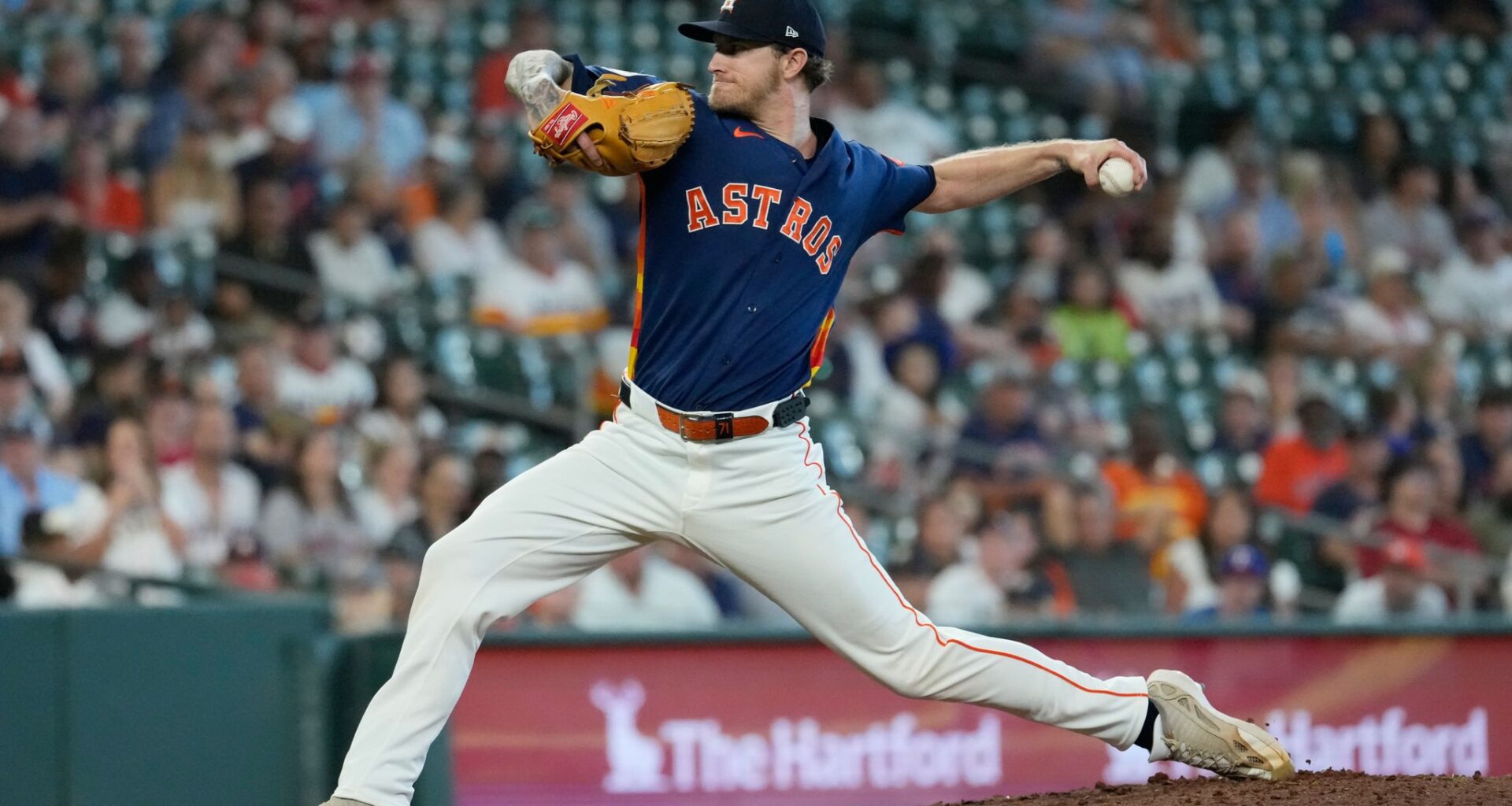
WASHINGTON — A gap of almost 10 months between major-league outings due to injuries invited at least some question about how sharp Josh Hader could be initially upon his return to the Houston Astros last month.
Results provide a clear answer. Hader made his 15th appearance since his return Sunday against the Rays. In 15 innings, the left-hander has allowed one earned run and two hits, walked seven batters, struck out 24 and converted all nine of his save chances.
The sample is still small but reflects the kind of dominance expected from Hader, who is in the third year of a five-year, $95 million contract. Since at least 1995, just 17 relievers have allowed two or fewer hits in their first 15 outings of a season, per Baseball Reference. Only Hader has done it twice in that group.
His current stretch is heartening for the circumstance. Hader ended last season on the injured list with a shoulder capsule sprain and started this season on it due to biceps inflammation that arose during his buildup to spring training. His only previous time on the injured list was on the COVID-19 IL in 2021.
That makes his return this year something of uncharted territory. So far, the results appear familiar. The Astros are not using Hader for more than three outs, at least for now. But he has already crossed other thresholds, such as pitching back-to-back days and making three appearances in four days.
While injury rehab and recovery were objectively new, Hader said Monday that a focus during his return was preparing to pitch with the automatic ball-strike (ABS) challenge system that Major League Baseball introduced this season.
“You’re not getting pitches (called strikes) that you typically would,” Hader said. “So that was my biggest thing was being able to attack the zone, because you can’t do much behind in counts.”
For pitchers, getting ahead and then expanding the zone is nothing new, but the early stages this season showed the impact wrought by ABS’ introduction. Entering Monday the league-wide 9.0% walk rate was the highest in a full-length season since 2000. The rate of pitches in-zone was the second-lowest in a full-length season and down 3% from last year, per Baseball Savant.
Hader did not pitch in spring training games, missing that chance to acclimate to the ABS zone, which is relative to individual hitters’ heights but widely regarded as smaller than in past seasons. His five rehab outings at Double-A didn’t afford an opportunity either, as ABS is not used at that level, making his four Triple-A rehab appearances valuable.
“I think Triple-A set me right,” Hader said. “Obviously, my fastball at the top got hit a couple times in the minor leagues in my rehabs. But at the same time that just showed that there were some outings that I had to get the fastball inside line, so I had to really work on pounding the inner half of the zone with the heater or trying to throw the ball at the top of the zone. I had to go through those home runs or those at-bats to make sure my lines were good.
“That’s why you don’t really take into account the results (on rehab), more so did I execute what I was trying to do. The result’s the result. If I’m executing and getting my lines with my pitches, now when I get to the point where I’m in a game up here (in the majors), it’s like I already know that line, now I can just use my sequencing to manipulate the zone and manipulate the hitters to where I can get them to chase things that I want them to chase.”
In his first 15 outings, Hader threw first-pitch strikes to 72.2% of batters faced, which would be a career-high and well above his 61.1% career mark. He also generated a 43.8% chase rate, well above his 32.2% career mark. He did walk seven of 54 batters faced, a 13% rate that would match his career high, though three of those walks occurred in one outing in Detroit.
Sustaining his early results seems unlikely, yet other aspects of Hader’s start are auspicious. His fastball velocity has resembled its pre-injury average last season. His slider has generated a 60.5% swing-and-miss rate. Hader’s slider has looked slightly different, averaging an extra tick of velocity, four inches less of vertical drop and about 2.5 inches less of horizontal break than last season, per Baseball Savant.
“I change up my sliders throughout the year (facing) different teams and stuff like that,” Hader said. “But last year, like I said, we didn’t have ABS, so I have to try and make those pitches look almost identical to the heater. So it’s just manipulating the slider a little bit and trying to get those to where they tunnel as far as they can.”
Hader has induced a 40.8% overall whiff rate on par with his 40.5% rate of the past two seasons. When hitters have made contact against him, they have averaged a 78.3 mph exit velocity. Tigers rookie Kevin McGonigle hit a fastball from Hader into the Crawford Boxes on June 17 for the lone blemish thus far on his still-young season.
“I can’t control what (hitters) do, but I can control what I do,” Hader said. “And if I know that my lines and tunneling is good and my sequencing is good, I’m going to put myself in a good position to succeed.”