
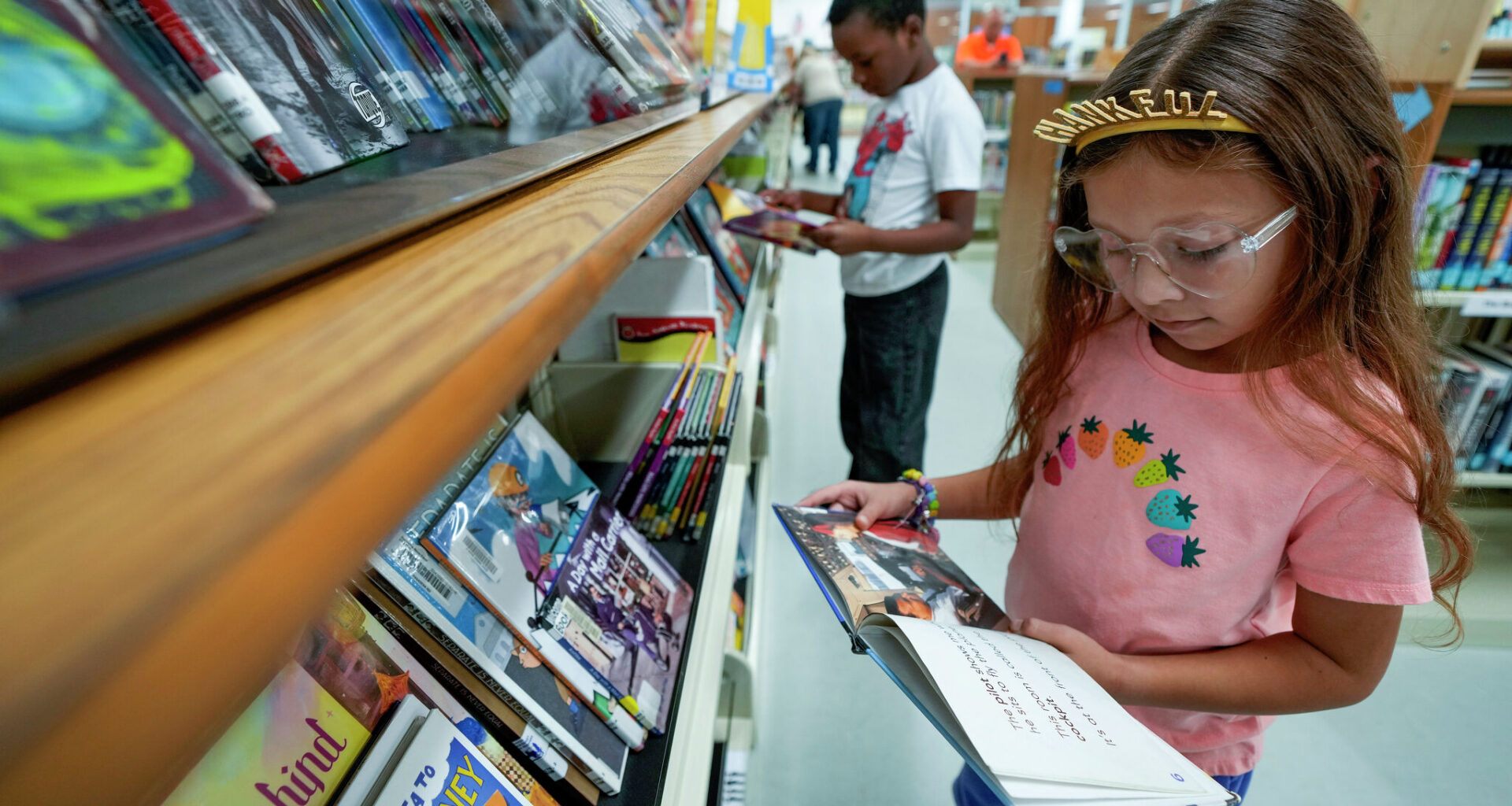
Madalynn Martinez looks at a book to check out from the Burnett Elementary School library in Houston in 2024. Until every child can read proficiently, our focus should remain on evidence-based instruction, state Rep.-elect Montserrat Garibay writes.
Brett Coomer/Staff photographer
The Texas State Board of Education’s recent decision to require public school students to read selected Bible passages reflects a troubling shift away from what should be our state’s highest educational priority: ensuring every child becomes a strong reader.

The issue is not whether the Bible has historical or literary significance. It does. The question is why Texas is prioritizing one religious text instead of addressing the literacy crisis affecting millions of students.
Article continues below this ad
As a former bilingual teacher and lifelong educator, I believe students benefit from studying many influential texts, which can include the Bible when taught in an objective academic context. The Bible has shaped literature, history, art and culture for centuries. But in a public school system that serves students from many faiths, cultures, languages and backgrounds, no single religious text should be elevated above the broader goal of developing strong readers and thinkers.
Texas educates more than 5.5 million public school students, yet reading outcomes remain deeply alarming. According to the most recent National Assessment of Educational Progress (NAEP), often called the Nation’s Report Card, only about one in three Texas fourth and eighth grade students reads at or above proficiency. Achievement gaps remain especially wide for emergent bilinguals, students from low income families and historically underserved communities.
RELATED: Texas didn’t stumble into this school crisis. It built it
Gov. Greg Abbott has led Texas since 2015. During that time, our classrooms have experienced chronic underfunding, teacher shortages, increasing political interference and repeated attacks on public education. Instead of investing in the needs of students through early literacy programs, school libraries, reading specialists and teacher preparation, state leaders continue to prioritize ideological debates.
Article continues below this ad
Research consistently shows that students become stronger readers when they engage with rich, meaningful and culturally relevant texts. That does not mean excluding the Bible. It means ensuring students encounter materials that both reflect their own identities and introduce them to perspectives beyond their own. Literature should serve as both a mirror and a window, helping students see themselves while expanding their understanding of others.
Texas is one of the most diverse states in the nation. More than 40% of our public school students are multilingual. Our classrooms include families from many religious traditions and cultural backgrounds. Texas’ curriculum should reflect that diversity by a broad range of authors, cultures, histories and viewpoints that prepare students to thrive in a global society.
The goal of reading instruction is not simply exposing students to important texts. It is teaching them to analyze ideas, evaluate evidence, recognize bias, compare perspectives and communicate effectively. These analytical and critical thinking skills prepare students for college, careers and engaged citizenship.
ALSO READ: Morath’s public education crusade puts more than tax dollars at risk
Article continues below this ad
Students develop those skills through diverse literature, meaningful discussion and excellent teaching, not through state mandates that prioritize one tradition over others.
Public education exists to serve every child. We should trust educators to select age appropriate, academically rigorous materials that reflect the diversity of Texas while helping students become thoughtful, informed readers.
If state leaders truly want to improve student outcomes, they should fully fund public schools, strengthen teacher recruitment and retention, invest in school libraries, expand access to high quality instruction, and ensure every child has books that inspire curiosity and a lifelong love of reading.
The Bible deserves a place among the many influential texts students may study as part of a well-rounded education. But it should not become the centerpiece of a political agenda that distracts from the urgent work of improving literacy.
Article continues below this ad
Texas doesn’t have a Bible problem. It has a literacy problem. Until every child can read proficiently, our focus should remain on evidence-based instruction, educational excellence, and a curriculum that reflects and serves the rich diversity of all Texas students.
Montserrat Garibay is the representative-elect for Texas House District 49 in Central Austin. She is a former bilingual teacher, a former senior leader at the U.S. Department of Education under the Biden Administration and a public education advocate for more than 25 years.