
Choose a museum. It doesn’t matter which one. When it’s too hot outside, head indoors. The weather’s always fine inside these five Austin history museums.

Three of the five exhibits focus on the history and ideas of America at 250. A fourth toasts the stories and images of Texas community festivals, while the fifth shares the natural history of bats, who are smart enough to stay out of the daytime heat, too.
Crowns, parades and giant pecans
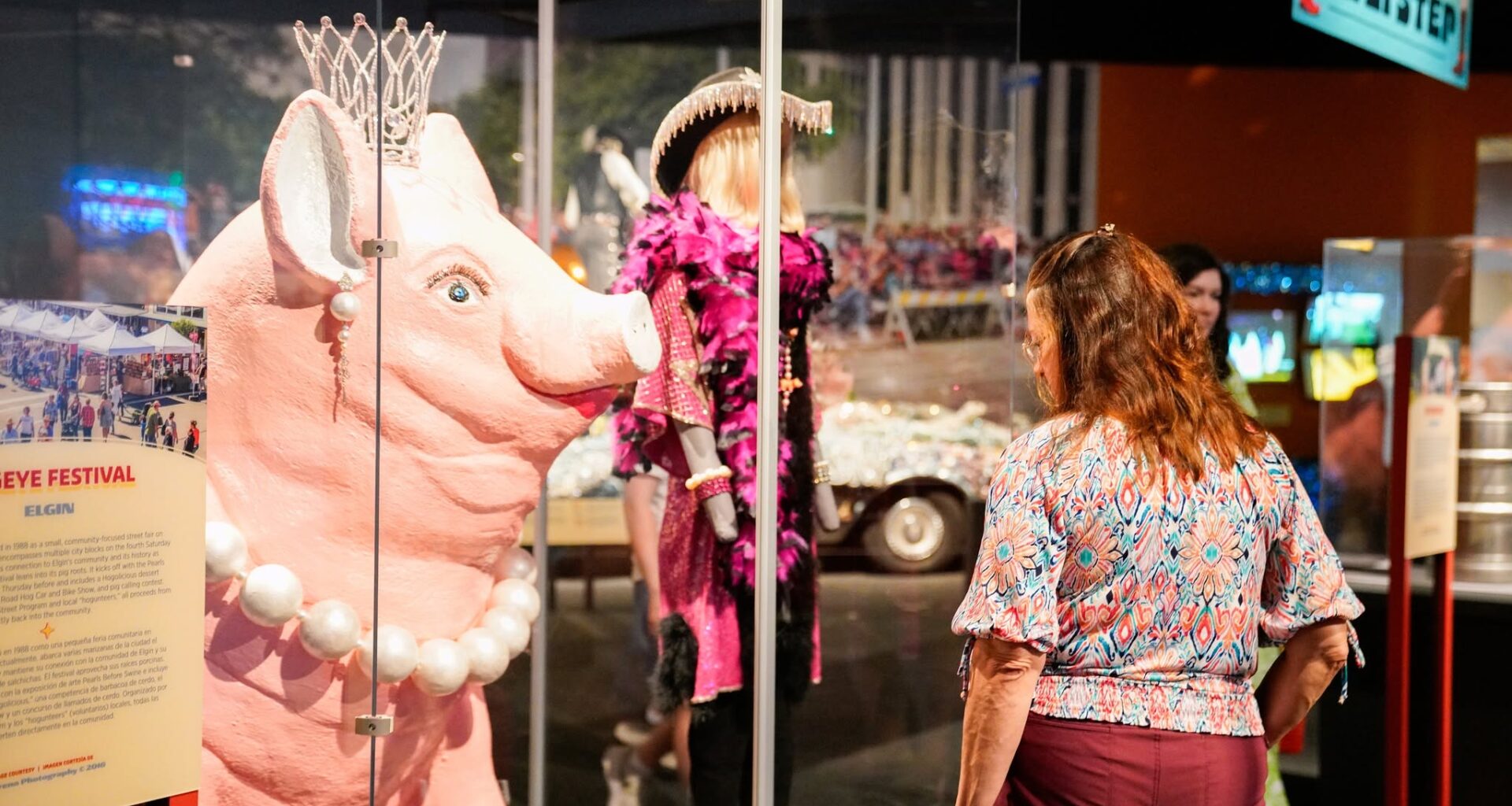
The Hogeye Festival in Elgin includes mascot Priscilla the Pig.
Bullock Texas State History Museum
When Kathryn Siefker, senior curator at the Bullock Texas State History Museum, envisioned the current playful exhibit, “Texas Festivals,” she urged the museum’s employees to fan out across the state. Did they ever! In 27 Texas small towns and big cities, they noted a giant pecan (Seguin), a trophy for spitting watermelon seeds (Luling), a neon strawberry festival sign (Poteet), a fat-headed onion mascot (Weslaco), as well as models for Priscilla the Pig from the Hogeye Festival (Elgin) and Big Jake from the Texas State Forest Festival (Lufkin).
Article continues below this ad
What might surprise some visitors to the show, which runs through Sept. 27, are the displays of sparkling regalia designed for festival royalty: crowns, scepters, sashes, robes, trains, costume jewelry and more. Locally chosen kings, queens and royal courts were — and in many cases, still are — key parts of community festivals. Traced to agricultural fairs and pageants that go back at least to the early 20th century in Texas, these temporary aristocrats promoted local products and heritage. They often traveled to other community festivals as ambassadors for their hometowns.
Perhaps the most amazing display of all is a Texas SandFest mermaid fashioned on site by a master sculptor from a pile of special granules imported from Port Aransas. A ton of the sticky stuff was shipped to Austin because experts insist that the Mustang Island beach materials make superior sculptural shapes.
Founded in 1997, Texas SandFest is the largest beach sand sculpture competition in the United States. Each April, some 500,000 square feet of beach beckons tens of thousands of visitors and more than 400 volunteers.
Article continues below this ad
Respect is due. (thestoryoftexas.com) — Michael Barnes
LBJ Library brings America’s founding documents to Austin
The original Statue of Liberty Deed of Gift is on display at the LBJ Presidential Library in Austin as part of “The American Experiment: Pursuing Our Promise.”
Jay Godwin/Provided by LBJ Presidential Library
The light inside the LBJ Presidential Library feels different on a summer day. It almost feels cautious — designed to protect documents that have survived generations of political change and the people who created them. This summer, those papers are going on public display.
Article continues below this ad
To mark the nation’s 250th anniversary, the LBJ Library has opened “The American Experiment: Pursuing Our Promise,” a rotating exhibition built from National Archives materials that trace the evolution of American identity through landmark documents, signatures and decisions. The exhibition is open through Jan. 10, 2027.
The LBJ Library is the only presidential library in Texas hosting both sets of National Archives touring exhibits, part of a broader program that stretches across two installations and several months. The documents rotate in and out: Alexander Graham Bell’s telephone patent, the Statue of Liberty’s deed of gift and Thomas Edison’s light bulb patent in one wave; the Louisiana Purchase, the original Senate amendments that would become the Bill of Rights and early designs for the Great Seal in another. Starting July 11, visitors can find the Fourteenth Amendment, as well as the Brown v. Board of Education decision.
Taken together, the exhibits ask a central question: What does it mean to participate in an American experiment 250 years in the making? (lbjlibrary.org) — Ana Gutierrez
How to interpret the country’s flag and other potent symbols
The flag, like other American symbols, can be interpreted in countless ways.
Briscoe Center for American History
In any ordinary year, the Fourth of July is loud. In 2026, that percussive experience has been kicked up a notch because we are toasting the semiquincentennial of our country’s Declaration of Independence. Face it, the word semiquincentennial is harder to pronounce — and a bit harder to understand — than bicentennial, which we saluted in 1976 through countless community events and actions on the 200th anniversary of our country’s divorce from the British Empire.
Article continues below this ad
Anyone else remember the more than 900 helpful and instructive “Bicentennial Minutes,” mini-documentary episodes that ran from July 4, 1974, until Dec. 31, 1976, on CBS? This year’s anniversary, and for that matter, CBS itself, feel different.
Given the inescapable hubbub associated with “America at 250” on the state and national levels, it has been a relief to spend quality time in quiet museums contemplating just what all this means.
Pay attention to the Briscoe Center’s “Stars, Stripes and Symbols: America at 250,” which runs through Dec. 18 at the research center’s unpretentious but carefully curated galleries in Sid Richardson Hall, across the plaza from the LBJ Library on the University of Texas campus (briscoecenter.org; ask at the front desk about free parking). — M.B.
Congress Avenue Bridge isn’t the only place to see bats
“Masters of the Night: The True Story of Bats” at the Texas Museum of Science and Natural History is definitely family friendly.
Callie Richmond/Provided by Texas Science & Natural History Museum
Not only are our migratory friends, the bats, back in town for the summer, but these cherished flying mammals will haunt the upper reaches of the Texas Science & Natural History Museum at least until August 2027. Yes, even during the cold months, when their wild counterparts leave Austin and head to warmer climes.
Article continues below this ad
That’s because a special collaborative exhibition at the hilltop museum on the University of Texas campus is devoted to these biological wonders. Why so wonderful? For one thing, Mexican free-tailed bats — moms and their pups — consume some 6 million pounds of insects each year during their Central Texas stay. They also pollinate plants and disperse seeds.
“Bats are often misunderstood, but they play essential roles in ecosystems across the globe,” said Pamela R. Owen, associate director at the museum. “This exhibit invites visitors to look more closely, ask questions and gain a deeper appreciation for these remarkable animals.” Learn more about the current show at sciencemuseum.utexas.edu. — M.B.
Texas and American history intertwined
The high, formal lobby at the Texas State Library and Archives Commission is not large. At least compared to the imposing façade of the Lorenzo de Zavala Building that houses this treasure trove of papers, books and artifacts. Part of the collection, that is, since the library requires several off-site storage facilities, some far away from Austin.
Article continues below this ad
“Texas America 250” is the library’s contribution to the nationwide celebration of the signing of the Declaration of Independence in July 1776. It consists of interpretive banners, inset wall displays and multiple electronic devices. In addition, when the library reading room is not in service to researchers, the librarians are on call to answer your questions. Go ahead and ask.
While the banners explain background about “Texas America 250,” the meat of the show is found in the glass-fronted cases that protect and display thematically arranged artifacts from the library’s collection.
“The Lone Star State has long been home to creativity, ingenuity and dynamic collaborations that have generated unique sounds and scenes in the arts and led to groundbreaking energy, science and research capabilities, benefiting the entire nation,” reads the library’s interpretive display. “Items from our collections show the vast natural resources and beauty of the landscape, images of politicians and presidents, and documents that preserve the record of government action. From cowboys to astronauts, from Beaumont to Big Bend, the country would not be what it has become without Texas.”
Article continues below this ad
The displays concentrate on widely adopted themes such as cattle ranching, oil and gas exploration and production and modern technological innovations. While the well-curated library exhibits won’t absorb hours of your attention, I stop by whenever I’m in the Capitol Complex. (tsl.texas.gov/lobbyexhibits) Nearby is the recently renovated Texas Capitol Visitors Center, another surefire way to dig deeper into our shared past. (tspb.texas.gov) — M.B.