
By Michael Gryboski, Editor Monday, July 06, 2026
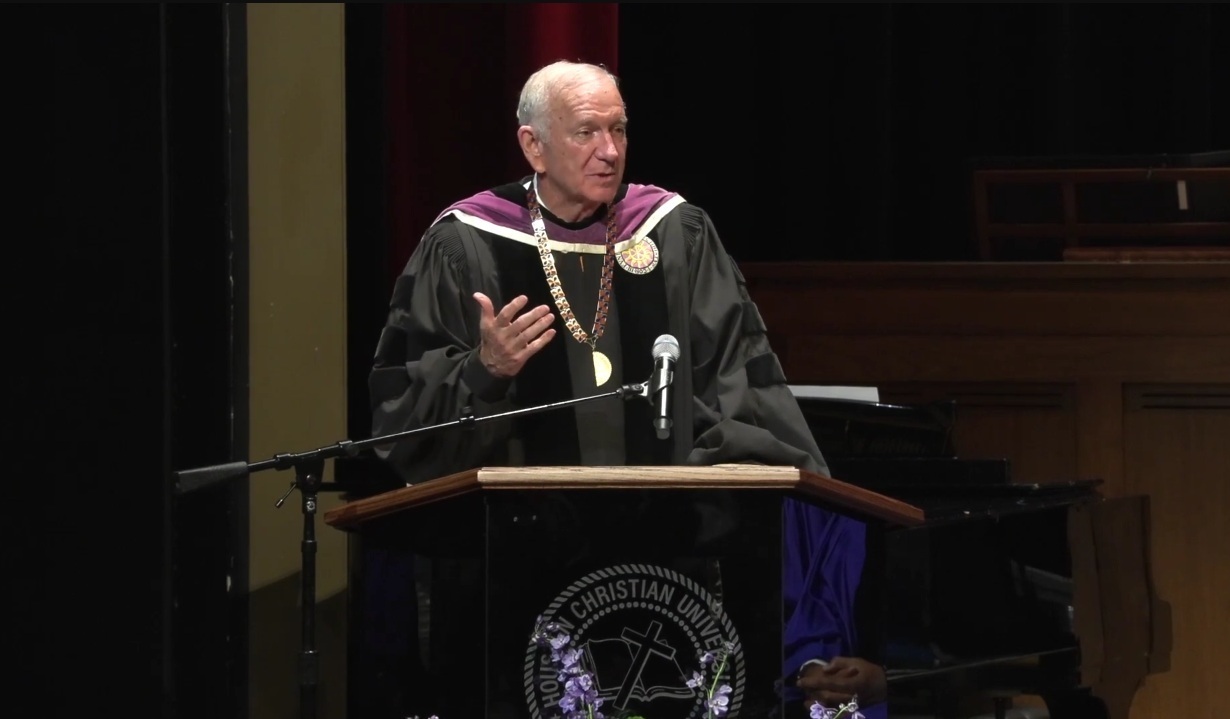
 Robert B. Sloan Jr., president of Houston Christian University, gives a commencement address to college graduate in 2023. | YouTube/Houston Christian University
Houston Christian University President Robert B. Sloan Jr., who is credited with helping expand the status of Baylor University amid controversy, has died suddenly at the age of 77.
HCU Board Chairman Ramiro Peña issued a statement on Saturday announcing that Sloan had died suddenly that morning, asking for prayers for his wife, children and grandchildren.
“For two decades, Dr. Sloan led HCU through her most monumental and glorious years, impacting countless lives of students, faculty, alumni, staff, trustees, and friends,” stated Peña.
“Under the leadership of God’s hand during his presidency, the university experienced unprecedented growth in student population and degree programs, campus construction and expansion, national visibility, and incomparable spiritual awakening.”
Peña added that the “fingerprints of Dr. Sloan’s leadership will continue to be upon the success of HCU for generations to come, and the impact of his presidency will yield outcomes both measurable and eternal.”
Dr. Richard Land, executive editor of The Christian Post, said in a statement to CP on Monday that Sloan was a “tremendous academic leader and spiritual leader” who “provided decades of outstanding administration to Baptist universities in Texas.”
A native of Coleman, Texas, Sloan was born in 1949 and graduated from Baylor University in 1970, then earned a master of divinity degree from Princeton Theological Seminary. Later, he earned doctorate in Theology at the University of Basel in Switzerland.
Sloan was president of Baylor from 1995 to 2005, having also served there as the founding dean of George W. Truett Theological Seminary and university chancellor from 2005 to 2006.
Current Baylor President Linda A. Livingstone said in a statement on Independence Day that Sloan helped to make the Texas-based Christian academic institution into a top-tier school.
“His greatest contribution was the adoption of Baylor 2012, a 10-year vision that placed Baylor on the path to become a top-tier university while remaining committed to our historic Christian mission,” stated Livingstone.
“And that is where Baylor stands today.”
Sloan’s time at Baylor was not without controversy, as some took issue with the implementation of the Baylor 2012 initiative, believing it was too costly and moved the university away from its core values.
In September 2003, the faculty senate at Baylor gave Sloan a vote of “no confidence,” ABP News reported in 2005, while five regents, three former regent chairmen and the editorial board of the campus newspaper called for his removal.
At one point, nearly half of Baylor’s 838 faculty at the time called for his removal from office, though a 2004 vote from the board of regents indefinitely postponed a call for his resignation.
When Sloan transitioned from president to chancellor, Baylor Board of Regents Chair Will Davis said in January 2005 that “Baylor has been through a challenging period over the past 18 months.”
Nevertheless, Davis believed that “you will see ample evidence that President Sloan has led Baylor through a period of tremendous growth and progress” during his time in office.
“Anyone who walks across this campus or talks to faculty, staff, students, parents, donors and alumni, or to higher education leaders across the nation, will see and hear tangible expressions of the progress made under President Sloan,” he added.