
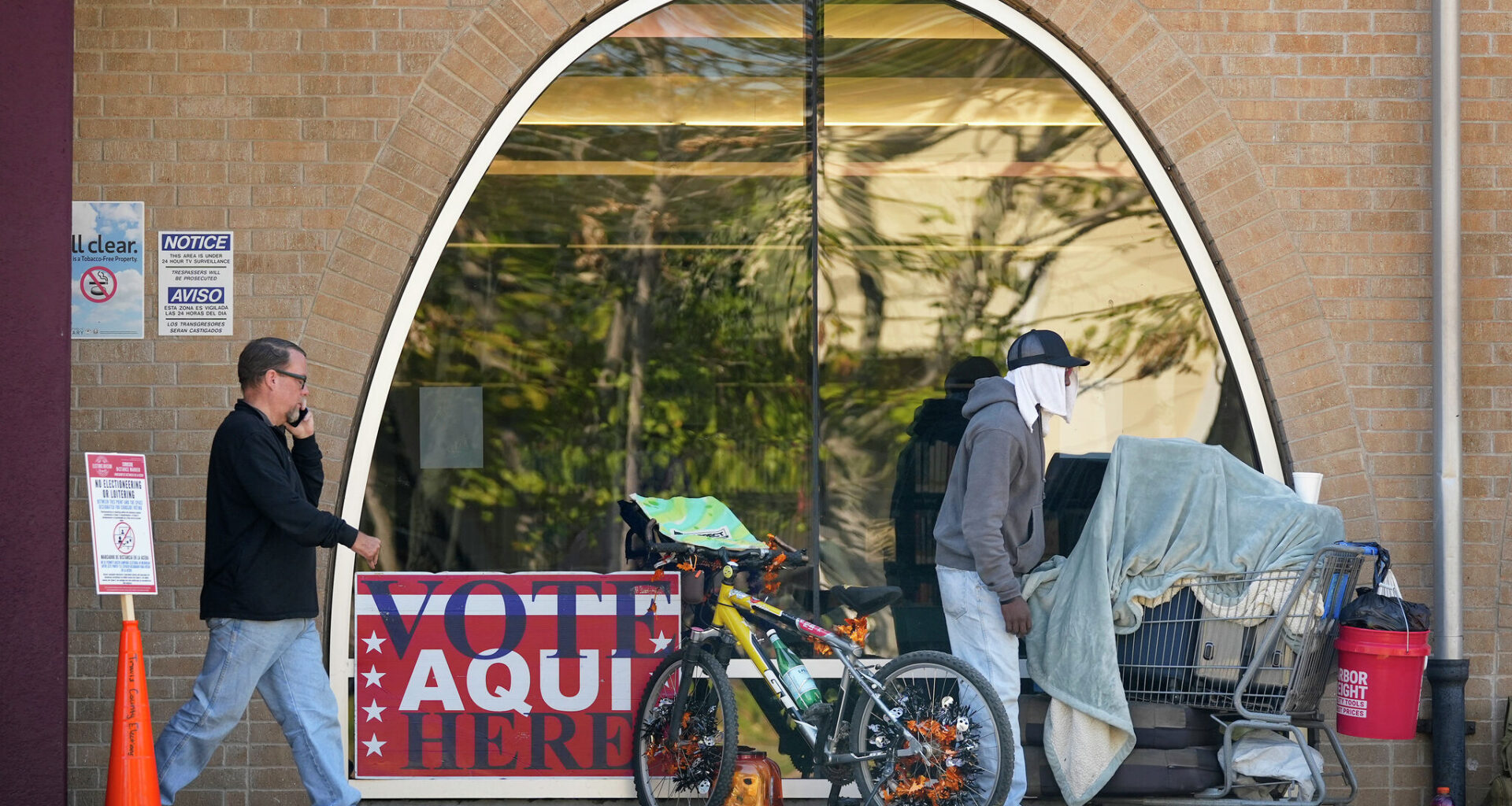
Donald Earl, who said he has been homeless for eight years, stands with his belongings outside a voting location at the Terrazas Branch Library on Tuesday, Nov. 4, 2025.
Jay Janner
Austin budget officials are proposing to phase in millions in planned cuts to the city’s social safety net spending over two years, with the steepest reductions aimed at programs such as transportation, legal services, basic needs and community planning.

In a Thursday memo to Mayor Kirk Watson and City Council members, Austin Budget and Organizational Excellence Director Kerri Lang said a previously announced $16.8 million reduction to Austin’s $74.2 million social services contract portfolio should be spread out over the next two fiscal years. That would mean a $6 million to $8 million cut in the 2026-27 budget, followed by an additional $8.8 million in the 2027-28 spending plan, according to the memo.
Article continues below this ad
The proposal comes days before City Manager T.C. Broadnax is expected to deliver a pared-down budget proposal to Austin City Council that must account for a $26 million projected deficit. The 11-member council may make amendments to that plan as it sees fit before adopting a final budget in late August.
Broadnax zeroed in on social service spending late last year after Austin voters rejected Proposition Q, the council-backed tax rate election that would have raised property taxes to help fund a slew of initiatives, includingsocial services. In late February, City Council directed his office to develop a standardized rubric to help decide how to spread the cuts across services for Austinites in need.
Transportation, legal aid and basic needs face deepest cuts
Thursday’s memo outlines much deeper reductions to certain categories of spending while noting staff are still refining recommendations. The preliminary plan would largely spare behavioral health, homelessness services and clinical services from the largest percentage cuts, while imposing steeper reductions on smaller categories.
Article continues below this ad
Transportation services could be reduced by up to 38%. Basic needs and legal services could each be cut by up to 35%. Family services could be reduced by up to 34%, while workforce development and HIV services could each face cuts of up to 32%.
The city is also proposing to eliminate one service category entirely: community planning, which covers community-led planning efforts, civic engagement and neighborhood capacity building in historically underinvested areas. Staff identified it as a lower-priority investment area and proposed cutting its $251,431 budget by 100% in fiscal year 2026-27.
Meanwhile, categories including behavioral health programs and health equity and clinical services would see reductions of only about 10%. Homelessness services, the largest category in the city’s social services portfolio at $33.8 million, could be cut by up to 10%, too.
Article continues below this ad
The cuts would follow a round of social service reallocations the city made after Prop Q failed. According to the memo, Austin adopted an amended fiscal year 2025-26 budget that did not reduce the overall amount of social service funding but shifted dollars among providers. Some received increases, while others saw reductions of up to 10%.
As part of the broader review, city staff also determined that about $27 million in contracts currently listed in the social services portfolio primarily support city operations. Those dollars will be moved into the operating budgets of Austin Public Health and Homeless Strategies and Operations to continue funding city-owned emergency shelters, bridge shelters and domestic violence shelters.
Staff also identified $5.6 million in operational contracts that provide services similar to those funded through the social services contracting process. Those contracts have been included in the broader review and may also be considered for reductions.
How city officials decided what to cut
The city began its review in February, when staff started gathering feedback from social service providers, local government partners, OneVoice Central Texas and city advisory commissions. Broadnax also hosted five community budget listening sessions in March. Staff said that feedback helped shape the framework used to evaluate existing social service focus areas and contract investments.
Article continues below this ad
The review covers 15 focus areas, including homelessness services, behavioral health, health equity, crisis response, child and youth services, violence prevention, basic needs, legal services, transportation and community planning. A separate, more comprehensive analysis of the city’s housing investments is expected to continue through the fiscal year 2026-27 budget process.
A final proposal will be presented as part of the proposed city budget for City Council consideration.