
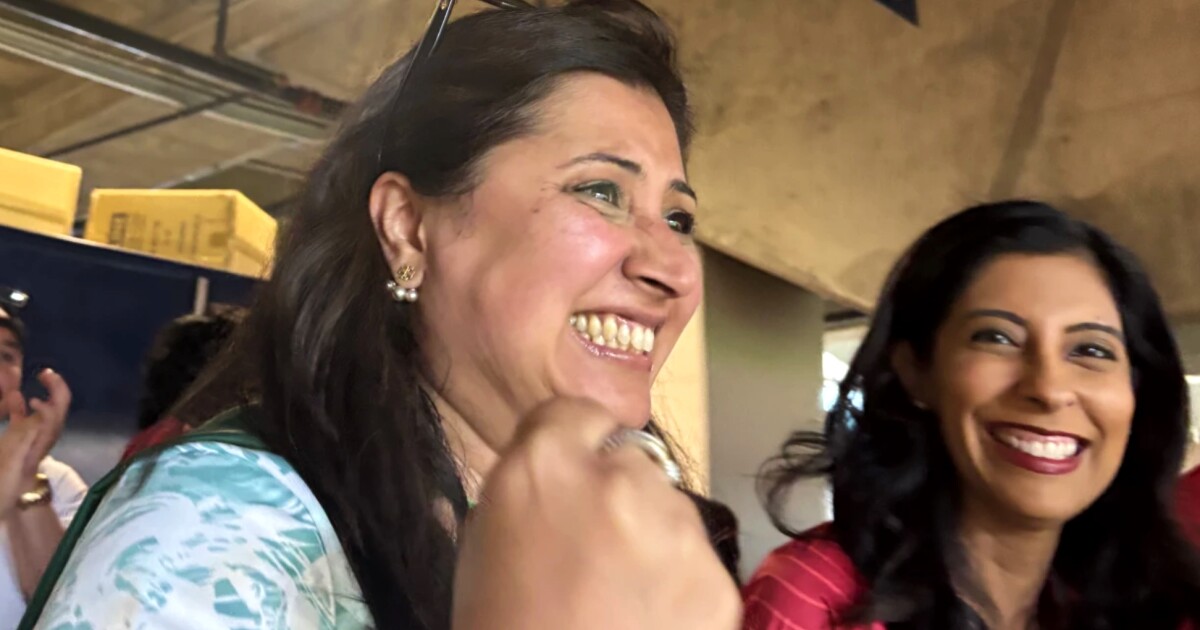
The World Cup is first and foremost about the sport of soccer. But for Farah Ali, it’s also about reconnecting with heritage and childhood memories.
Growing up in Lisbon, Portugal, her father and grandfather took her to Sporting CP matches — the underdog team at the time, but now the club best known as the first professional team of legendary footballer Cristiano Ronaldo.
And while Spain’s 1-0 win eliminates Portugal from the tournament and marks the end of Ronaldo’s World Cup career — he announced earlier that it would be his last run — Ali says she was proud of him.
“I thought it was amazing that he held his head up high as he left the pitch,” she said. “It just showed that no matter what, you know, it’s for the love of the game and the passion for the game.”
But when her family moved to North Texas when she was a young teenager in the 1990s, she was largely disconnected from the sport.
In 1994, a 14-year-old Ali was in the stands at the Cotton Bowl when Germany defeated South Korea 3-2. And while it felt good to be back around soccer, the energy wasn’t the same. It was more quiet.
“I came from a culture where football — what we call football but they call soccer here — was so strong that coming here felt like it was kind of tame,” Ali said.
That’s why this World Cup has been such a special experience. Walking into Dallas Stadium at the front of Portugal’s fan march, the energy was unlike anything she’d seen in the U.S.
It reminded her of Lisbon.
The match between storied rivals Portugal and Spain had such electricity among the fans that Ali was immersed back into those childhood years.
Ali first went to Houston on June 23 to watch the contest between Portugal and Uzbekistan. She hit the road that morning despite not having a ticket at her brother-in-law’s insistence.
About 30 minutes outside Houston, the brother-in-law came through with a ticket to the match.
She was seated near where the 20-yard line would be in Houston Stadium, around 16 rows up, when the flags were unfurled over the pitch.
“I’m like, completely crying and just bawling and I was like, where is this coming from? I don’t get it,’ ” Ali said. “It was just a sense of pride like, I did it, you know? And then the anthem comes on, and I’m singing at the top of my lungs.”
Portugal’s dramatic 5-0 win in that match led her friends back in Lisbon to call her their lucky charm. Clearly she had to be at the Monday’s match with Spain, too.
Wearing a Portuguese flag over her shoulders, she was at the front of the team’s fan march to Dallas Stadium on Monday, even having her picture featured in an Instagram post by Portuguese soccer magazine A Bola.
Ali still has connections to Portugal and regularly travels back to visit other friends and family who live there. She was born fourth generation Portuguese, her family arriving via Mozambique in the early 1900s, when it was still a colony of the European nation.
Seeing soccer find new popularity in the United States has made her realize the sport is a bigger connection to her past than she knew.
It’s also a connection to Portugal shared by many Americans now, she says. Most people she met for years after her family immigrated to North Texas didn’t know where Portugal was. That’s changed, and she credits soccer and especially Ronaldo for playing a big role in that recognition.
When she was growing up in a family that rooted for Sporting CP, her favorite team was widely considered the underdog. Soccer as a whole has felt that way in the U.S. since she first moved here, but that seems to be changing.
And while Ronaldo’s last game didn’t go the way Ali wanted it, she said she’s glad she was there for it.
“It definitely did hurt. I completely bawled at the end of the game,” she said. “I couldn’t hold it in multiple times, but I’m glad I got to see it.”
It’s also a teachable moment, she said.
“I think that’s a lesson for all of us to carry and to remember, regardless of his skill level and his being the greatest of all time, he still held his head high,” she said.
In the end, she says the sport’s growth in America is still something to celebrate.
“Nobody really saw soccer or football as an option as a professional sport, in my opinion,” Ali said. “So what I grew up with, I feel like that’s finally made its like world stage now in the U.S.”
James Hartley reports on Arlington for KERA News. Got a tip? Email James Hartley at jhartley@kera.org.
KERA News is made possible through the generosity of our members. If you find this reporting valuable, consider making a tax-deductible gift today. Thank you.