
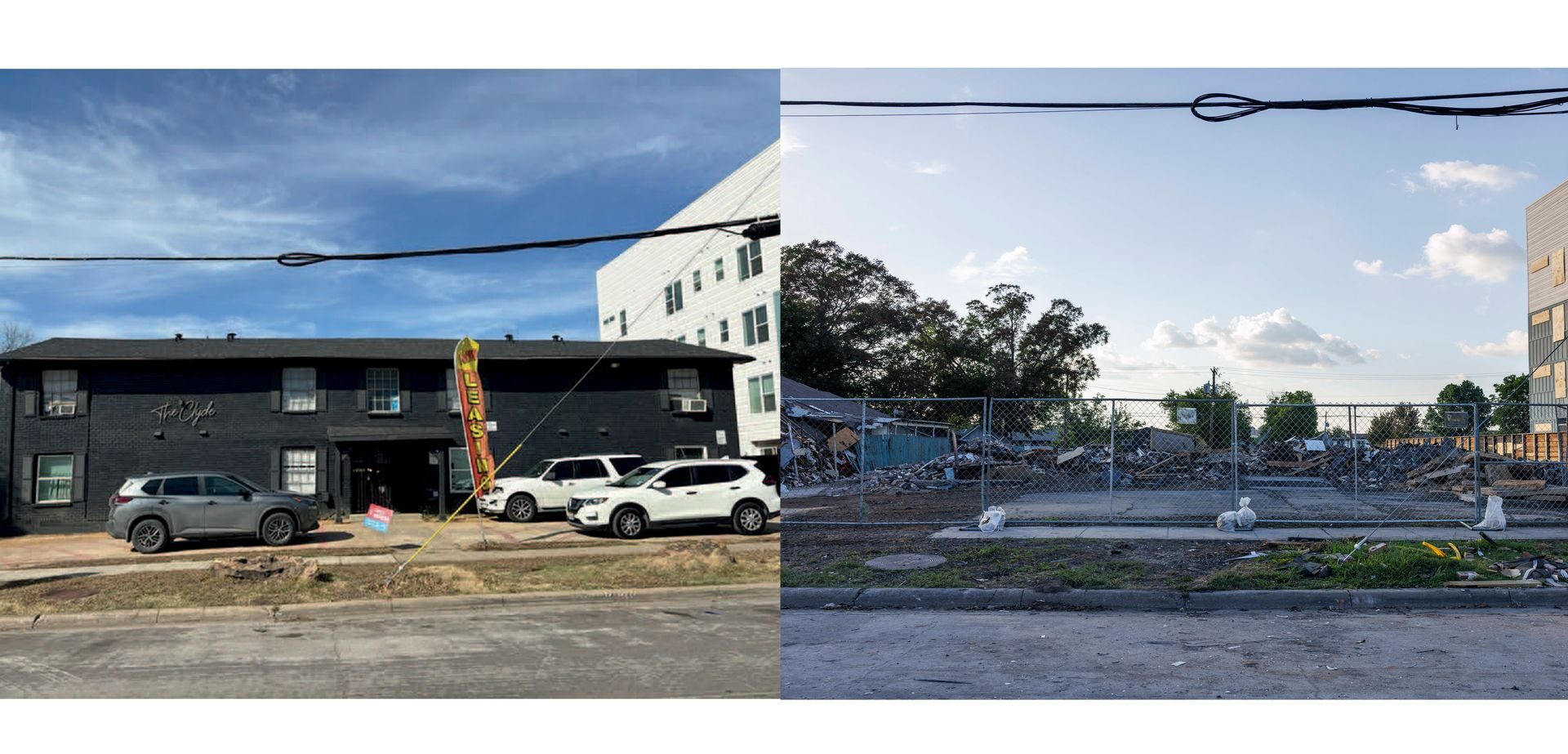
A before and after view of The Clyde, the Dallas apartment building that exploded in May.
Elías Valverde II/Texas Department of Housing and Community Affairs
The system used to locate underground utility lines faces mounting pressure nationwide from rapid growth, heavier workloads and an increasingly crowded web of buried pipes and lines, experts say, making the work prone to deadly accidents like the natural gas explosion and fire that killed three people in Oak Cliff in May.

Though officials are months away from producing a detailed report on the deadly blast, the National Transportation Safety Board, which investigates gas line explosions, said last week a gas line on the property was not properly marked before a contractor ruptured it with a drill just minutes before the explosion.
Line locators, experts say, must deal with tight deadlines and unpredictable workloads. They might not have the best tools for the job. And even if locators do their job right, excavators can make mistakes too.
Article continues below this ad
“There are a series of issues. There’s not one. A lot of them have to be addressed concurrently,” said Sarah Magruder Lyle, who leads the Common Ground Alliance, an industry group that offers best practices for preventing damage to underground utilities. “We’re at a point now where the incremental changes are not keeping up with the amount of construction and requests and calls that’s happening due to the investment in our country.”
The May 28 explosion in Oak Cliff, in which a 23-unit apartment building was leveled, killing three people and injuring at least six others, occurred as a drilling rig was collecting soil for analysis for future construction. The engineering firm that hired the driller had put in a request to mark underground utilities with Texas811, the state’s utility locator system, but the NTSB found that while some lines had been marked, the service line had not.
Atmos Energy Corporation, the natural gas supplier to the apartment, has denied wrongdoing and said it is “actively supporting” the NTSB’s investigation. The company that performed line marking at the site, USIC Locating Services, LLC, previously told The Dallas Morning News in a statement it was cooperating with NTSB but could not comment further due to the ongoing investigation.
To be sure, most underground digging does not result in damage to gas lines, let alone explosions. Atmos’ Mid-Tex division, which includes the Dallas-Fort Worth area and other properties such as Fort Hood and Baylor University, received 1.3 million requests to mark lines before excavation last year, according to data submitted to federal regulators; pipes were damaged 2,377 times.
Article continues below this ad
811 Pitfalls
The one-call process is supposed to be simple: Someone plans to dig, they call 811, utilities are notified, lines are marked and work begins.
Sometimes utilities use their own employees to locate lines; other times they use contractors.
The location process sometimes begins with the locator finding the gas meter for the property, then following signals from a tracer wire buried along the gas line, said Greg Jeffries, an engineer and 42-year veteran of the utility industry. Jeffries has worked as a line locator, owned a location company, served as president of NULCA, the national association representing utility line locators and helps write standards for the American Society of Civil Engineers.
Line locators can also use maps provided by utility companies.
Article continues below this ad
In either case, the locator is supposed to mark the line’s position with paint, flags or both, then report the job complete, clearing the way for the excavator to begin digging.
As straightforward as that sounds, there are pitfalls along the way, Jeffries said. They start with the number of 811 requests that come in each day.
In Texas, state law requires utility lines be marked within 48 hours of a request entering the 811 system. Requests are free, and there’s no limit on the number a single party can submit.
That means, industry experts say, excavators have an incentive to put in extra requests. Say a company needs to dig at multiple sites over a several week period, but doesn’t know which site it can get to first. The company might put in several requests and decide where to start work later.
That’s convenient for the excavator, but drives up the workload for line locators.
Article continues below this ad
And there’s no predicting how many 811 requests will come in on a given day, or how much time they’ll take.
“On Monday they could receive one request and on Tuesday they could receive 100,” Jeffries said. “Or the locator was out on another project and it was problematic, he had issues, so it took him much longer than anticipated. So now he’s delayed in getting to your ticket.”
The tight deadlines and unpredictable workloads make errors more likely.
“There are so many of these little pressures and intricacies that come together that all conspire to create problems in the system,” Jeffries said.
Related: Judge orders Atmos to preserve evidence from Oak Cliff explosion as survivor sues utility
Article continues below this ad
And then there’s potential for problems with equipment or experience.
Line location, which experts say is the most critical step in safe excavation, is not a licensed profession in Texas,, although the industry has talked about it nationally for decades. If locators were licensed like other professionals, they could be required to meet state requirements such as passing proficiency exams, according to the Texas Department of Licensing and Regulation. A licensing agency could also investigate complaints and take disciplinary action.
Each time something tragic like this happens,” Jeffries said, “that discussion ramps up. It gains traction for a little while, and then it slowly fades away.”
Accurately locating utility lines also requires good equipment. Tracing devices have to be properly calibrated. Underground tracer wires can deteriorate.
Even when lines have been located accurately, mistakes can still happen. Someone might pull up a flag marking a line, paint on concrete can wear off and paint on grass can get mowed.
Article continues below this ad
Other accidents can happen if a driller, asked to dig in a tight spot, changes the drilling location so the excavation or drilling equipment will fit.
Accidents can also happen when an excavator digs in an unmarked area, or needs to dig close to a marked gas line.
Sharing maps
Utility companies, experts say, don’t always make maps available to locators or excavators. Atmos did not respond to a question about whether it provided maps of its lines to the locator who marked lines at the Oak Cliff apartment.
But one state is trying to change that.
Minnesota’s 811 system has developed software that lets utility companies share their maps of underground lines as an additional safety measure. Eventually the system could also allow locators or excavators to report back to the utility companies if they find maps are incomplete or wrong, said Kelly Connolly, chief operations officer of Minnesota’s 811 system, Gopher State One Call. The state is making the software freely available and hopes to begin using it on 811 tickets early next year, Connolly said.
Cost vs. Benefit
Industry veterans say preventing damage to gas lines will cost money. Utilities pay for most of the damage-prevention measures, either by hiring their own line locators or choosing between companies vying for a contract.
“The bids keep getting lower and lower,” Jeffries said. “It gets to the point where there’s no way to have enough technicians out in the field to answer these requests within the allotted 48 hours, and to do them exactly correct every time, because the cost for that would be way more than what they’re being paid to do it.”
Regulations also need to be stricter, and financial penalties have to be meaningful, said Bill Caram, executive director of the nonprofit Pipeline Safety Trust located in Bellingham, Wash. The trust was formed when three boys died there in 1999 after a gasoline pipeline leak and explosion.
Caram said he couldn’t speak about Texas in particular, but said in general the industry pushes back on regulations because of cost.
“If it were cost effective to have these regulations,” Caram said, “then you probably wouldn’t need the regulations in the first place, because they would be saving money by doing it.”
Mourners leave the funeral for Dallas community activist Sylvia Collins, at Kessler Park United Methodist Church in Dallas, Texas, Saturday June 13, 2026. Collins was one of the victims of the Oak Cliff gas explosion.
Anja Schlein/The Dallas Morning News
In the 2025 Texas legislative session, two bills aimed at easing pressure on the 811 line-marking system failed to make it out of committee. In October, lawmakers held a hearing with industry representatives to discuss whether the law should be modernized.
At the hearing, state regulators, utility operators and locators grappled with how to prevent costly utility strikes that sometimes are fatal.
The bulk of the discussion in the hearing centered on water utilities’ participation in the state’s 811 system. But gas line location came up, too. Keith Wall, director of regulatory affairs for CenterPoint Energy, the Houston-area gas and electric utility, asked for 72 hours to locate a line instead of 48 hours. He also said the law should limit a single 811 request to 1,500 linear feet.
Jeremy Moore, an executive at the line location company USIC, also advocated for increasing the 48-hour window.
The current 48-hour baseline is designed for “routine, short-scope digs,” he said at the hearing. On larger projects involving multiple utilities, he said, that timeline can lead to hurried markings, retickets and mismarks — increasing both safety risks and costs.