
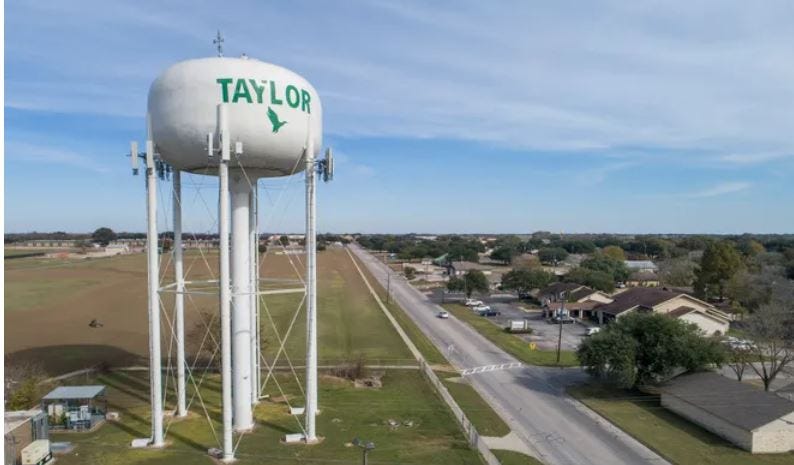
Taylor officials are considering action this week on a resident petition that would temporarily ban data centers until the city develops a special zoning district for them.
Jay Janner/American-Statesman
Another Austin suburb has joined the growing list of Texas cities grappling with the spread of resource-intensive data centers fueled by rising demand for artificial intelligence.

This week, the Taylor City Council will discuss a resident-led push to remove data centers from all current zoning districts and prohibit new ones after more than 1,400 residents submitted a petition to the city.
Article continues below this ad
Erin O. holds up a sign outside a meeting with consultants and staff from EdgeConneX at the Bastrop County Community Center on June 18, 2026 in Bastrop. EdgeConneX hosted its third of three meetings for residents to ask questions and learn about the data center that is under construction in Cedar Creek.
Aaron E. Martinez/Austin American-Statesman
If approved Thursday, the proposal would immediately ban new data center development, though not permanently, remaining in place “unless and until a zoning district specifically created for digital infrastructure uses is adopted,” according to the petition.
“This is not anti-AI, it’s not even anti-business,” Taylor resident and community activist Carrie D’Anna said. “It’s a people-first prerogative.”
Residents push back
The petition comes as grassroots movements against data centers have pushed city, county and state lawmakers across Texas to take action to slow the industry’s rapid growth.
Article continues below this ad
Members of the grassroots organization HALT Taylor Data Centers delivered the petition to the city June 11. Since then, city spokesperson Daniel Seguin said, the city’s legal department has been reviewing its language and verifying the signatures. The City Council will hear the results of that review at its Thursday evening meeting.
Under Taylor’s city charter, a valid petition, one with signatures from at least 10% of registered voters, requires the City Council to either enact the proposed ordinance within 30 days or send it to voters at the next general election.
“We knew that it’s unreasonable to say that we could ban them completely,” D’Anna said. “But it was reasonable to say that we needed adequate protection for the people who already live here.”
Article continues below this ad
Taylor has seen a wave of large industrial growth in recent years, led by Samsung Electronics’ $17 billion chip factory, which is set to come online by the end of the year. The semiconductor plant also has attracted several data centers to the area.
Williamson County is seeing a wave of data center development driven in part by Samsung Electronics’ semiconductor plant set to come online this year. The facility has also spurred significant residential growth in the Taylor area.
Aaron E. Martinez/Austin American-Statesman
In March, the City Council unanimously approved a $2.5 billion data center next to Samsung’s semiconductor plant. Nearby Hutto has given the green light to several data center projects, including Skybox’s 160-acre, 600-megawatt “PowerCampus.”
Taylor also approved a 135,000-square-foot data center planned by Blueprint Data Centers at 1601 E. Martin Luther King Jr. Blvd. in 2024.
Article continues below this ad
But after nearby residents received construction notices on their doors, community members began questioning how the 87-acre site was marked for development.
The tract was transferred to a public trust for $10 in 1999, with the former farmland earmarked for a public park. The development is about 500 feet from a small neighborhood of about 35 predominantly Black and Hispanic families, D’Anna said.
“We didn’t plan on being data center activists in the beginning, we say there’s an inequity happening here,” she said. “But we started realizing our zoning was just inadequate. It was very easy for data centers to come in and follow the rules, but data centers are not a daycare or a gas station. We stepped back and asked, ‘How can we slow this down to get conversation started around this.’”
Pushback against the development eventually led to a lawsuit against Blueprint, though the case was dismissed by a state district court judge in October 2025. The plaintiffs have appealed the decision. Blueprint did not respond to a request for comment.
Article continues below this ad
While those data centers have been approved, the proposal would keep them from receiving permits until the city rezones them.
“Council wants to extend our city limits and incorporate these data centers so they can get the tax revenue, so they don’t miss out on what they say is control,” D’Anna said. “But if you don’t have zoning? That’s not control. It’s just responsibility that the taxpayers are bearing the burden of for the next 30 to 50 years.”
Data center bans
Taylor, roughly 30 miles northeast of Austin, would not be the first to pass a ban on data centers. Last month, San Marcos became the first city in Texas to ban future data center developments months after rejecting a proposed $1.5 billion data center. Niederwald, a small town in Caldwell and Hays counties, is also considering a similar data center ban this week.
Article continues below this ad
More than 1,400 residents signed a petition in Taylor calling on the city to remove and ban data center developments until the city develops a special zoning code. The Austin suburb joins a growing list of Texas cities struggling to regulate the rapidly growing industry.
Mikala Compton/Austin American-Statesman
Last month, Hays County approved a water protection review period that temporarily pauses approvals for data centers and other large, water-intensive developments. Gov. Greg Abbott later called for a statewide ban on new AI data centers in rural neighborhoods, though no such state action has been taken.
DIVE DEEPER: Central Texas emerges as data center hotspot, raising rural concerns
After the petition was submitted, the city created a website outlining its position on data centers, saying the developments “carry high appraised values and generate significant long-term tax revenue for the city and school district,” while producing little traffic because they have relatively small staffs.
Article continues below this ad
Once operating, data centers typically do not create many permanent jobs, though the industry points to the construction work generated by new projects.
Data centers, the server-filled buildings that power much of today’s computing, have become a hot-button issue in Texas as they spread beyond Austin, Dallas-Fort Worth, San Antonio and Houston into more rural communities.
The American-Statesman is tracking more than 75 data centers between Temple and San Antonio, including at least 11 in Williamson County.
Article continues below this ad