
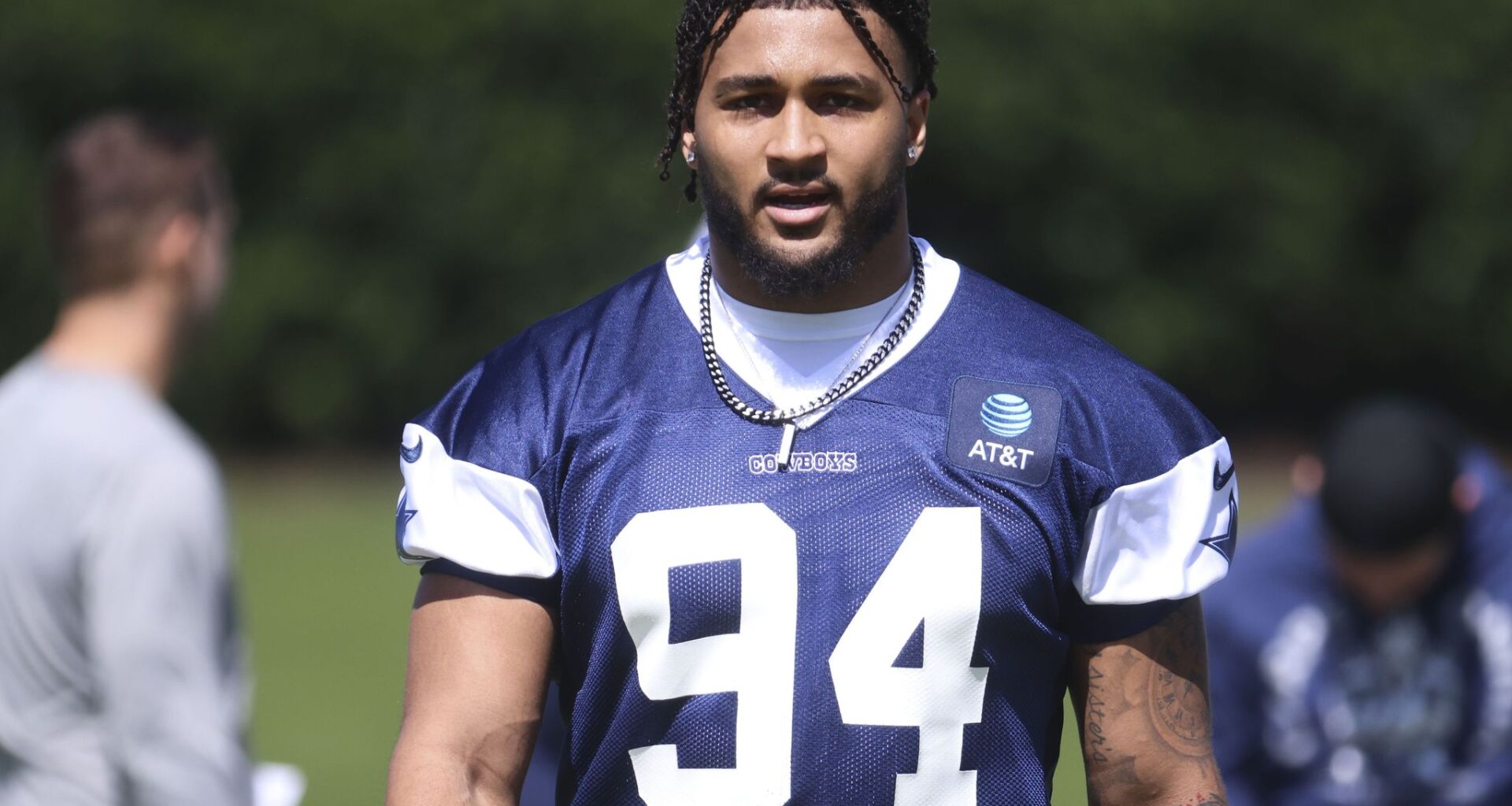
Dallas Cowboys defensive end Marshawn Kneeland (left) exits the field following a rookie minicamp, on Friday, May 10, 2024 at The Star in Frisco.
Shafkat Anowar/Staff Photographer
Former Dallas Cowboys defensive end Marshawn Kneeland had stage 1 CTE when he died by suicide in November, according to an announcement from the Concussion and CTE Foundation on Tuesday.

“Unfortunately, I was not surprised to find CTE in the brain of Mr. Kneeland, because we have found this progressive brain disease in nearly half of the athletes we’ve studied who have died before the age of 30,” Dr. Ann McKee, director of the Boston University CTE Center and chief of neuropathology for the VA Boston Healthcare System, said in the announcement.
CTE — or chronic traumatic encephalopathy — is a disease likely caused by repeated head injuries, according to the Mayo Clinic. Stage 1 CTE has been linked to headaches, loss of attention and concentration, as well as short-term memory problems, depression, “explosivity and executive function issues,” in some individuals, according to the CTE Society.
Article continues below this ad
A 2023 study of about 150 athletes who played contact sports such as football, hockey and rugby and died before age 30 found more than 40% had early-stage CTE.
Related: Dallas Cowboys’ Marshawn Kneeland had stage 1 CTE. Here’s what to know about the disease
Kneeland’s family asked for privacy, according to the announcement, but his family and his girlfriend, Catalina Mancera, released a statement.
“While this diagnosis does not change the tragedy of his passing, it provides important context about some of the struggles he may have been facing. We share this information to help people understand what NFL and other high contact sport athletes might be struggling with. Raising awareness is important to us. We continue to remember Marshawn with compassion for the person he was, rather than defining him by the final moments of his life. One Love.”
Article continues below this ad
Kneeland was 24 when he died by a self-inflicted gunshot near the team’s facility in Frisco on Nov. 6. A police chase preceded Kneeland’s death. According to Plano police, a welfare check was called for Kneeland at 11:30 p.m. the night before, but Kneeland wasn’t there. Kneeland was found dead by police roughly two hours later.
In an audio recording obtained by The Dallas Morning News, Kneeland’s girlfriend told police that Kneeland was armed. She also told police that he had a history of mental illness and he would “end it all.” Police also said in a recording before midnight that they learned Kneeland had texted his family goodbye.
Kneeland’s mental health history spanned back to his college days. Police performed two welfare checks on Kneeland while he attended Western Michigan, according to ESPN.
Related: Marshawn Kneeland’s death spotlights mental health stigma in Black community
Kneeland became a star pass rusher at Western Michigan. The Cowboys selected him in the second round in the 2024 NFL Draft. Kneeland had 26 tackles in 18 NFL games. He recovered a fumble and scored his first NFL touchdown the game before he died.
Article continues below this ad
Teammates and coaches remembered Kneeland for his effort on the field and his smile off it.
“He was magnetic with his personality,” said former Cowboys special teams coach John Fassel, who coached Kneeland during his rookie season. “He was hard-working and tough and it was just a fantastic combination of all the right things, which makes this honestly even more tragic, just because of the person that he was.”
Kneeland’s girlfriend was pregnant at the time of Kneeland’s death. She gave birth to their son, Makhai, on June 11. Cowboys head coach Brian Schottenheimer said they showed a picture of the baby during a team meeting.
A memorial fund was set up and shared by the Cowboys shortly after Kneeland’s passing. It was made to help Mancera and Makhai.
“When you’re part of our family, you’re family for life,” Schottenheimer recently said. “So we want to make sure we do a great job of looking out for her and baby Makhai.”
Article continues below this ad
Mental Health Resources
The Crisis Text Line offers 24-hour support. Text “HOME” to 741741 or find more information at crisistextline.org.