
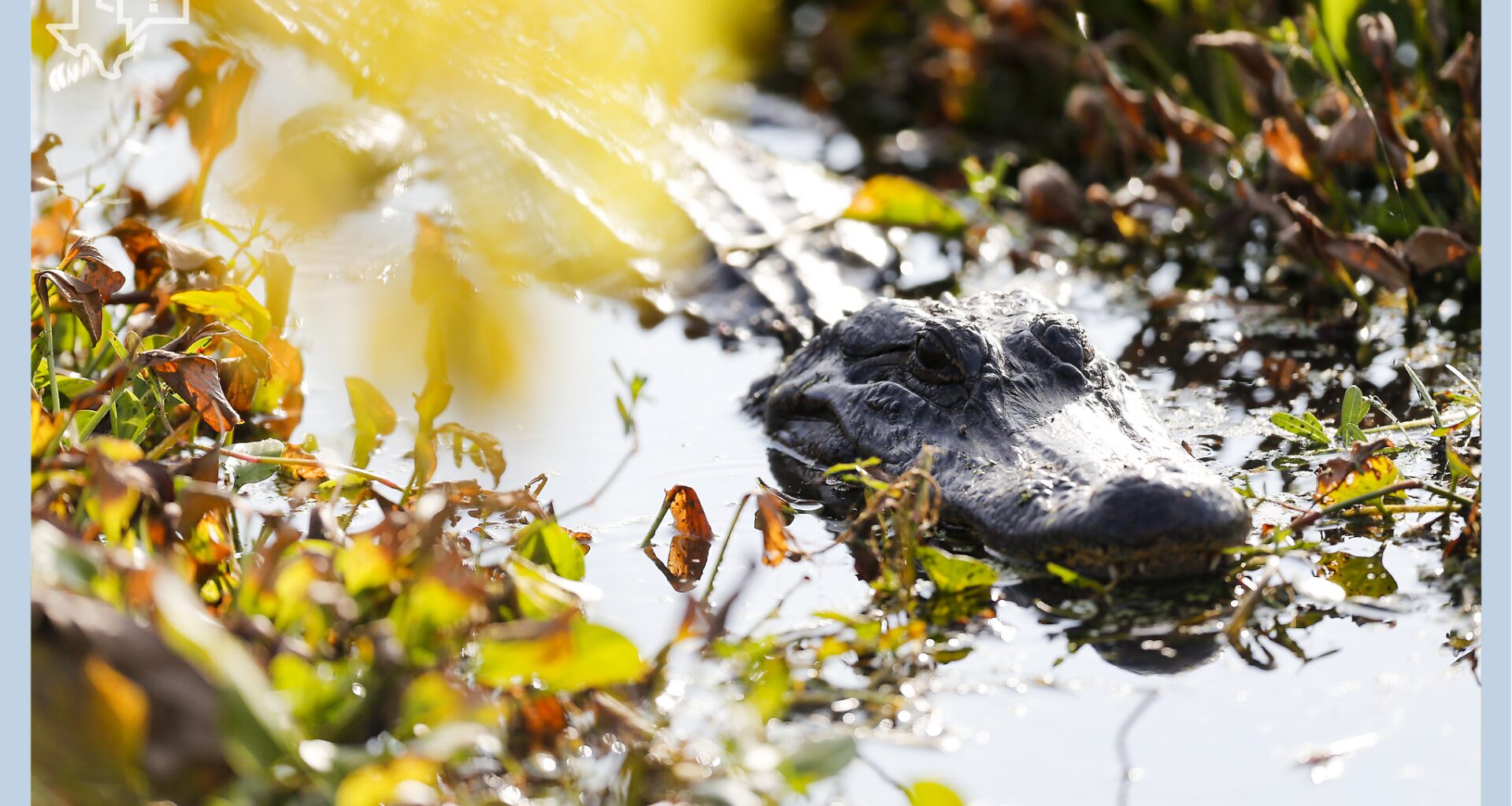
An American alligator lays in shallow water near the trail at Brazos Bend State Park in Needville, Texas on Monday, Nov. 25, 2019.
Elizabeth Conley/Houston Chronicle
Join us on a journey to better understand Houston, one question at a time. Sign up to get the Houston Explained newsletter in your inbox every Tuesday and Friday.
If a Houstonian could travel back in time to the summer of 1776, they would not recognize this place.
Where today’s freeways cut through prairies and modern skyscrapers mingle with the clouds, there were instead vast wetlands and unsullied bayous teeming with wild birds and alligators. And as the nation was being written into existence more than a thousand miles to the east, herds of bison waded through seas of tall grass, the meadows speckled with wildflowers of every color and swarms of monarch butterflies.
Article continues below this ad
There were people here, too, at least for part of the time. Not the Spanish, who had claimed what’s now Texas since the early 1500s but had largely ignored what today is the Houston region, but the Karankawa, the Atakapa and other semi-nomadic Indigenous peoples who lived off the land for thousands of years before Europeans and, later, Americans came to trade, to war, to die of mosquito-borne illnesses in this climatically (and, eventually, politically) unforgiving pocket of the Gulf Coast.
In just a quarter millennium, that world — the people and the ecosystems that called this region home before anybody else — has been lost to time and urbanization. But, if you know where to look, glimpses of it survive.
The land
One of those places is Brazos Bend State Park, an hour southwest of downtown near Needville, where the prairie and the wetlands still look more or less the way they would have in 1776. Near the nature center stand several live oaks that arborists estimate to be more than 300 years old, which would have made them decades old when the Declaration of Independence was signed.
Article continues below this ad
Jonathan Argo, who works at the park’s nature center, said massive live oaks like that one, dripping with Spanish moss and covered in resurrection ferns, were common in the Houston region back then as they are now.
“That means they’ve lived in several different countries,” he said, “but they’ve never left this spot.”
Also common across the region were the prairies, savannas, marshes and waterways you can find scattered about the park. Those grasslands, 250 years ago, would have been teeming with life that has mostly vanished from the Houston region now: grazing bison, wolves, ocelots, monarchs, fireflies and plenty more.
Perhaps the ecosystems Houston has most regretted losing are the wetlands. The marshes and bayous held the region’s water, absorbing floods and letting them seep slowly back into the ground.
Article continues below this ad
“The reason Houston floods all the time is because those wetlands were destroyed, paved over,” Argo said. “Houston was built in its place.”
The people
Argo said the park sits on ground that Indigenous groups moved through for millennia, hunting, fishing and gathering rather than farming it like the massive ranches that today surround Brazos Bend.
“There’s evidence of indigenous habitation here going back 3,000 years,” he said.
That’s also the case for most of Southeast Texas.
Article continues below this ad
The Karankawa lived and moved along the coast and Galveston Bay, eating fish and shellfish in what is still a massive fishery. Meanwhile, the Atakapa and their Akokisa band lived inland along Buffalo Bayou and the rivers that fed it.
They ate what the region gave them: oysters and fish, deer, alligator and the bison that grazed the coastal prairies. What they left behind, mostly, were middens, heaps of discarded shells and bones that still turn up along the bayous and around Galveston Bay.
All while dodging hurricanes no one could forecast, floods that tore through the prairies, mosquitoes that swarmed the wetlands and a heat that has not let up to this day.
But the violence and disease that allowed Europeans to conquer the Americas would eventually reach this coast in the 19th century, and the people who had outlasted the torrents and punishing climate of this place for thousands of years could not outlast that.
Article continues below this ad
The politics
Europeans had been stumbling onto this coast for hundreds of years by 1776.
The Spanish mapped the Texas coastline in 1519, but it wasn’t until explorer Álvar Núñez Cabeza de Vaca was shipwrecked near Galveston around 1528, leaving him stranded among the coastal Indigenous peoples for years, that a European actually traversed the region.
The result was that Spain claimed the region on paper, like it did almost everything else in this hemisphere, but left it otherwise alone for centuries.
That was until the 1720s, when French traders from Louisiana slipped into the territory to trade furs, skins and bear grease along the Trinity River and Galveston Bay. Unwilling to let the French gain ground, Spain planted a mission and presidio called El Orcoquisac near the mouth of the river in 1756.
It went terribly. Battered by hurricanes, floods, heat and isolation, it was abandoned around 1771.
So when 56 men signed the Declaration of Independence five years later, it meant nothing in this place so hostile it had sent an empire running. That is, until the new nation (and its people) started creeping west.

What is your Houston question?