
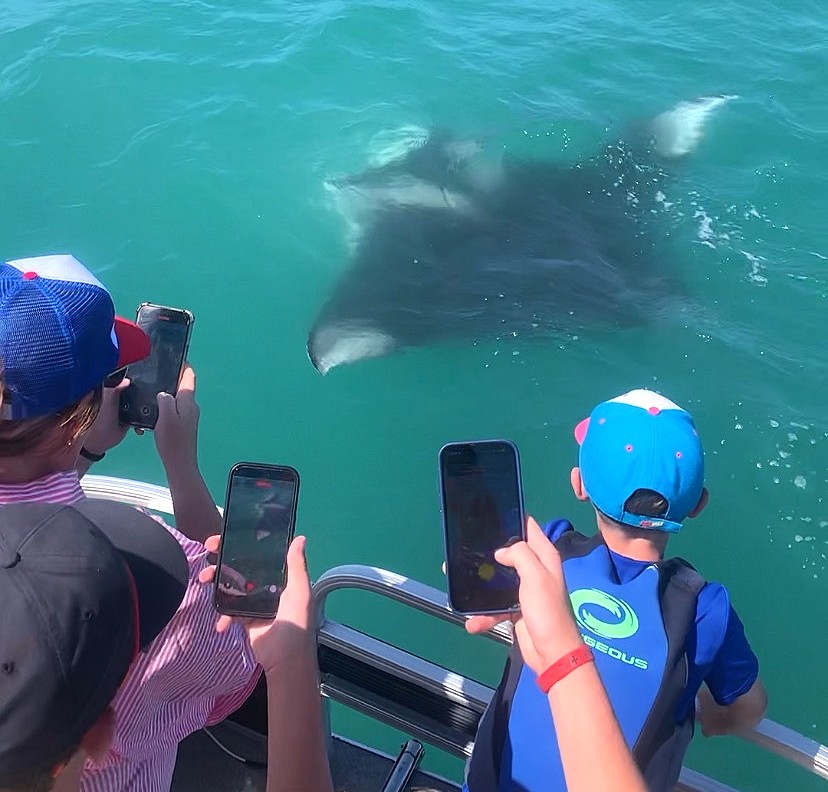
A South Texas fishing guide had a once-in-a-lifetime experience while leading a group of tourists on an expedition over the Fourth of July weekend — an experience with a gentle giant of the ocean that left him awed for the first time in nearly 20 years on the water.
“I don’t get excited like that very often,” Captain Michael Rasco, of Tritoon Charters, told MySA on Monday, July 6.
Rasco was speaking about a large manta ray he and his clients encountered while on a sightseeing trip in the waters off South Padre Island on Friday, July 3. Not long after, Rasco posted video of the manta ray to social media the following day. The placid sea creature easily dwarfed Rasco’s 8-foot-wide boat. After spending the last 17 years sharing the wonders of the South Texas coast with tourists, it was Rasco who found himself as amazed as his guests when they spotted the creature, whose wingspan he estimated to be between 8 to 10 feet.
“That thing was humongous,” Rasco said.
The charter caption spotted the manta ray swimming in the Brazos Santiago Pass near the jetties at the mouth of the Brownsville Ship Channel. That day, the wind, weather and currents had combined to create the ideal conditions for ultra clear turquoise waters. Rasco thinks it was those rare conditions that drew the equally rare manta ray in so close to shore.
“It was just those couple of days that lined up just right and we were able to see it,” Rasco said.
The docile creature was feeding on a shoal of small fish that had been schooling near the northern side of the jetties at Isla Blanca Park on South Padre Island. The ray repeatedly plunged through the school of small fish with its mouth agape, which Rasco said looked like a brown cloud as they scurried to escape next to his boat.
“It was cool seeing it feeding. … People ask, ‘Well, why was it here?’ Well, it just followed that blue water in,” he added a moment later.
There are two kinds of manta ray: the giant manta ray — often called the oceanic manta ray — and the reef manta ray. Both species are threatened with extinction and are classified as endangered and vulnerable, respectively, by the International Union for Conservation of Nature. The wingspans on a giant manta ray can get as much as 23 feet across, while reef mantas max out at around 16 feet. It’s not often that manta rays are seen so close to shore. They tend to spend most of their time in deeper waters, though they can be spotted near reefs and “in productive coastal areas” around the world, according to the National Oceanic and Atmospheric Administration.
“I just kept going on and on about how it was out of place, and how I had never seen one in all these years. It was super cool. I wish more people could see it,” Rasco said.