
 Credit: Charles Grand for CandysDirt.com
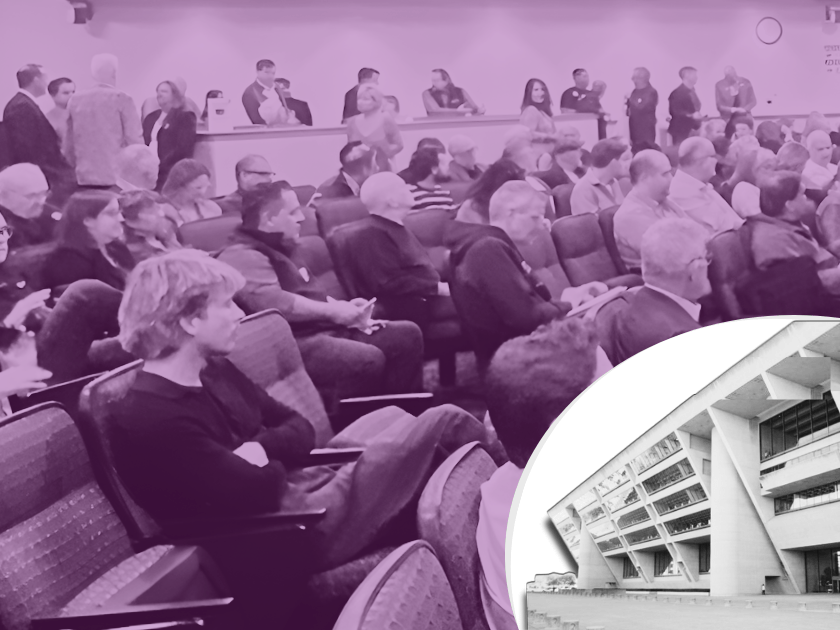
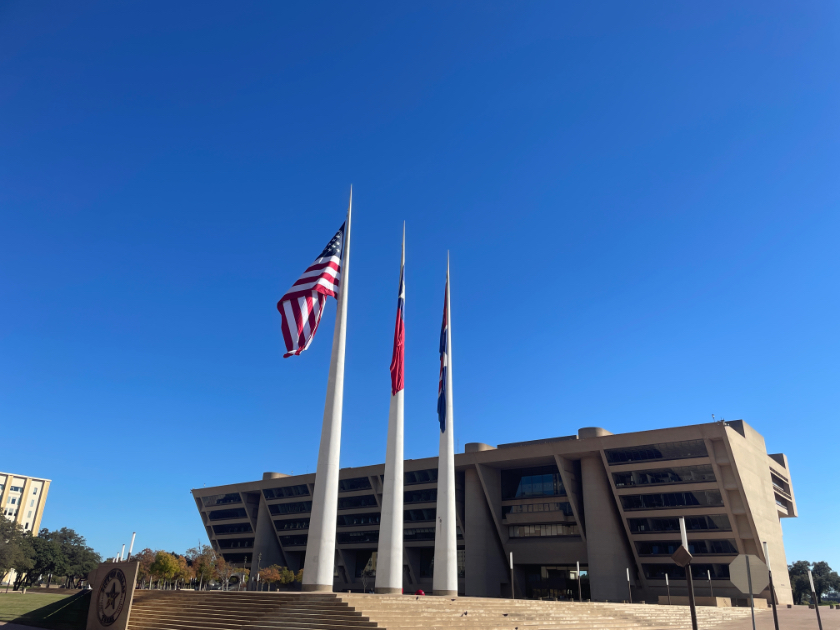
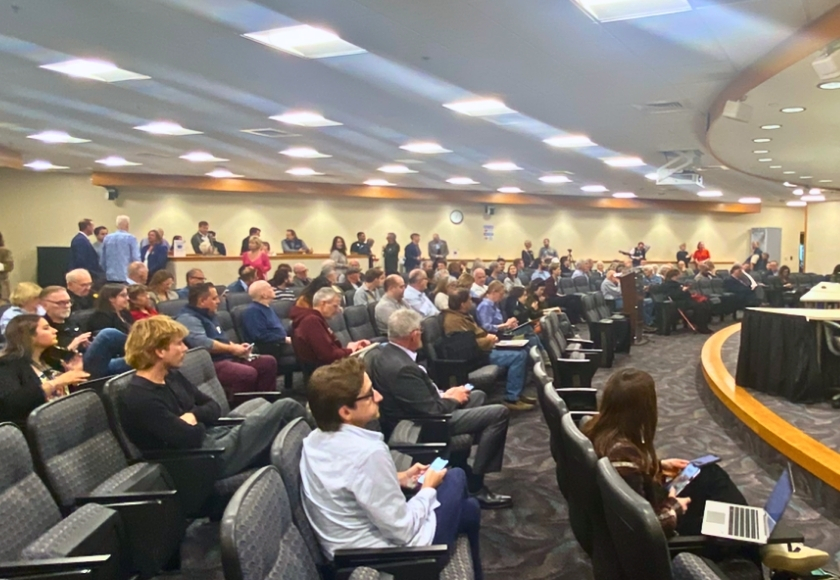
Dozens of people turned out to a public meeting Monday night to show their support for preserving Dallas City Hall as the fate of the iconic Brutalist structure at 1500 Marilla St. seems precarious amid speculation developers have their eyes on the site.
Speakers described the I.M. Pei-designed building as both an architectural treasure and a civic symbol, noting its long history as a gathering place for protests and public celebrations. The crowd comprised a diverse array of residents, architects and engineering professionals, and current and former local officials.
“When we demolish buildings, we don’t just lose brick and mortar. We sever our connection to collective memory in place, and we lose these unique places that give Dallas its own soul,” said District 1 resident Anthony Rash, citing past examples of historic buildings being razed.
 Credit: Karen Eubank for CandysDirt.com
 Credit: Charles Grand for CandysDirt.com
Some attendees implied or flat-out accused city officials and staff of inflating rough estimates of what it’d cost to update the aging building to angle for a sale. Last month, staff claimed that deferred maintenance totaled anywhere between $152 million and $345 million.
Multiple mentions were made of the sense of urgency seeming to surround the issue as well as the Mavericks’ alleged interest in the site for a new arena. A handful of committee meetings on the state of City Hall have already been held.
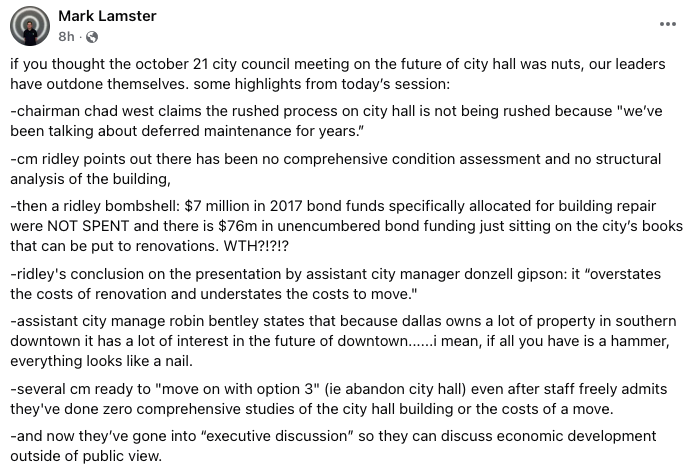
On social media, Dallas Morning News architecture critic Mark Lamster offered his take on the special-called joint meeting of the Finance and Economic Development Committees:
Another committee meeting is scheduled for Tuesday afternoon.
“It has been sitting at the designation committee of the Landmark Commission for months. The fix is in and has been for a long time,” said former council member Philip Kingston. “When the estimate starts at $29 million during the bond debate and suddenly we’re at $350 million, you know that there is a result that is trying to be achieved that is not backed up by facts.”
Landscape architect Shelley Potter described the situation as “demolition by neglect.”
“The rush to make a decision to keep or raze City Hall is a clear announcement that every property owned by the City of Dallas is for sale to any developer who wants to make an offer,” she said.
Dallas maintains a pretty hefty portfolio of city-owned properties, many of which are not getting the attention they require in terms of maintenance, not least of which is City Hall.
The fate of 1500 Marilla St. came to the forefront of civic debate following the creation of the Finance Committee, which Mayor Eric Johnson charged with determining “whether Dallas City Hall and other municipal facilities effectively support City operations and best serve the citizens of Dallas; Consider all potential options and identify the most fiscally responsible course to address the mounting deferred maintenance and carrying costs of Dallas City Hall.”
Staff subsequently pitched the committee on some of the city’s options, which included making repairs as needed, investing in the building for the purpose of maintaining it properly, and offloading it and relocating city operations.
 Sarah Crain
“I think this issue is so much bigger than just preservation,” said Sarah Crain, executive director of Preservation Dallas. “Really being able to invest in our building, City Hall, is a sign that city council is not just going to take care of our home base but the library in your neighborhood, the fire station in your neighborhood, the police station in your neighborhood. They have a wealth of properties across the city, and not being able to take care of this one and measuring this one’s value to repair versus the value of its real estate maybe puts all of their other properties at risk of that same conversation.”
Council Members Cara Mendelsohn (District 12) and Paul Ridley (District 14) hosted Monday’s event. The pair gave staff the hardest time last week over the failure to budget for City Hall maintenance and throwing out such huge numbers without having a comprehensive survey of the building’s needs conducted.
Also in attendance were Council Members Paula Blackmon (District 9) and Bill Roth (District 11).
 Paula Blackmon
Speaking with CandysDirt.com, Blackmon recounted the building’s history as a representation of open, transparent government and healing in the aftermath of the JFK assassination, which had marred the city’s reputation.
“We built something grand because it was supposed to be like the beacon on the hill… I kind of tear up about it because we’ve let it get into this shape,” she said. “Let’s be honest, we did. We allowed it, and so now we’re just going to tear it down? I’m having a hard time understanding.”