
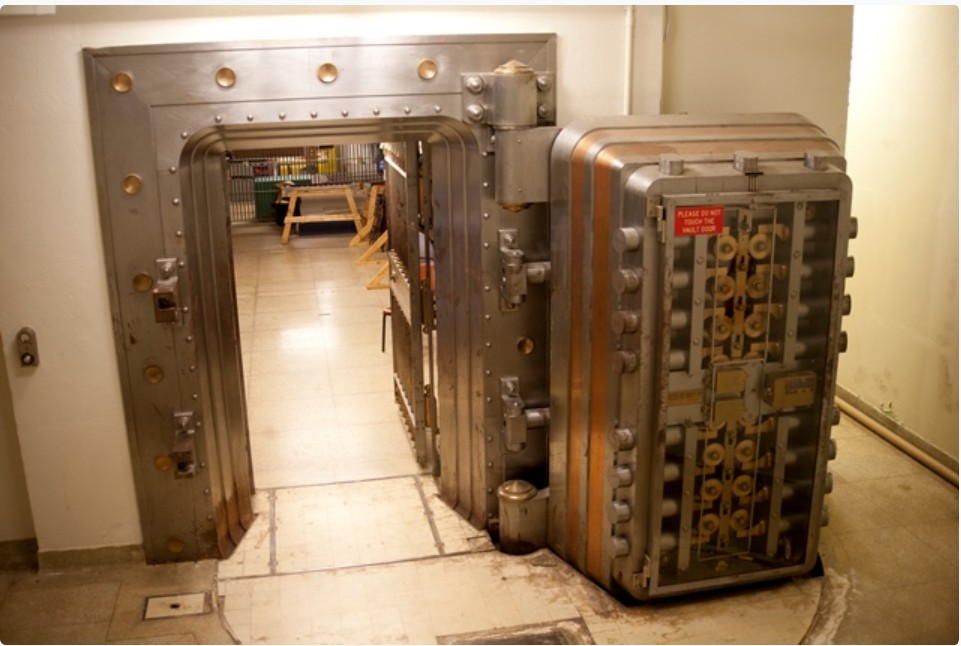
Built in 1936, the former Texas Treasury vault, reached through the basement of the Texas Capitol, is guarded by an enormous bank door of layered metals.
Texas State Preservation Board
All this time, there’s been a secret vault in the basement of the Texas Capitol, and few living souls have seen it.

During a recent tour of the magnificent building with Kevin Koch, the Architect of the Capitol, we discussed discoveries made during efforts to preserve the building’s granite, limestone, mortar, plaster, paint, terrazzo, iron, oak, pine and, in decorative flourishes, polished mahogany, walnut, cherry and cedar.
Article continues below this ad
All these materials have been fashioned and refashioned as the “People’s Palace” has been restored and renovated repeatedly since it opened with a grand party in 1888.
As a person whose case of acrophobia has only escalated with advancing age, I skipped parts of the private tour that might have taken me high above the Great Seal of Texas, which is rendered under the ribbed dome in terrazzo collected from all over the state.
Yet when Koch mentioned a rarely seen subterranean treasury vault built in 1936, my response ran along the lines of, “Yes, please, with all my curiosity ablaze!”
How to protect millions
The subterranean vault was carved out in 1936 to provide a new place for the Texas government’s cash and securities.
Michael Barnes/American-Statesman
Why a new state treasury during the 1930s?
Article continues below this ad
Recall that this was the era of headline-grabbing gangsters, some of them local or regional, others national figures roaming Texas. Let’s just start with the Barrow and Newton family gangs, the first better known by its charismatic duo, “Bonnie and Clyde,” the second as the “Newton Boys.” In addition, every big city in Texas seemed to generate tight-knit crime families, such as the Maceo syndicate in Galveston and the Piranio network in Dallas.
These gangsters staged spectacular crimes: celebrity kidnappings, daylight bank robberies, mad jailbreaks, mass shootings and mob assassinations. For safe cracking, mobsters used explosives and torches to defeat the escalating defenses of safe makers, which included multiple, thick layers of metal, inventive locks and anti-explosive devices.
Within an underground cavern and behind a huge bank vault door is the safe that held millions of dollars in cash and securities for the Texas Treasury starting in 1936.
Michael Barnes/American-Statesman
According to a Jan. 1, 1936, American-Statesman article about the new state vault, Texas then held some $35 million in cash reserves and $40 million in bonds and other securities.
Article continues below this ad
That would translate to more than $1.8 billion today. Not peanuts, though a fraction of today’s state budget, $336 billion for 2026-7.
Still enough to tempt an eager safecracker during the depths of the Great Depression in a desperately poor agricultural state such as Texas.
“Originally, the Texas Treasury occupied the west side of the first floor of the south wing, as well as the office in the west wing closest to the rotunda, today the Capitol Information and Guide Service, along with other offices and utility spaces,” Koch says. “During Gov. James Allred’s administration, plans were made to create a very secure, large subterranean vault for the state treasury. A large hole was dug near the Capitol in 1936 so that a subterranean vault with a large safe could be installed to hold legal tender. A guard was stationed at the safe’s steel door for extra protection, and four mirrors were placed at each corner so the guard could see all sides of the vault.”
What’s the vault like?.
The safe door inside the Texas Capitol 1936 Treasury vault is only one of many underground security barriers.
Michael Barnes/American-Statesman
One enters through an undistinguished — and locked — door in the Capitol basement. Beyond a short, narrow corridor is an enormous bank vault door of alternating thick steel and copper, which Koch explains together provided a more explosive-proof entry. Behind a barred enclosure within the reinforced cavity is another thick safe door. Some historical artifacts are on display in antique cases.
Article continues below this ad
Koch knows how things operated because, as Architect of the Capitol, he works for the Texas State Preservation Board, which was created in 1983 by the Legislature to oversee the monumental work on the Capitol, partially damaged by a Feb. 6, 1983, fire that started in the east wing inside the apartment of then-Lt. Gov. William “Bill” Hobby. A new north extension, dug as much as four stories underground, provided new offices, parking, hearing rooms, a café and a gift shop.
The Preservation Board has since expanded its oversight beyond the domed 1888 structure to preserve, restore and maintain the Capitol Extension; the Capitol Visitors Center, housed in the 1857 Texas General Land Office Building; the Texas Governor’s Mansion, built from 1854 to 1856; the Texas State Cemetery; the Bullock Texas State History Museum; and three legislative office buildings within the Capitol Complex.
Back to 1936 and the subterranean project: “Fifteen feet through clay, and eight feet down in solid rock, the underground chamber for the state’s future outdoor treasury vault adjoining the Capitol has been excavated,” reads the 1936 American-Statesman article. “Thick reinforced concrete walls and top will be built in, and a covering of earth put back on top of the vault.”
To be clear, this excavation extended south from the south wall of the basement. One door, entered from the steel-barred basement of the treasury, cut through the basement walls into the vault chamber. A clever system of mirrors, still in place, allows the authorized staff and guards to view any movement around the barred enclosure within.
Article continues below this ad
“Because it might affect the Capitol building, blasting of the rock was prohibited,” Koch says. “The hard limestone was flaked off in chunks of about a ton each. Air drills were used to make rows of holes along the sides and under a ‘bite’ of the rock, then squeegees were used to split the rock. These were tapering steel rods driven slowly into a long row of holes until the pressure caused the rock to split.”
The safe came from the Mosler Safe Company of Hamilton, Ohio. The company, founded by brothers M. William and Julius, provided many large safes and vaults at that time. Other Mosler clients include the United States gold reserve at Fort Knox, Kentucky.
“The safe in the subterranean vault has a 28-ton door and 28-inch-thick walls with a collapsible floor and iron bars,” Koch says. “Originally that floor surrounding the door dropped eight inches to permit the safe door to be opened and closed. Today the floor is fixed so the door cannot close.”
Some artifacts have been collected and displayed in the hidden underground vault at the Texas Capitol.
Michael Barnes/American-Statesman
The Texas Treasury moved out of the Capitol and into the LBJ Building to the north on what is now the Capitol Mall in 1970. The subterranean vault was abandoned and used as a storage area, until Rep. Joe Allan, who represented Baytown and other parts of Harris County, used the windowless room as his Capitol office starting in 1973, according to Jan. 10, 1977, article in the American-Statesman.
Article continues below this ad
“Since the expansion of Capitol offices into the underground extension in 1995, it was no longer needed as office space,” Koch says. “It was used for maintenance storage for many years, and is now accessible for VIP tours, with a display space for interesting artifacts and images from the Texas Capitol.
Not everybody took the vault seriously. State Treasurer Charley Lockhart jokingly told visitors in 1936 that the vault was being built to “store the state’s $11 million deficit.”
When the Texas treasury was robbed
“Chaos in Civil War Texas: The Tumultuous Tenure of Governor Pendleton Murrah” by Austin historian Lori Duran describes the robbery of the Texas state treasury in 1865.
Lori Duran
As luck would have it, Austin historian Lori Duran gives us another reason to consider why Gov. Allred and other leaders wanted a really secure place to deposit cash, bonds and other securities.
Article continues below this ad
That’s because the Texas Treasury had been totally ransacked seven decades earlier, in 1865, as Duran describes in her slender, nifty new book, “Civil War Chaos in Texas: The Tumultuous Tenure of Governor Pendleton Murrah” (History Press, 2026).
“At the end of the Civil War, the Texas Capitol expected dire consequences for the war, and it was under siege from within,” Duran writes. “Austin resident and prolific writer Amelia Barr described in her journal that in May and June of 1865, the people in Austin were gloomily expecting a Union invasion. They had just heard of Gen. Robert E. Lee’s surrender, and that Confederate President Jefferson Davis was hurrying himself to the Trans-Mississippi. Barr reported that Confederate soldiers without officers or orders were coming in every hour.”
Eyewitness Barr reported that people were taking Confederate supplies: “there was nothing but plunder and sack going on, with the citizens as bad as the soldiers.” She added that when the soldiers who served on the Rio Grande reached Austin, they “went straight to the Capitol and demanded payment either in gold or government property for their long service, and as no one had a right to pay them, they paid themselves.”
Barr described the soldiers. “They are dividing the mules and horses and saddlery amongst themselves. The noise and tumult are indescribable.”
Article continues below this ad
Barr reported that looting and quarreling were going on, and “everyone seemed to have had a claim against the Confederacy for which they were paying themselves.” Barr’s husband Robert slipped away and came home, and later he went to a “public meeting about protecting the town.”
Duran tells us that, on June 11, 1865, nine days after Gen. E. Kirby Smith surrendered the Trans-Mississippi Department — the Confederacy west of the Mississippi River — Texas Gov. Pendleton Murrah abandoned his wife and left for Mexico to live in exile along with other prominent leadership from the western side of the Confederacy.
Austin historian Lori Duran paints a picture of utter pandemonium in Austin during the Civil War in her new book.
Lori Duran
“They left because they expected to be tried and punished for treason,” Duran writes. “Some didn’t want to surrender, and some wanted to regroup south of the border. The collapse of the Trans-Mississippi leadership and the state government left Austin vulnerable and triggered another dramatic event.”
Article continues below this ad
Later that night, the Texas Treasury was violently robbed by 40 to 50 ex-soldiers. The bandits outnumbered volunteers — who were all that was left to guard state assets — by a margin of 2 to 1.
“The robbers shot their way out of town and one of them died, reportedly reeking of whiskey spilling out of his wounds,” Duran writes. “But the rest made it out of town, heading west.”
According to some sources, near Mount Bonnell the robbers dropped a few pieces of the gold and silver.
“They left behind other valuables in the vaults in their haste to make a quick getaway once the volunteers started to respond,” Duran writes. “Other than the bandit who died, the others were never caught and the loot was never recovered. Military and government administration had ceased, and it doesn’t appear that much of an investigation was conducted. Chaos and lawlessness were then the rule of the day in Austin and all over Texas.”
Article continues below this ad
Gunslinger Ben Thompson, who in 1880 became city marshal of Austin, seems likely to have participated in the heist along with fellow ex-soldiers from the same Confederate unit. “Thompson’s unit was recognized by citizens,” Duran writes, “who overheard the commotion and Thompson had just been busted out of jail in Austin, after being arrested for murder, immediately before the robbery, and afterward he left for Mexico where he stayed for two years.”
Things calmed down after Union forces occupied Austin in June 1865.
Yet the chaotic robbery at the end of the Civil War set a precedent: Yes, under certain circumstances, one could steal directly from the treasury of the state of Texas.
Article continues below this ad
Please send tips and questions to mbarnes@statesman.com.