
Downtown, the people sleeping on the sidewalks outside the day shelter, waiting for it to open, were gone. Good Samaritans, armed with meals, socks or toiletries, drove past spots where they had previously made deliveries, looking for someone to aid.
“Has anyone noticed a sharp decline in the number of homeless individuals present in downtown?” someone wondered on Reddit last winter.
Meanwhile, in the Facebook group Baytown Engaged Citizens, a post began with the words, “The Baytown Homeless is Out of Control.” Nearly five hundred comments sparred over what was happening in the community 40 miles from the heart of Houston. Many blamed perceived upticks on the larger city’s crackdown on homelessness, saying it had pushed homelessness “into smaller towns.”
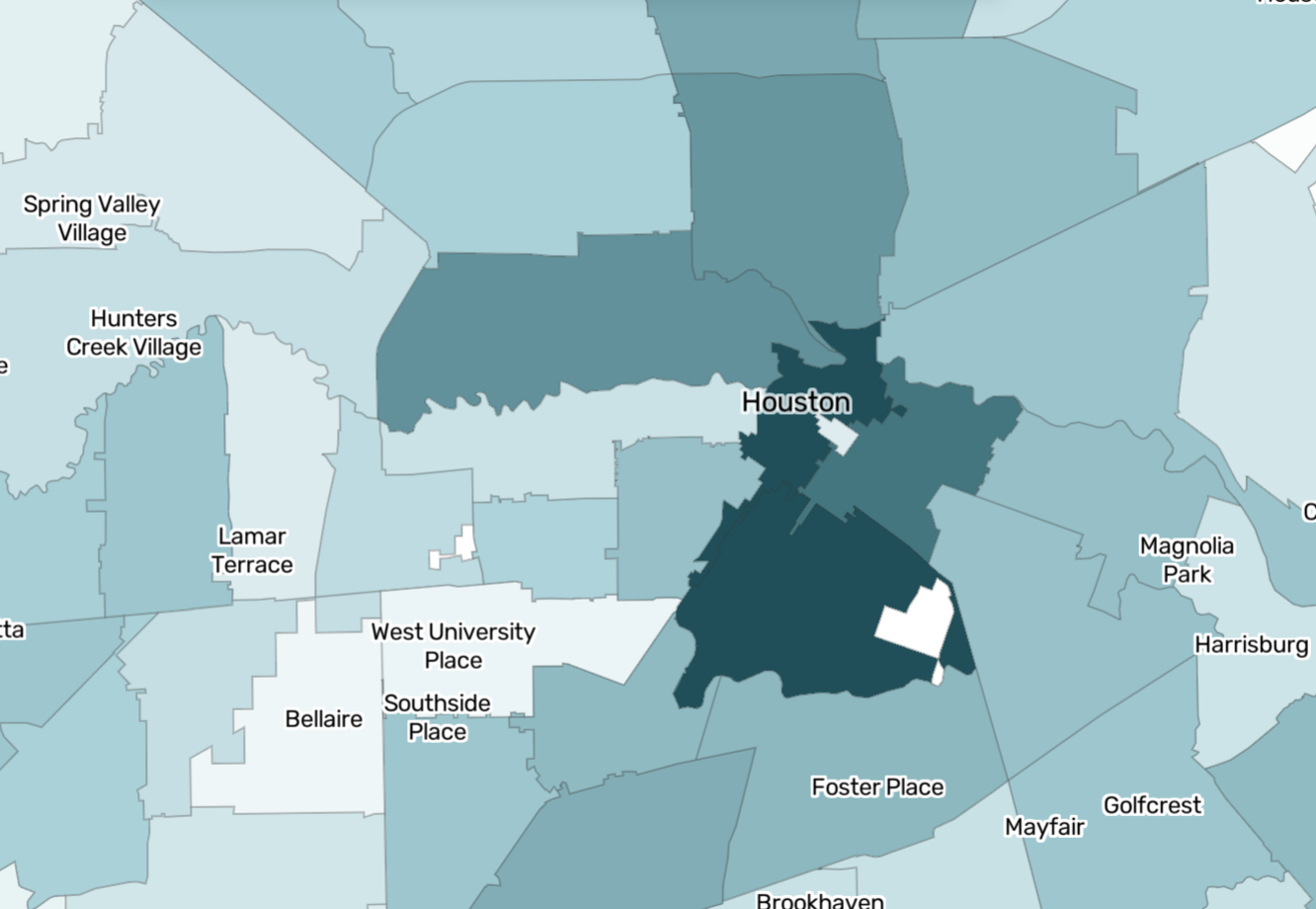
Houston’s homelessness numbers dropped significantly in the past five years, which officials attribute to an influx of COVID-era federal funds. But when the annual count is broken down by ZIP code, a more complicated picture emerges.
A Houston Chronicle analysis found that while unsheltered homelessness has fallen sharply in Houston’s core, it has become more dispersed across the region. Some of the largest increases have occurred in communities far from downtown, fueling claims that homeless people are being pushed from one community to another. The data, however, cannot show whether people are moving from one community to another, and for some vocal communities, such as Baytown, whether the homeless population has increased depends on the baseline year. Still, the overall data suggests homelessness is less concentrated than it once was.
Harris County Flood Control District records point in the same direction, showing a growing number of encampments on remote land along bayous and tributaries, places largely hidden from public view.
A woman walks down to the bayou in the Heights to get water for her dog on March 26, 2024. She was one of a number of people living on the banks of the bayou, which officials say poses a safety risk in the event of a flood. File photo/Houston Chronicle
The greatest decreases in the homeless population have been in very central ZIP codes – many of which have actually seen an increase in overall population in recent years. The Chronicle’s analysis compared the average numbers recorded during the five-year period from 2022 to 2026 to those of the previous five-year period.
While homelessness has increased in some parts of the region, no community has seen gains large enough to offset the sharp declines recorded in central Houston. Instead, much smaller increases have appeared across a wider range of ZIP codes, the biggest of them on the region’s outskirts. Fewer ZIP codes now record no homeless presence at all.
The massive, human undertaking behind the data
All regions that receive federal funds to reduce homelessness are required to count the number of people living in shelters and those living in places not meant for habitation (such as in tents, vehicles and abandoned buildings) on a single night. While counting the people spending the night in shelters is straightforward, counting those without shelter is not.
Harris, Fort Bend and Montgomery counties cover so much ground – more land than Puerto Rico – that the region has gotten permission to conduct the count over a span of three days. Volunteers and outreach workers fan across Houston and the surrounding cities. Downtown, they walk the sidewalks, but in most of the region, they pile into vehicles, weaving up and down streets and pulling over when they see someone or a sign (a shopping cart, a footpath into a wooded area) that someone might be around. The vast operation is coordinated via app, telling volunteers which area they’re surveying, tracking which streets they’ve gone down and cataloging responses to their survey questions.
Outreach coordinators with the Coalition for the Homeless Jackie Urbina and Jeremy Sanders speak with James Brown, who is living in a van, during the annual point-in-time count of people experiencing homelessness Feb. 24, 2026, in Houston’s Fifth Ward. Jill Karnicki/Houston Chronicle
In other words, the data collection is very human, infrequent and likely an undercount. One neighborhood leader compared it to taking a person’s temperature once a year to gauge his health. Nonetheless, since the method is the same year over year, experts believe it can be used to gauge trends. The Chronicle averaged the findings over five-year periods to minimize fluctuations.
As of 11 a.m. on the first day of the count, the app showed that volunteers had already spoken with 264 homeless individuals. In addition, they had logged 170 observations – people they believed were homeless, but for one reason or another, could not talk to.
Some people declined an interview. Others are too hard to reach. Later that day, for example, outreach workers in Fifth Ward glimpsed a tent in the back of a boarded-up house. They logged an observation.
Jackie Urbina, one of the outreach associates, said tents appearing in residential neighborhoods may be the first sign of how unsheltered people are adapting after City Council made it a misdemeanor in 2025 to sit, lie down or leave belongings on public property downtown and in EaDo, where the FIFA Fan Fest is held.
“Because we were like, where are they going? If they aren’t downtown, where are they going?”
The Harris County Flood Control District suggests that people are also increasingly setting up camp in places that are harder for volunteers to survey.
In the 2021 fiscal year, the district cleaned up only five encampments at a cost of $47,000.
In the 2025 fiscal year, it cleaned up 32 encampments at a cost of $488,000, including encampments in the ZIP codes with the largest increases in homelessness. Partway through 2026, it has already closed 41 encampments.
While the engineers who work for the district never foresaw diverting so many resources to address homelessness, officials say it ultimately boils down to the district’s core mission: flood safety. The land they manage is prone to flooding, meaning that setting up camp not only endangers those living there but also those living downstream, along tributaries that might clog with washed-away possessions.
In 2025, 10 individuals whose official records linked to homelessness were found dead in Houston’s bayous, up from 4 individuals in 2020.
Feeling left out of central Houston’s success
Baytown has never had a dedicated budget for homelessness. Its police don’t have a homeless outreach team. And it doesn’t have a playbook for “decommissioning” an encampment. For a long time, residents say, Baytown didn’t even have a homelessness problem. That perception has changed, and for the first time, its city council is considering dedicating half a million dollars to tackling homelessness.
When making their April pitch for funds, Baytown Police officers pinned the city’s homelessness on Houston’s success. Assistant Chief Aaron Crowell said homeless individuals and other law enforcement agencies “have told us they are bringing people out to the east side of Harris County, pushing them out of the downtown area around where all the (World Cup) festivities and events will be taking place.”
Though the latest two tallies recorded an uptick in Baytown-area homelessness compared to the four years preceding them, point-in-time count data is prone to year-over-year fluctuations. When the Chronicle compared averages over five-year periods, the most recent five-year period, from 2022 to 2026, was nearly flat compared to the preceding one.
Bill Eckert, executive director of Bay Area Homeless Services, which provides shelter to sober, working individuals and families without serious criminal histories, suspected that narratives around increasing homelessness were a perception issue. The shelter in Baytown has seen a steady volume of inquiries over the years, though there have been shifts in who has been calling. Since 2016, it has seen a decrease in inquiries from families and an increase from single men (there is a waiting list for both groups). The shelter is currently building a new, 16-bed building for men, which it expects to open around September.
That being said, he acknowledged that “the fact that there are a lot of unhoused folks,” including people who wouldn’t be interested in the shelter, “because we’re a sober living facility.”
Women and family housing at the Britton-Fuller Center in Baytown on Wednesday, May 13, 2026. Elizabeth Conley/Houston Chronicle
Assistant Chief Aaron Crowell showed the city council a slide of “homeless incidents,” which he said had increased to 1,000 in 2025 from 600 in 2022. But he clarified that homeless incidents include both interactions with homeless individuals, which they’ve only recently started tracking, as well as calls about suspicious or intoxicated persons, burglaries and thefts. When the Chronicle asked for any data it had collected showing the impact of homelessness on the department, the Baytown Police said in an email, “we do not yet have comprehensive data or trend analysis available regarding complaints, encampments, or enforcement actions,” and that it hadn’t seen an uptick in “homelessness-related incidents” during the World Cup.
The difficult, resource-intensive work of reducing homelessness
Kris Larson, chief executive of the Downtown Management District, cautioned against looking for a simple formula to reduce homelessness.
Downtown spends more than $1 million annually on homelessness initiatives, employs 11 full-time outreach workers and coordinates with city officials, service providers, law enforcement and mental health agencies. Even with those resources, progress has depended on unusual circumstances, including a surge of pandemic-era federal funding and Mayor John Whitmire’s more recent strategy of pairing enforcement with new shelter beds and encampment closures.
And none of it happens quickly.
“It’s not like it takes one interaction for a person to decide to live differently,” Larson said. “Often it takes an average of 30 interactions.”
In comparison, the strategy in Baytown is still in its infancy. The police and parks departments’ requested budget to address homelessness has yet to make it to a city council agenda. On a recent Tuesday, police officers met with homeless service providers in the public library to learn how they could work together.
“We’re the boots on the ground here,” said Tammy Guidry, director of homeless services for the Marcelous-Williams Resource Center, a nonprofit program. She uses the reading room of the library on Tuesdays from noon to 4 p.m. to connect people with resources, such as food, shelter, ID recovery, job placement and housing navigation.
Once a week Tammy Guidry, director of homeless services at the Marcelous-Williams Resource Center, meets with people needing services at the Sterling Library in Baytown on Wednesday, May 13, 2026. Elizabeth Conley/Houston Chronicle
Like the police and parks departments, the Marcelous-Williams Resource Center is seeking funding to fight homelessness. It is currently not receiving federal funds, which are coordinated through the Coalition for the Homeless, but says it is now in talks with the Coalition.
While the meeting between police officers and nonprofits took place, Rodney Parker was waiting outside. He said he didn’t have a home, but had lived in Baytown for 25 years. The problem, he said, was economic. Workplaces “don’t need you as much as they used to.”
Inside, at a table reading “Slenderman,” Alvaro Chavez agreed. He had worked in construction until “bad legs,” which run in his family, caused painful swelling after prolonged periods of standing.
His 10- to 12-hour shifts were no longer an option. So he left to work in warehouses, where he tries to stick to eight-hour shifts that give him enough time to rest his legs before another shift. Just three weeks before, he had landed a promising job, but then his ride fell through. He doesn’t like to stay with friends when he isn’t working “because I don’t like overstaying my welcome.” His priority is saving up enough for a car.
But he hadn’t traveled to Baytown after losing his housing – he had lived there since he was in third grade at Ashbel Smith Elementary.
And as far as people coming from elsewhere, he didn’t know. While he’d seen new faces, he didn’t know their stories.
Alvaro Chavez looks up from his book at the Sterling Library in Baytown on Wednesday, May 13, 2026. Elizabeth Conley/Houston ChronicleAbout the data in this story
Every year, the Coalition for the Homeless conducts a point-in-time count of people experiencing homelessness on a single night across ZIP codes in Harris, Fort Bend and Montgomery counties.
For this story, reporters mapped the Coalition’s data onto U.S. Census ZIP Code Tabulation Areas. Data includes ZIP Code Tabulation Areas that fall at least partly within Harris, Montgomery and Fort Bend counties.
The following ZIP codes are not defined as ZIP Code Tabulation Areas and were not included in the analysis: 77001, 77201, 77333 and 77472. Tallies for those ZIP codes did not significantly alter geographic analyses shown here.