
Hadley Whytlaw was a self-professed AI hater — until a college class changed her mind.

For years, the Texas Christian University student avoided ChatGPT. She watched classmates use it to cheat on assignments and grew concerned it would short-circuit her learning.
Then a semester-long course about how to use AI ethically made Whytlaw reconsider. She learned how to use a range of AI platforms. She researched gender and racial bias in AI systems. She figured out how the tool could take her disorganized ideas and streamline it into a cohesive perspective.
The technology is here to stay, she realized, and knowing how to work with it, instead of against it, could be a boon for her career.
Article continues below this ad
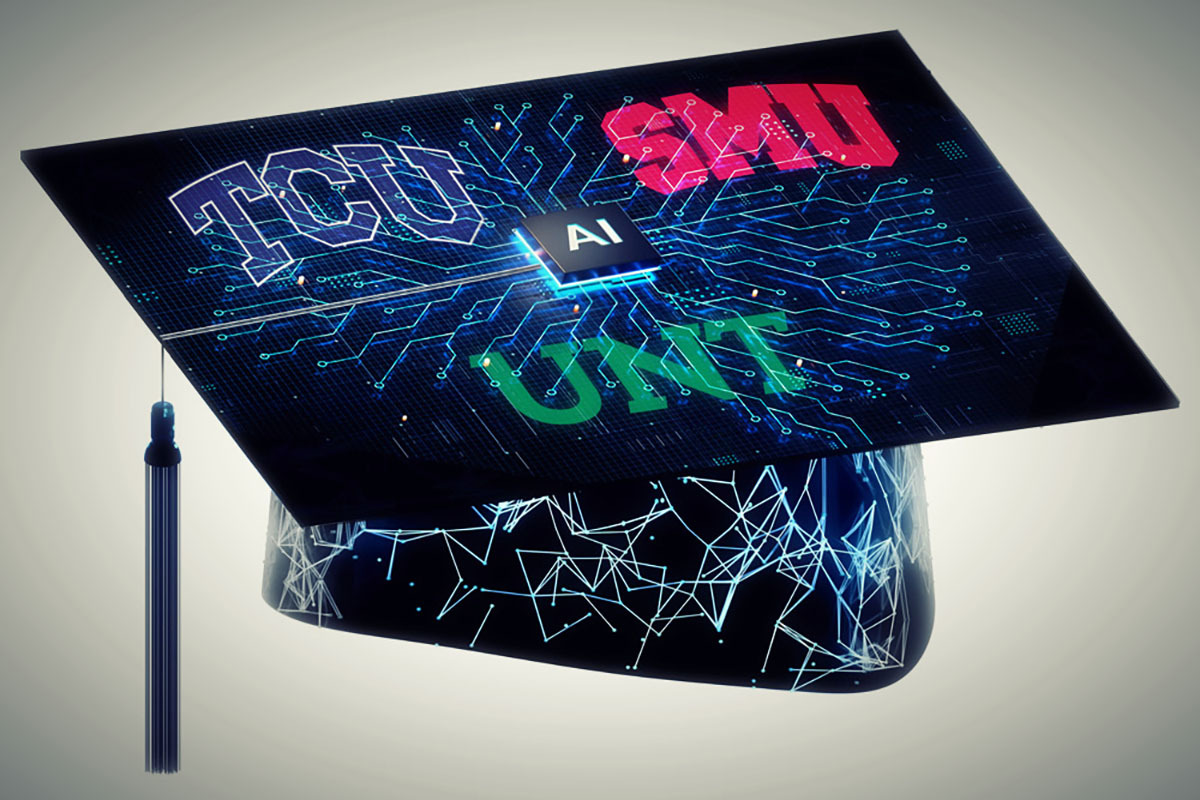
College students are grappling with how to prepare for a future workforce reshaped by artificial intelligence. Universities across the country are responding to the demand, launching new classes and degrees focused on the inner workings of AI and how to use it across careers. In North Texas, Southern Methodist University, the University of North Texas and TCU are poised to launch new programs this fall.
Related: D-FW leaders encourage job seekers to hone ‘human skills’
The frenzy to launch these offerings comes even as the extent of AI’s impact on companies’ operations and the job market is still unclear.
The schools, keen to prove their value, believe AI will soon become a foundational concept for undergraduates in all academic fields. The students say they anticipate AI knowledge will be an expectation in the workplace.
Article continues below this ad
Whytlaw now lists AI literacy on her résumé. When she applied for internships in the sustainability sector last fall, she fielded questions about how she would use AI to support her in the role. She leaned on lessons from her course: how to prompt efficiently, how to detect algorithmic bias, how to stress-test a chatbot’s answers.
Afterward, she recalled, recruiters told her she was a stronger candidate because of her AI knowledge.
“AI isn’t going to take your job, but someone who knows AI will definitely take your job,” said Reuben Burch, vice provost of research at TCU. “If we’re going to lean into that, then we need TCU students to be the one that takes the job.”
AI’s impact on the job market
Administrators and educators say the new programs are responding to forecasts that employers will increasingly prioritize talent with AI knowledge. TCU, a private school in Fort Worth, is going so far as to say that every student and academic discipline should get a taste of the technology during their time on campus.
Article continues below this ad
Students give their final presentations on how to implement AI ethically in the class “A Human-Centered AI Future” at Texas Christian University in Fort Worth, Texas, on Monday, May 4, 2026.
Milla Surjadi/The Dallas Morning News
The school’s initiative, which is anchored by a $10 million commitment and backed by contributions from Dell Technologies, Microsoft and Amazon Web Services, ranges from research on the new technology to embedding AI tools into how professors teach.
Related: TCU announces $10 million investment to launch AI initiative
In the fall, the school will launch a four-course certificate on the use and ethics of AI that students can add to any major. The goal of the credential is two-pronged: familiarize students with the range of AI platforms and ready them to think critically about how the technology and its usage will change in the next few years.
“We’re basically trying to prepare them for the unknown,” said Muriel Cormican, associate dean of undergraduate students at TCU.
Article continues below this ad
A recent Federal Reserve Bank of Dallas survey of businesses found two-thirds of more than 300 firms were using AI in some form in their workplaces. About 30% of AI-using employers said they expect the technology to decrease their need for workers.
Related: Most Texas companies are using AI — and some say it’s decreasing their need for workers
Meanwhile, unemployment rates among recent college graduates spiked to 5.6% this year, one of the highest rates since the pandemic. The data has raised questions about whether AI is replacing entry level jobs or if the decreased opportunities are a casualty of today’s “low-hire, low-fire economy.”
Some analysis, like a May Dallas Fed report, suggests displacement concerns could play out. An analysis of payroll data found young and entry-level workers in fields that are highly exposed to AI, such as customer service or sales, are seeing their opportunities decrease slightly.
Aneesh Raman, Chief Economic Opportunity Officer at LinkedIn, speaks during the “What’s Actually Changing About Work (and What Isn’t)” panel at the University of North Texas’ University Union in Denton, TX, Tuesday, April 21, 2026.
Juan Figueroa/The Dallas Morning News
Other employers, however, are ramping up hiring of young workers as they integrate AI into their workplaces. A recent national survey of 1,500 employers found nearly three times as many company executives expect AI to increase entry-level hiring in 2026, not decrease it, according to Strada Education Foundation. Employers say they expect those junior roles to become more complex as AI usage shifts entry-level work away from administrative tasks.
Article continues below this ad
“Companies don’t know what they don’t know, but they know they need AI,” said Shelly Heinrich, senior assistant dean of graduate admissions and the Career Management Center at the SMU Cox School of Business. “They’re looking to this new generation that’s graduating to help them build that strategy.”
Educators say keeping pace with the technology’s breakneck development will be a challenge, and are leaning more heavily on industry and employer feedback than ever before.
“This kind of stuff literally changes over the weekend,” said David Keathly, associate chair for undergraduate studies in UNT’s computer science and engineering department.
Eric Bergin, the founder of 3E Management, a Dallas private equity consulting company, is embedding the technology across his organization’s workflow. Over the last three years, an in-house AI model has taken over junior analysts’ grunt work, such as extracting data out of PDFs or modeling an acquisition.
“We can do more work with less people,” he said.
Article continues below this ad
Bergin expects new graduates to already be using AI tools in their everyday lives. What makes potential hires stand out is whether they know which platforms to use for which task — Claude for Excel, Gemini for research, ChatGPT for email-writing — and whether they can probe the answer that an AI model spits out.
During the hiring process, Bergin asks applicants to model an example deal and send him an email write-up. He encourages them to use AI to complete the task, but will evaluate applicants based on whether they take the extra step to edit the model and message.
“You can tell if it’s AI-written,” he said. “If you literally just copy and pasted this, and you didn’t spend time to read over what you’re submitting or personalizing it, that would be a fail.”
The technology has also changed the skills he looks for. Excel proficiency no longer carries the same weight it once did. He’s hiring more people with strong communication skills, rather than technical ones, since AI tools can fill their knowledge gap. And job applicants can’t be resistant to change.
“I want problem solvers and I want critical thinkers,” he said. “How can we use these tools today, knowing that the tools six months from now may be different, and that’s okay?”
What does an AI program teach students?
The AI programs launching at North Texas universities differ in scope, credential and coursework. Some focus on under-the-hood knowledge about how AI works, while others place a larger emphasis on its usage.
At the SMU Cox School of Business, where a three-course AI specialization for undergraduates will launch this fall, faculty are prioritizing real-life applications of the technology.
AI has “democratized coding,” said Karthik Babu Nattamai Kannan, a visiting assistant professor who teaches the “AI in Business” course, which looks at how to apply AI in operations, marketing and finance fields.
Students are eager for the instruction, Kannan said. Enrollment in his class jumped from 17 students last fall to more than 40 this fall, plus a waitlist.
Pearson Rice, a rising senior at SMU Cox, added the specialization to his degree in a bid to make AI a cornerstone of his job applications. Rice wants to go into talent acquisition, a field that is rapidly changing as AI automates away core parts of the job.
He said his professors are increasingly incorporating lessons about generative AI to expose them to a range of agents and models. One exercise in a marketing class saw students researching different AI platforms, such as Grok or Gemini, and discussing which was the best to use in a marketing campaign or to analyze large amounts of unstructured data.
At TCU, where a four-course AI certificate will launch this fall, administrators are trying to reach students across all disciplines, especially the non-techie ones.
Students in the program will take a required course, titled “A Human-Centered AI Future,” and three electives focused on AI implementation or critical perspectives on AI. The electives are courses that TCU already offers and range in academic fields, including computer science, digital culture and religion.
The credential is “a signpost for employers,” Cormican said. “They’re getting a degree in geography. But you know what? Underneath that, there are these AI skills that will be important to you.”
TCU has offered “A Human-Center AI Future” as a standalone course twice so far. Some students, like Whytlaw, said they took the class because they were skeptics. Others wanted to get ahead of the AI curve.
“It is a competition at the end of the day. You’re competing for that promotion, you’re competing for the new job title,” said Stella Lenzie, a recent TCU graduate who took the inaugural class in 2025. “If I’m falling short in the AI realm, I’ve gotta start packing my bags.”
The course culminates in group research projects on the ethics of how AI is implemented in the real-world, such as how AI is reshaping modern warfare or proposals for more state oversight of AI in response to deepfakes.
At UNT, administrators are going all-in on AI. This fall, the school’s College of Engineering will roll out a new undergraduate major in AI, where students will design, build and deploy AI software and systems and assess its social and ethical implications. The university already has a master’s program and several certificates students can add to their degrees.
Related: UNT to launch new major in artificial intelligence to meet workforce demands
University officials say the bachelor’s degree will prepare students to meet an increased demand in North Texas for professionals in AI and machine learning fields. A university analysis found there are about 2,000 postings per month in the Dallas-Fort Worth region related to artificial intelligence.
Some of those are new roles at tech, finance and defense companies that focus on building their AI strategy for the next decade, Keathly said.
The first-year salary for someone with an AI degree is just above $68,000 a year, according to the UNT analysis. That number jumps to $105,000 after five years. A student with an AI degree could break even on their investment in three years — twice as quick as the average UNT student.
It’s unclear how employers will regard the AI programs and too early to tell whether the credentials help students clinch jobs they wouldn’t have otherwise.
This summer, Rice is interning at the Dallas branch of Holmes Murphy, a national insurance firm. During his interviews for the position, he made sure to highlight the AI specialization program. He’s not sure if it secured him the role, but he thinks it helped him stand out.
Rice “absolutely” plans to use AI tools during the internship to speed up his work.
“I think it’s a skill that is quickly becoming just as important as soft skills in business,” he said. “It’s something that makes my work better. It improves how I interact with everyone around me.”
The DMN Education Lab deepens the coverage and conversation about urgent education issues critical to the future of North Texas.
The DMN Education Lab is a community-funded journalism initiative, with support from Bobby and Lottye Lyle, Communities Foundation of Texas, The Dallas Foundation, Dallas Regional Chamber, Deedie Rose, Garrett and Cecilia Boone, Judy and Jim Gibbs, The Meadows Foundation, The Murrell Foundation, Ron and Phyllis Steinhart, Solutions Journalism Network, Southern Methodist University, Sydney Smith Hicks, and the University of Texas at Dallas. The Dallas Morning News retains full editorial control of the Education Lab’s journalism.