
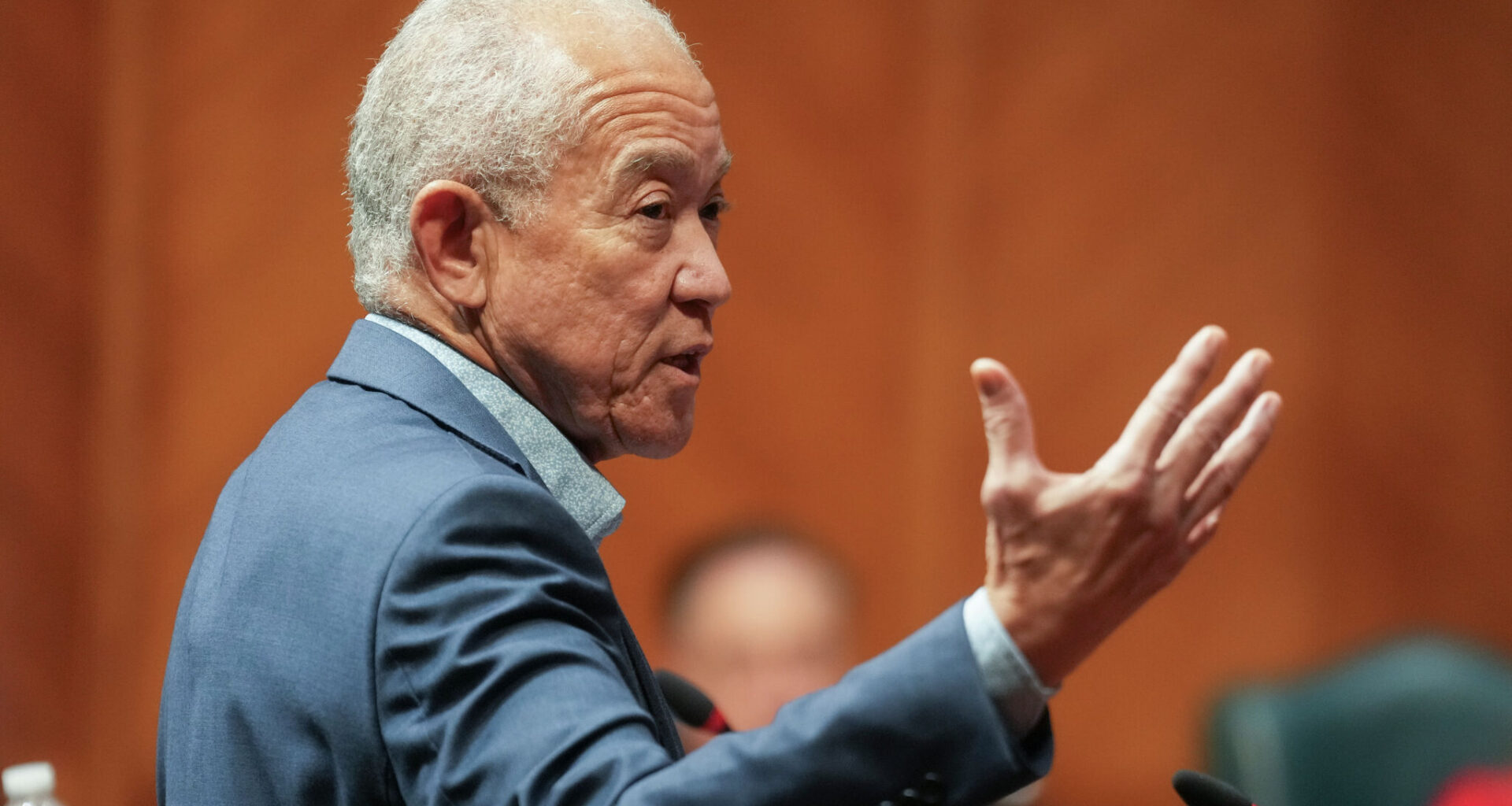
Houston ISD Superintendent Mike Miles speaks in front of the Houston City Council Committee on Economic Development in Houston, Wednesday, Sept. 17, 2025.
Jason Fochtman/Houston Chronicle
Houston ISD state-appointed Superintendent Mike Miles has published a 200-page book advising other leaders on how to reform their school districts.
The 200-page book, titled “By Design: How to Transform School Systems,” lays out how to design a “coherent” school system, establish the conditions for change and operate a “New Education System.” Miles said he wrote the book to help simplify the transformation process for district leaders.
“In the end, readers will find that there is no secret sauce or requirement for heroics,” Miles wrote on LinkedIn Monday. “What transformation requires is an understanding of and commitment to working systemically, along with a willingness to make the tough decisions that transformation demands.”
Article continues below this ad
Paradigm Leaders Press published the paperback, which is being sold on Amazon for $28.99. HISD did not immediately respond to a request for comment on the book, including questions about the publishing company.
DISTRICT CHANGES: HISD is reorganizing its central office again. Here’s what’s changing.
In the book, Miles introduces the “Foundational-Design-Paradigm” model to guide transformation in large school districts. Under the model, leaders examine the “foundational” principles that govern a system. Then, they establish the design principles of the organization and “shift the paradigms” that determine how decisions are made.
“Systems do not produce different results because people work harder, care more, or adopt better programs,” Miles writes. “They produce different results when the system itself is redesigned to do so. Understanding how systems behave, and why they so often absorb, weaken or reform, is therefore the prerequisite for any serious attempts to produce durable improvement.”
Article continues below this ad
In the book, Miles draws on his experience overhauling HISD. He writes that HISD’s “transformation” demonstrates that large-scale systemic change can produce “dramatically” different outcomes in a short period of time, although it does not come without challenges.
He said, for example, that before the 2023-24 school year, HISD’s Human Resources department aimed to fill hundreds of teacher vacancies to achieve a goal of “zero vacancies,” but the measure became a “compliance exercise.” Mentoring, coaching and accountability structures helped mitigate “what might otherwise have become a much larger problem,” he said.
SCHOOL BUDGET: HISD passes $2B budget, with $25M deficit heading into 2026-27 school year
“Many vacancies were filled with teachers who met the minimum requirements, such as certification, but who had not fully embraced the mental shifts required for the new instructional model and the higher expectations that accompanied it,” Miles wrote.
HISD has reported a significant increase in teacher turnover since the beginning of the state takeover, which some teachers said were due to the district’s stringent expectations and culture. About 4,700 of HISD’s roughly 11,000 teachers left the district during the 2023-24 school year, according to a Chronicle analysis.
Article continues below this ad
Miles also writes that the role of elected school boards in shaping accountability is “intentionally treated lightly” in the book. He says in many districts, governance plays a significant role in preserving the status quo or slowing reform efforts, but he writes that governance is a “constraint to be managed,” not a reason to abandon systemic reform.
“In Houston, the presence of a non-elected, appointed Board of Managers created conditions that allowed for whole-scale system transformation without the typical forms of political interference,” Miles writes. “That context made it possible to move quickly, redesign accountability structure decisively and sustain focus on student outcomes.”
Michelle Rhee, the former chancellor of D.C. Public Schools and a controversial educational reformer, wrote the foreword for the book. She said the book describes, in plain language, “what very few in education leadership are willing to say aloud” and is “exactly what this field needs right now.”
“For those of us who have watched trends and leaders come and go in urban districts for a long time — and who have at moments been tempted to make peace with the status quo — Mike brings something the field has genuinely been missing,” Rhee writes. “He brings evidence that change is truly possible.”
Article continues below this ad