

Texas voters have approved a new weapon in the fight against brain diseases: the Dementia Prevention and Research Institute of Texas, or DPRIT.
In Tuesday’s election, Texans weighed 17 proposed changes to the state constitution, including Proposition 14. Created with bipartisan support, the measure sets aside $3 billion from the state’s general revenue over the next 10 years to support research into and prevention of neurodegenerative diseases, including dementia, Alzheimer’s, Parkinson’s and related disorders.
“I think the research DPRIT will support is going to fuel a generation-defining medical advance,” said Dr. Brendan Kelley, a professor of neurology at UT Southwestern Medical Center. “Texans have been bold enough to envision a future without dementia, and DPRIT really demonstrates a willingness to invest in that future.”
A counterpart to the Cancer Prevention and Research Institute of Texas, DPRIT arrives at a pivotal moment. More than seven million Americans have dementia, including nearly 10% of people 65 and older. In 2020, Texas had almost half a million residents living with Alzheimer’s disease, the most common form of dementia, according to the Alzheimer’s Association and the Texas Department of State Health Services. Nationwide, the number of Americans who will develop dementia is expected to climb sharply in the coming decades, and the economic burden of health and long-term care is projected to rise to $1 trillion by 2050.
Breaking News
In this year’s Texas legislative session, DPRIT was carried by the Senate’s lead budget writer, Sen. Joan Huffman, R-Houston, with dozens of other lawmakers signing onto the bill as co-authors, sponsors or co-sponsors.
A handful of lawmakers — such as State Rep. Brian Harrison, R-Midlothian — raised concerns about the $3 billion price tag and the expansion of state government.
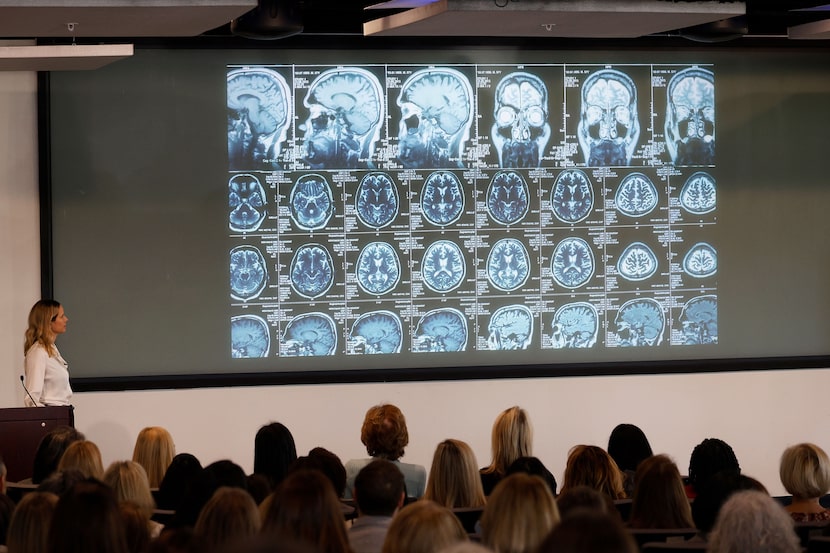
Emily Jacobs, PhD, University of California, Santa Barbara, far left, speaks about “The Maternal Brain,” during Empowering Women Through Brain Health Conference Program at Center for BrainHealth, Wednesday, Feb. 26, 2025, in Dallas.
Chitose Suzuki / Staff Photographer
The bill overwhelmingly passed both the Senate and the House. Lt. Gov. Dan Patrick applauded the passage of the bill, which he had named as one of his priorities for the session.
Scientists and clinicians told The Dallas Morning News that state funding from DPRIT could accelerate progress on stubborn questions in brain research, from clarifying the immune system’s role in neurodegenerative diseases to uncovering risk factors and developing predictive artificial intelligence models. The institute will also award grants for recruiting academic talent and for building or expanding research programs and facilities at public and private organizations across Texas, much like the state’s cancer institute has.
Pedro Maia, a mathematics professor at the University of Texas at Arlington, is researching ways to leverage AI and machine learning to better understand Alzheimer’s disease. He said he’s eager for the wealth of specialized data — from brain scans to lifestyle factors — that DPRIT could unlock.
“I expect for sure that new and very interesting data sets will be published and many new studies conducted,” Maia said. “I am hoping to see if that part of the funding will be used to incentivize research in the space of AI, machine learning and data-driven methods.”
Both Maia and Gagan Wig, a cognitive neuroscientist and professor of psychology at the University of Texas at Dallas, said DPRIT will help fill gaps created by interruptions in federal support.
The institute “gives us a lot of hope that we don’t have to curtail any research we’ve been doing or wait much longer,” Wig said.
“We really are at the brink of some major discoveries, both in identifying biomarkers and interventions to slow down or possibly prevent disease,” Wig added. “It’s really fortunate that Texas voters have given approval to this and recognized the emergency and the need to really push the science forward.”
Staff writer Emily Brindley contributed to this report.
Miriam Fauzia is a science reporting fellow at The Dallas Morning News. Her fellowship is supported by the University of Texas at Dallas. The News makes all editorial decisions.